I mentioned earlier that the actual integration of singing, dancing, and breathing is of primary importance in both my research into transdisciplinary pedagogy and my artistic-creative practice. At the same time, they also became recurring themes and metaphors throughout my written thesis. This section is a bypath that reveals the importance of cultivating metaphor in connection to one’s own research and artistic interests.
Vocal production is possible through the coordination of physiological structures, muscular engagement, and airflow through the body. This essential coordination is inherent in us from birth, as a baby’s first cry can attest. Over several years it evolves into the capacity for speech and song as certain muscles strengthen and more complex and nuanced control is achieved. Similarly, as we grow, our capacity to move permits increasing coordination and complexity, from crawling, to walking, running, cycling, and dancing.
In my metaphorical methodology, I think of the dynamic relationship between various cycles/spirals and their outputs as the ‘first dance’. The output, connected with this first dance, becomes a metaphorical voicing or articulating, the singing or song that emerges during a ‘dance break’ (mainly a pause in the metaphorical dancing of artistic and/or research practice, although I enjoy the paradoxical popular music inference here).
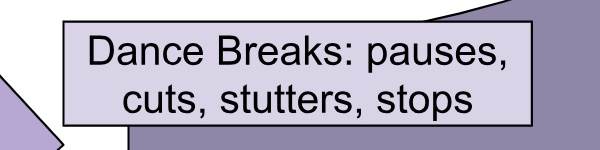
The dance break often creates the archivable outputs mentioned earlier (writings, images, recordings) but can also include ephemeral things such as live performances. What these metaphorical ‘songs’ share is a definable moment in time that either was captured or can be remembered as such. Most importantly, this moment of capture is linked to a clearly defined creative process: one or more revolutions of an annual cycle. In other words, the first dance is a full creative process, whereas the dance break is the comparatively brief moment in which the capture occurs. This can mean that, in ephemeral cases such as performances, the song (output) is simultaneously the dance break (its moment of capture). I equate this dance break with several different terms employed in the sources I reference here: distillation, pause, cut, stutter, and stop.
Walker’s Pro-Create Cycle was partly influenced by an analytical model of theatre practitioner-scholar Melissa Trimingham, which she describes as ‘a spiral which constantly returns us to our original point of entry but with renewed understanding’ (2002: 56). Reflecting on Trimingham’s description of the ‘disorderly creative process’, Walker comments on a process of ‘distillation’ that theoretical models can inform. In the specific context of discussing her own model presenting the virtuous cycle of autonomy to authority toward agency (see Fig.), Walker observes that, ‘Whilst not a definitive “answer”, [it] nevertheless … represents a substantial insight about the potential agential benefit of self-creating work’ (Walker 2015: 114).
But what happens to the first dance — the artistic/research process itself — in this moment of the dance break? Trimingham speaks of a ‘pausing’ or ‘point of exit’; she notes that ‘the research could continue indefinitely and may well be picked up again later, but for the purposes of a writing-up we “exit” the spiral temporarily’ (2002: 57). For Law and Manning, the situation is less straightforward. Inspired by David Appelbaum’s book The Stop (1995), in which comparisons are made between the rapidity of optical perception and the more deliberate touch-based perception of a visually impaired person, Law incorporates ‘the stop’ into his larger discourse on methods and reality:
The stop slows us up. It takes longer to do things. It takes longer to understand, to make sense of things. It dissolves the idea, the hope, the belief, that we can see to the horizon, that we can see long distances. It erodes the idea that by taking in the distance at a glance we can get an overview of a single reality. So the stop has its costs. (Law 2004: 10)
Law often precedes the concept of stop with that of ‘stutter’, but both point to a type of deconstruction, a dismantling of an otherwise smooth or continuous process in which ‘a break or an interruption … opens up the uncertainties of Otherness’ (2004: 163–64), a place where we can assess and reflect on the process itself while also articulating what the process produces. It is clear that such moments — the outputs or the metaphorical singing related to them — give only partial glimpses into the processes involved (discussed in more detail below). However, whether or not they are documented in writing or evolve non-verbally in the body or mind — what is called embodied or tacit cognition — these metaphorical songs are very much connected to the reflective component at the core of artistic research.
Manning aligns method beyond academic disciplines and institutions ‘to modes of existence’ (2016: 58). She explains:
For something to exist, for it to have been felt as such, there had to have been a cut, for it is the cut that brings the occasion to experience, making it known in itself… but it is a cut that remains operative, whereas method is a cut that stills. A method stops potential on its way, cutting into the process before it has a chance to fully engage with the complex relational fields the process itself calls forth. (Manning 2016: 58)
The ‘cutting’ of method that Manning refers to here is almost certainly what springs to mind as the gold standard of conventional research design — namely, an approach determined in advance and then followed — rather than the types of methods that artistic practice typically employs. For this reason, Manning prefers to replace the cutting of method with the more embodied idea of ‘appetition’. This word emphasizes ‘the way the occasion of experience itself seeks to come to fruition’ (Manning 2016: 59).
Aside from the literal connections to the fruits of my garden and the actual appetite I have cultivated as a result, concepts of fruition and appetition have rather important applications to the field of artistic research. This is particularly important to consider as many artists do this sort of research with no knowledge of the pre-existing field, its discourses, or even identifying themselves as artist-researchers. Taking myself as an example, I published my first book in 2013 partly because I felt that there was a gap in existing vocal pedagogical literature, but mostly because I had the appetite to do it. The urge was particularly strong for the final chapter involving an extensive critique on my early academic career and the perils of musical and musicological analysis. I had no inkling that the field of artistic research was beginning to flourish at the time of researching and writing that book; indeed, my inquiries with musicological academics only pointed me to a limited literature of music-related performance studies. However, the ‘pause’ I took to write this book (‘stutter’ is more appropriate considering the intermittent nature of how the project fit between my professional gigs during those years) resulted in a new methodology of performer’s analysis involving deconstructive and reconstructive components to assist performers with learning and embodying musical scores. In the reflective chapter I explained:
… consider the performer’s process when looking at just the first note of a score, for the first time, in a first attempt to produce it. The initial step is to determine what the notation says regarding a note’s pitch and duration, and determine (whether explicitly written or not), the volume, intonation, and timbre this note should/could possess in sound (deconstruction). Next, the mind must decipher the technical process by which this note may be produced, and finally the body must execute the note, which is the process I like to call ‘reconstruction’. This process can be spread out over a very long period of time in the practice room, but it can equally happen in an instant during a first reading. Indeed, for many performers, the entire deconstructive analysis can take place when first looking at a score; and if that was not remarkable enough, when a first reading coincides with a first play-through, they are able to apply a reconstructive analysis simultaneously to create music in sound. (Skelton 2013: 123)
This rich description of the method of performer’s analysis at work perhaps offers substantial new insights into the creative and artistic processes of musicians, at least from an academic’s perspective. However, from the perspective of professional musicians (who do this sort of work on a daily basis), it is nothing new. It is, in fact, totally banal. This became a major concern for me during my PhD, and also with my ongoing artistic research projects and what they will produce. Rather than what I offered in the final chapter of that book, I aspire to offer insights like Walker has offered me: insights that are of interest to both the performing artist and artist-researcher (and perhaps other academics too, but that is not the priority).
As mentioned at the beginning of this section, the first dance might include more than one revolution of a metaphorical annual cycle, which actually means it involves a perennial spiral. Although some scholarship in performance studies may attempt to look at this bigger picture, I sense that such work tends to focus on the most immediate or obvious spiral, usually the one most clearly linked with the resulting artwork. However, to meaningfully reflect on the depth and duration of one’s experience it is also necessary to consider less obvious and more enduring processes. Not only do these include the complex interactions between concentric perennial spirals themselves, but also between them and the (literal and metaphorical) ‘breathing’ of the individual and collective body.
Breathing is always of primary importance in our lives...
[next page]