Breathing is always of primary importance in our lives. We can live a week or more without food, and several days without water, but just a few minutes without oxygen and we become brain dead with the rest of our body’s functions quickly following suit. Given the profound interdependence of breathing, moving, and voicing, it is remarkable that we pay so little attention to breathing, whether literally in our daily living or metaphorically in the ongoing nourishment required in our practices.
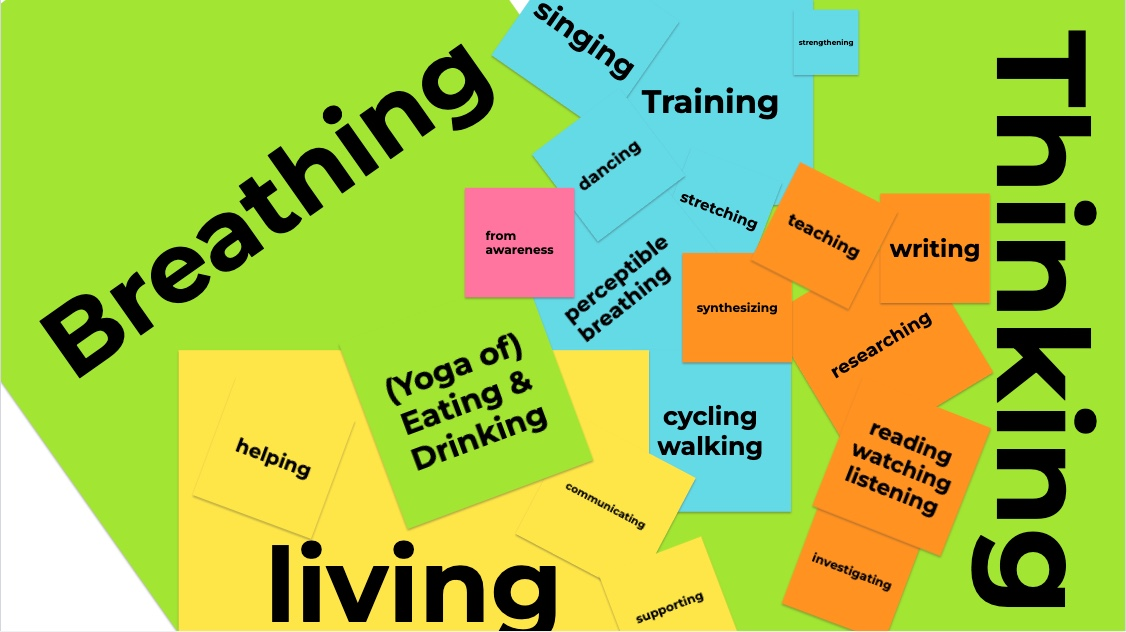
The metaphorical ‘breath’ in my artistic research practice is very personal and involves complex relationships between numerous activities occurring over many years. The Fig. below offers a collage of identifiable cycles and spirals in my life (green and yellow), artistic/physical work (blue), and research work (orange) (the pink ‘from awareness’ applies off and on to everything).
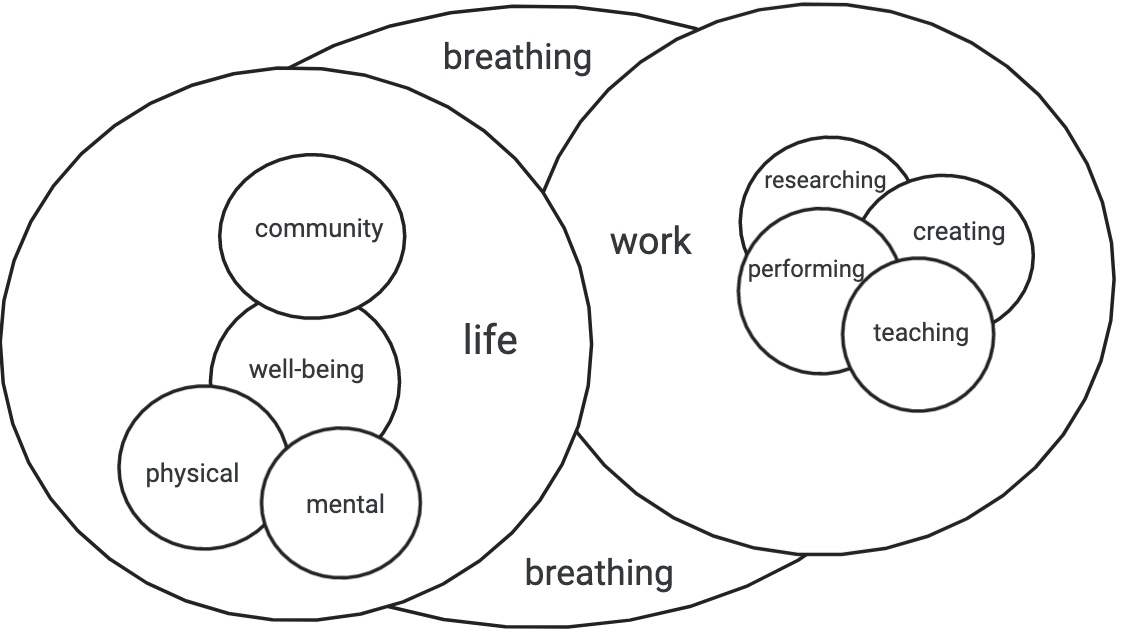
The Fig. below offers a distillation of that collage into a constellation of my praxical spheres (à la Nelson).
I do not presume that non-artist-researchers have any fewer things going on in their constellations of praxical spheres, but — if my days as a failed musicologist are any indication — they may be less explicitly interconnected than I now experience as an artist-researcher. So how might we come to understand these numerous cycles and spirals working together?
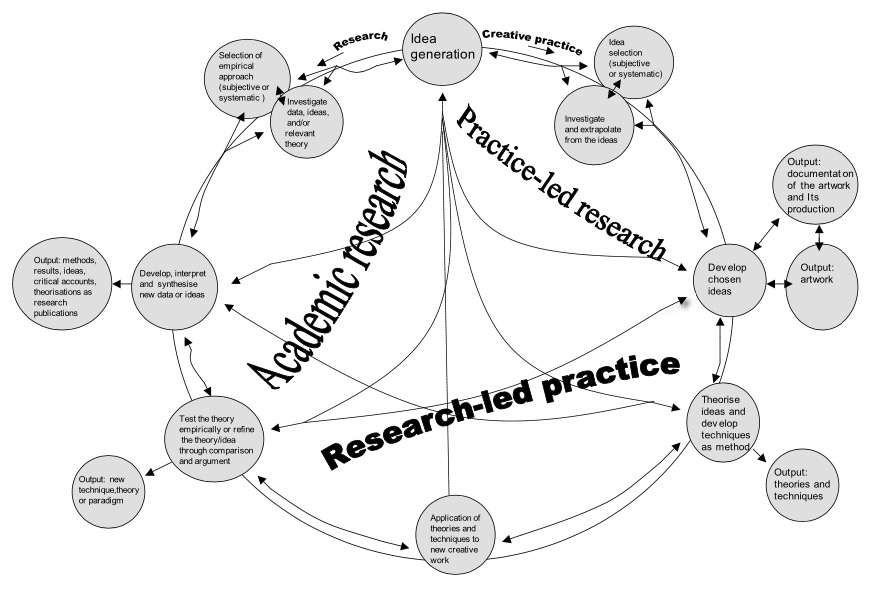
The above diagram was mentioned earlier in relation to outputs. I find the tripartite ‘web’ that Smith and Dean emphasize in the middle of their diagram interesting, even though I am somewhat sceptical — at least within the field of artistic research — of the relatively equal balance suggested in the representation between practice-led research, academic research, and research-led practice. Trimingham’s discussion of the exit point from an artistic research practice to write up was discussed already, but she also notes the point of (re‑)entry as deserving of attention, and this is helpful in understanding the concept of research-led practice. For Trimingham it is simple: ‘the question asked always determines the answer’ (2002: 57). However, a significant difference between artistic research and artistic practice can often be clarified through the nature of the question. In artistic research, so-called ‘research questions’ are frequently discussed and they tend to be explicit. Alternatively, in artistic practice the questions, impulses, and/or motivations are often tacit or embodied.
Around the internal triad of Smith and Dean’s web — like my collage above (and, I must confess, most of the diagrams in my book, mentioned earlier) — they attempt to capture the complexity of artistic research practice. However, it is gradually becoming clear to me that there are only so many double-headed arrows and boxes or circles filled with words that one can reasonably be expected to decipher (Nelson’s model is perhaps the limit). Just as my rich description of performer’s analysis is banal to the performer, I feel that Smith and Dean’s complex schema does not offer significant insights to the active artist-researcher, especially because it depicts a problematic separation between research and creative practice, at the top of the diagram. Even if the schema is remotely coherent to the non-artist-researcher (which I doubt), it is probably of little interest except in giving a false sense of assurance that research-led practice informed by academic research forms significant contributions to the field. Perhaps contexts will evolve, but I have not yet encountered any meaningful examples of research-led practice in the arts except where the research itself has emerged from artistic practice.
So how to move forward? Law offers a practical solution already alluded to in the quotation in the introduction of this exposition: ‘[I]t is about creating metaphors and images for what is impossible or barely possible, unthinkable or almost unthinkable’ (2004: 6). Thus, we do not need ever more complex diagrams and rich descriptions in writing that are simultaneously banal and incomprehensible, but rather metaphors that allow our imaginations to appreciate — in their own ways and on their own terms — the complexities of our interdependent practices and methods.
This moves this exposition’s trajectory towards rhizomes. Reflecting on their experience co-writing a book, Deleuze and Guattari begin A Thousand Plateaus with the now-famous phrase: ‘Since each of us was several, there was already quite a crowd’ (1987: 3). They describe their co-writing as an ‘assemblage’ — a dynamic and interconnected coming together of diverse elements — that challenges conventional (or convenient?) approaches to texts, how they work, and how they work with and on us. Beautiful and poetic allusions to nature in general and horticulture in particular are in abundance in Deleuze and Guattari’s writing. One of their key points is questioning tree-like concepts of thinking, reading, and writing that ‘plot a point’ or ‘fix an order’ (1987: 6) that comprise a ‘tree logic […] of tracing and reproduction’ (1987: 12). Alternatively, Deleuze and Guattari claim that a ‘rhizome as subterranean stem is absolutely different from roots and radicles’ (1987: 6) and they name several principles to ‘enumerate certain approximate characteristics of the rhizome’ (1987: 7–12).
Deleuze and Guattari note that ‘one of the most important characteristics of the rhizome is that it always has multiple entryways’ (1987: 12) and, for this reason, we could benefit from ‘mapping’ as a method for structuring our thinking, reading, and writing. But they go further in noting that mapping must also influence our ultimate means of representation.
For the past twenty years, a handful of scholars have been applying Deuleuzoguattarian rhizomatic concepts in their research methods. One of the leaders in this movement is education scholar Eileen Honan, who first used the approach in her PhD thesis, completed in 2001. Her work has subsequently been applied specifically to education policy (2004, 2015) and alternative approaches to writing a thesis (Honan 2007; Honan and Bright 2016). Within these diverse texts, the ideas of using rhizomatic principles in academic writing were most relevant to my thesis. In particular, I noticed a clear connection between what Honan calls ‘rhizo-textual analysis’ — ‘provisional linkages’ appearing while navigating ‘through and across the various discursive plateaus [and] formed by disparate flows and fragments’ (Honan 2007: 538) — and Deleuze and Guattari’s ‘multiplicities’ that include ‘lines of flight or rupture’ and ‘circles of convergence’ (1987: 22).
In a co-authored article, Honan and David Bright explain Deleuze and Guattari’s concept of ‘minor literature’, which is more concerned with its process than its product, and how such writing can ‘deterritorialize’ academic writing by questioning the presumptions inherent in its use of language (2016: 733). They propose using instead a ‘tetralinguistic’ model that embraces social theories of ‘vernacular, vehicular, referential and mythic uses of language’ (2016: 736). In direct application to re-thinking how to write a thesis, they suggest:
This moves us away from a logic of replacement (how can we replace the vehicular with the referential or mythic?) to instead trying to ‘establish a logic of the AND, overthrow ontology, do away with foundations, nullify endings and beginnings’ [(Deleuze and Guattari 1987: 25)]. This might result in a thesis text that acknowledges the limitations of representation, that is neither vehicular nor non-vehicular, but is always already vehicular and … and … and … (Honan and Bright 2016: 737)
Notwithstanding that Deleuze and Guattari explicitly did not consider rhizomatic thinking as metaphor (Honeychurch 2016) — the presence of actual rhizomes in our garden warrants at least some digression. For example, quoting myself (as I did earlier in reference to my book on performer’s analysis) could reveal itself as an important ‘line of flight’ (Deleuze and Guattari 1987) rather than self-indulgence or narcissism. The rich description in that quotation was far removed from the goals of my doctoral research, and yet, the idea to include it came from my interaction with Smith and Dean’s diagram. This particular process gave me pause to reassess the value of my ‘Collage of cycles and spirals’ and an attempt (via an online 3D drawing software) to schematically depict my metaphorical methodology (a task I subsequently decided to abandon in favour of the simpler distillation of my ‘Constellation of interconnected praxical spheres’ above). This rhizomatic ‘line of flight’ has ultimately led me to accept and avoid banal rich description and the incomprehensibility of overly complex diagrams in my academic work. Perhaps a future line of flight will reveal a way of assuring my readers that my use of non-vehicular language is not just meandering prose.
In looking at a survey of scientific literature on these ‘fungal-root’ systems…
[next page]