Openings
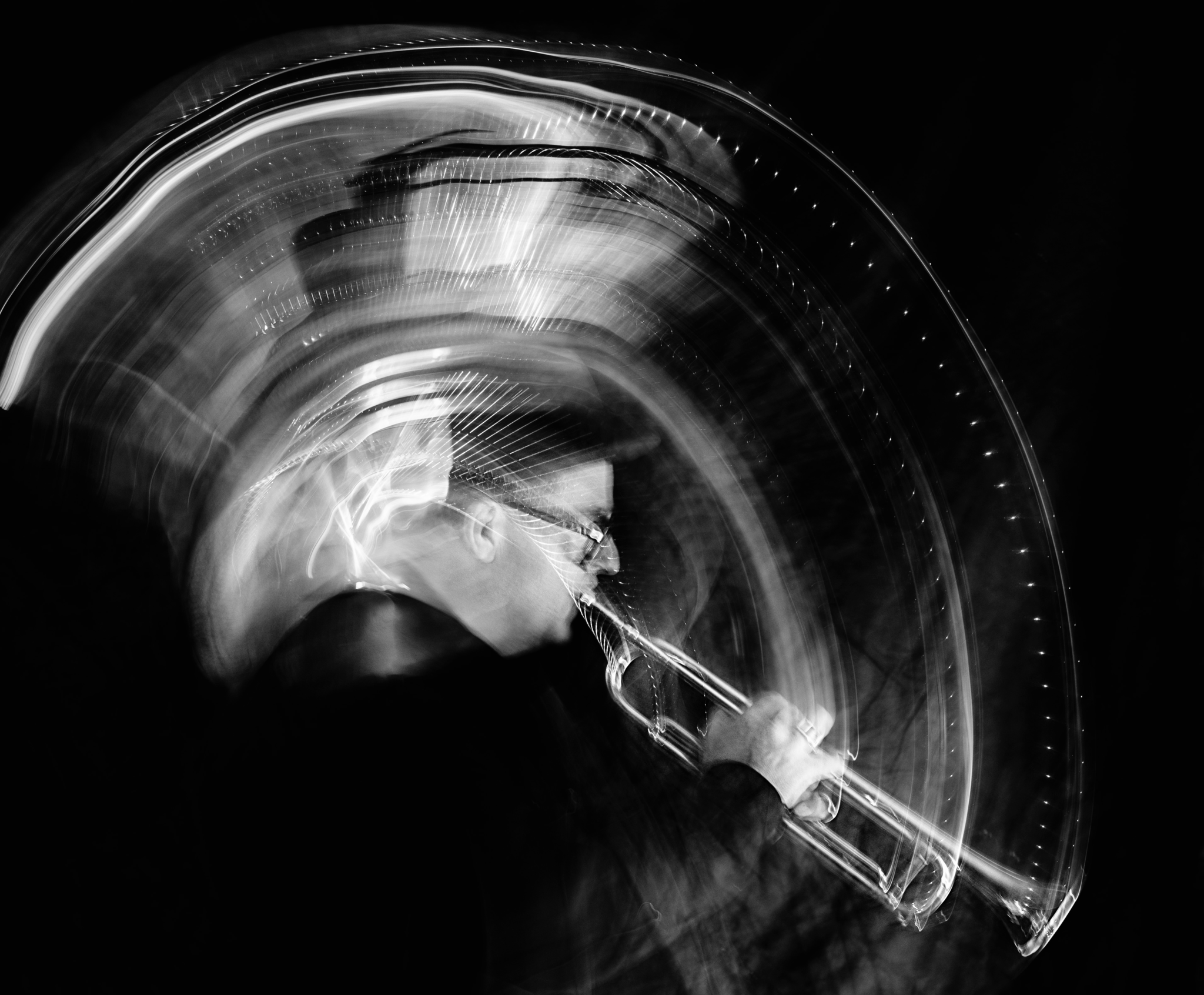
Through 30 years as an improvising trumpet player and melodist, I have come to understand melody not as a linear movement from A to B, but as a complex, multidimensional phenomenon. This artistic research project investigates new ways of conceiving, performing, and teaching melody in contemporary jazz improvisation by developing conceptual frameworks and practical methods rooted in four strands, Figurative / Directional / Temporal / Spatial that function as lenses for rethinking melodic orientation.
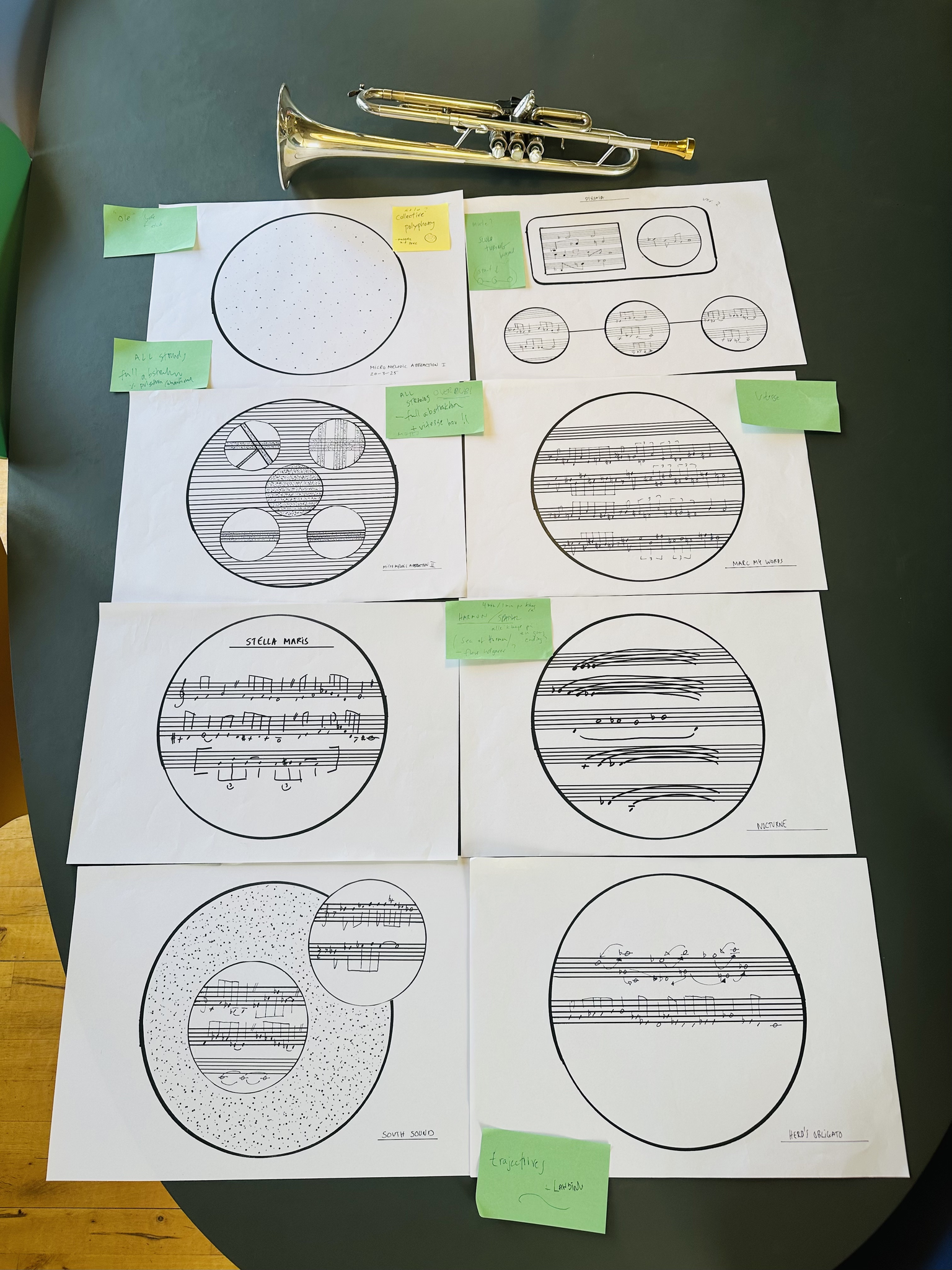
These strands inform the creation of hybrid scores, improvisational strategies, and ensemble practices. Grounded in performative experimentation, iterative workshops, reflective listening, and documentation, the project aims to provide improvisers and educators with new artistic resources for navigating melody as a multidimensional field.
Background
I learned early that music reading follows a left-to-right logic, implicitly reinforcing a linear understanding of melody. Yet as a teenager I sensed that music extended far beyond notation, whether in improvisation, brass band music, or the marches I played in youth orchestras. I also discovered that melodic expression seemed to speak directly to listeners; the sound within the melody could move people.
This insight has shaped my professional career across contexts: bebop groups, big bands, theatre productions, folklore traditions, free jazz, and a wide range of popular music. It became natural to explore how improvisers might cultivate new perspectives on melodic orientation within jazz-rooted improvisation.
Traditionally, melody in jazz is treated as a theme or as motivic elaboration within harmonic structures. Figures like Ornette Coleman reconfigured this, proposing harmolodics, an egalitarian field where melody, harmony, time, and phrase operate with equal weight. Later improvisers including Ingrid Laubrock, Anthony Braxton, Tyshawn Sorey, and Wadada Leo Smith expanded this through graphic and conceptual scoring, timbral exploration, and ecological interaction.
Parallel developments in experimental composition by e.g. Kaija Saariaho, Morton Feldman, and Cornelius Cardew, treated melody as spatial or spectral form rather than linear unfolding. Artists like Brian Eno, John Zorn, Barry Guy, Adam Rudolph, and Miya Masaoka have used graphic systems and game-logic to shift melodic roles, dissolve hierarchies, and foreground process.
Research Questions
The project investigates how improvisers can expand their understanding of melody beyond traditional linear and tonal frameworks:
- How can melodic orientation be re-conceptualized to include multidirectional, spatial, temporal, and illusory dimensions?
- What compositional and improvisational methods support such approaches in individual and collective contexts?
- How might these methods reshape ensemble roles and jazz pedagogy?
The aim was to open multidirectional connections in improvisers’ melodic perception and disrupt habitual ensemble structures. Two ensembles were central: one of professionals, one of RMC students. Both worked exclusively with improvisational strategies and hybrid scores developed for this project. Solo exploration ran alongside and proved crucial to the process.
The method alternated between individual mapping phases, where concepts and strategies were designed, and collective ensemble phases of collaboration, exploration, and reflection. All sessions were documented for further development.
Key Concepts
Melodology: The theoretical and philosophical study of melody as a multidimensional and dynamic phenomenon, emphasizing its structural, temporal, spatial, and expressive qualities in improvisation.
Melodography: A method of mapping and representing melodic ideas and trajectories, akin to a “cartography” of melody for improvisers, enabling new ways to visualize and engage with melodic flow.
Melodological Society: A collective forum for discussion and development of melodic theory and practice within improvisational communities.
Phenomelodology: An approach to melodic abstraction focusing on phenomenological experience, emphasizing perception, illusion, and the subjective dimensions of melodic sound.
Strands: Four conceptual fields guiding the research and practice. Each strand represents a dimension of melodic orientation and improvisational strategy explored through scores, improvisation, and reflection.
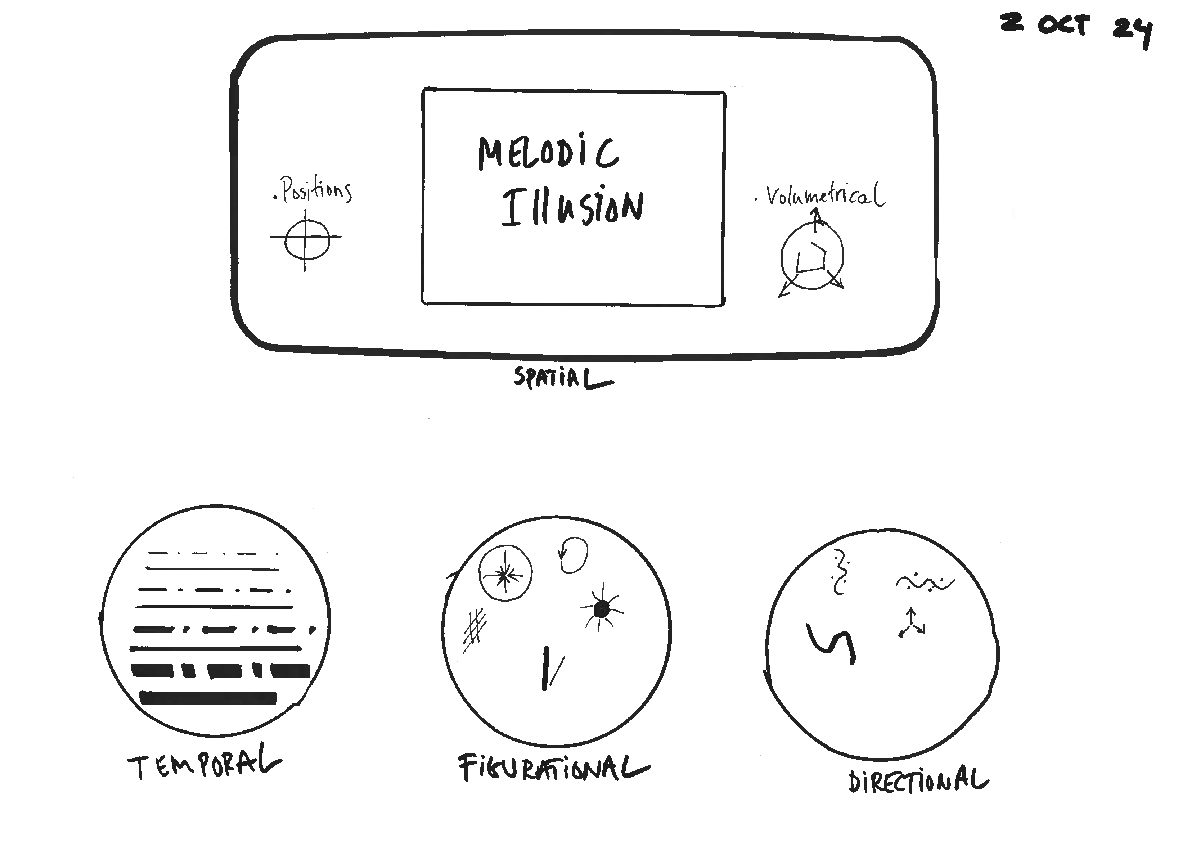
Melodic Illusions draws on these trajectories to propose melodology and melodography: frameworks that position melody as a multidimensional, ecological, and often illusory field. Through the four strands, the project offers concrete tools for navigating melody not as trajectory but as spatial, temporal, figurative, and directional environment.
The work moves beyond harmolodic equality, graphic openness, and ecological emergence by training performers to inhabit melodic space, engaging sculptural, fluid, elastic, and spatial dimensions. It contributes to practice-based artistic research in jazz by extending dialogues on non-linear form, spatial listening, and embodied improvisational interaction.
Conducted at the Rhythmic Music Conservatory (RMC) in Copenhagen, the project became equally pedagogical. Students actively engaged with concepts, hybrid scores, and improvisational strategies; their participation shaped the research and anchored it in shared practice.
This revealed an inherent tension: many of the project’s ideas, directional ambiguity, spatial phrasing, temporal elasticity, are intrinsically experiential and resist full translation into language or notation. They live in sound, gesture, relation, and time. Documentation can point toward these experiences, but cannot fully contain them.
Thus, Melodic Illusions is as much an invitation as a documentation, an encouragement to engage, experiment, and respond in sound. Knowledge in improvisational music is somatic, intuitive, and collective; it must be practiced and co-created.
The project deliberately sets aside traditional composition, extended techniques, electroacoustic innovation, and groove-based frameworks to focus on fluid temporality and melodic flow. While engaging spatiality internally, it does not explore architectural acoustics, suggesting possible future research directions.
Contextual influences are woven referentially rather than comparatively, situating the work in broader dialogues without fixing it to a single lineage.
The aesthetic of this exposition is intentionally archival recalling my time spent at the Hogan Jazz Archive in New Orleans. The tactile dimension is essential: I work with my hands, in a workshop, and the process unfolds physically as much as intellectually.
KT, August 2025