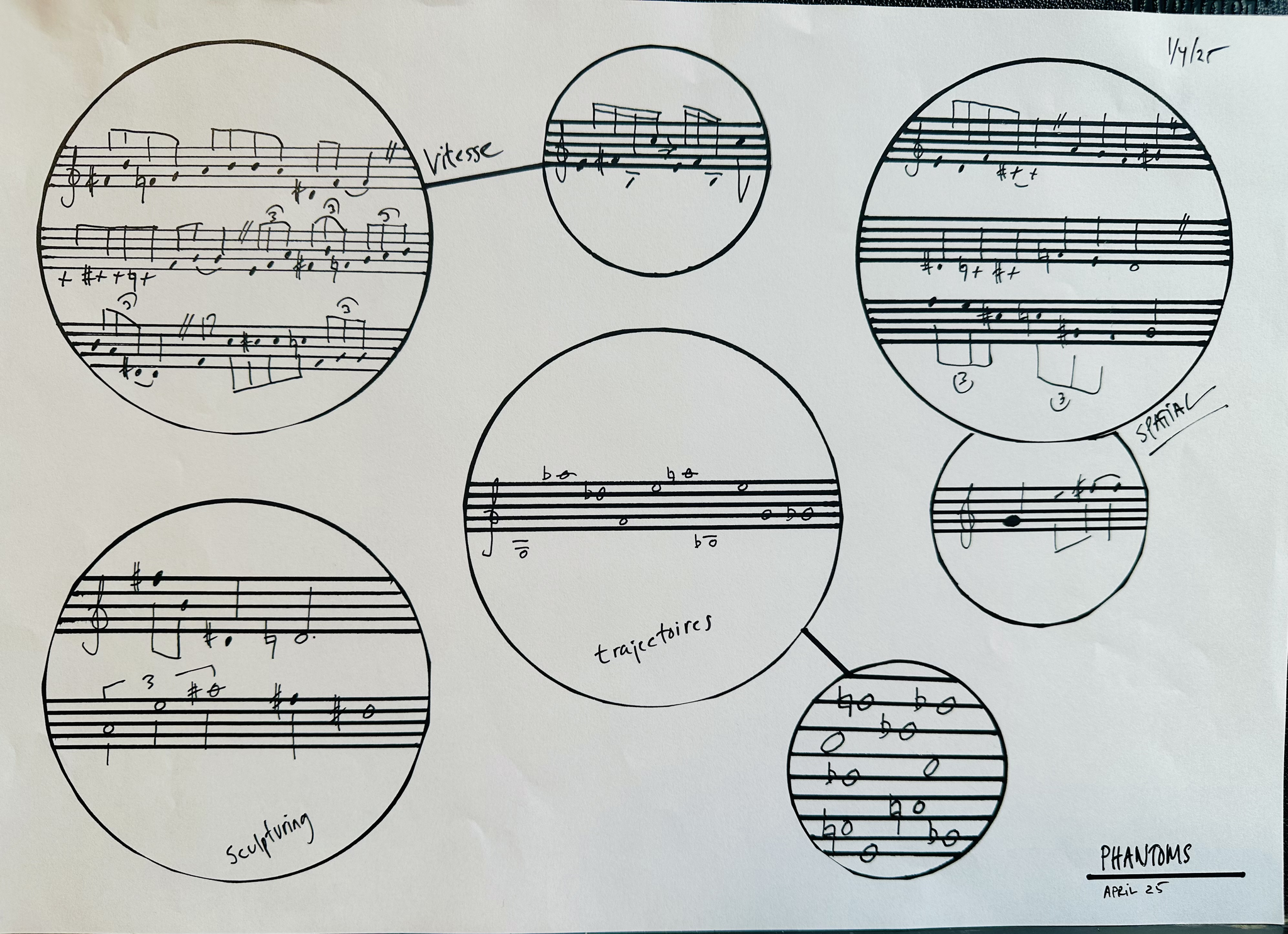
Conceptual Tension Fields for Melodic Improvisation
The four conceptual strands form the methodological core of the project. Each reflects opposing or complementary forces within melodic improvisation, offering multidirectional entry points for individual and collective exploration. Together, they support improvisational strategies that challenge linear, conventional roles of melody in jazz-based ensemble practice.
Early in the process, I set out to unfold these strands, which became the conceptual backbone of my work. A pivotal moment came in a conversation with a collegue, who suggested approaching melody not as a fixed object but as an environment. This opened new associations and led me to think of melody as environments or ecologies—spheres, enclosures, and dynamic systems.
This shift allowed me to develop a range of melodologies: flexible ways of thinking, sensing, and organizing melody in improvisation. Instead of defining melody, I focused on navigating melodic terrain through metaphor, abstraction, and spatial awareness. This also led to a melodography, a cartographic approach to mapping melodic ideas and trajectories.
I soon realized that my contribution would remain grounded in the metaphorical, symbolic, and illusory—qualities necessary to expand what melodicity can mean in improvisation.
To support this, I developed a note-taking system using horizontal A3 paper and circular templates based on CDs and LPs. Working with pens of varying weights, I drew and wrote my way into the material, often alongside trumpet explorations or ensemble work. This became the process notes apparatus, a visual workstation mapping weekly developments, detours, and resonances.
Through this mapping, the four strands emerged as shifting zones rather than fixed categories. They interact fluidly and can be activated individually or collectively, each articulating a distinct energetic force within melodic improvisation.
1. Figurative / Sculpturing
By mapping a range of melodic functions to physical or sculptural metaphors, this strand investigates melody as expressive form – how phrases, motifs, gestures, and patterns operate as sculptural, symbolic, or communicative elements in improvisation. Melody is approached not as a line but as a form in motion, something shaped and shaping expressive intent, working with gestures such as strokes, bursts, and strikes to explore how melodic fragments behave, disrupt, or interact within a phrase or ensemble texture.
Key melodic approaches developed:
• IDP (Internal Dialogue Phrasing)
• Micro Melodic
• Shadowing
• Contouring
• Splash melodic
2. Directional / Trajectoring
This strand explores melodic directionality as a dynamic force, not limited to linear (horizontal) or vertical (pitch-based) motion, but extending into lateral and multidimensional trajectories. It asks: How do melodies move, shift, bend, or warp within an improvised landscape?
By exploring how improvisers can play toward, away from, or around different focal points in real time, this strand works with notions such as arrows, signals, peripherals, and deviations, emphasizing navigation, orientation, and relational motion rather than destination.
Key melodic approaches developed:
• Signals
• Peripheral
• Melodronic
• Arrows
3. Temporal / Pulsating
This strand investigates how melody interacts with and unfolds through time, pulse, pacing, velocity, and elasticity. It approaches rhythm as a flexible and elastic field, working with shifting cadences, layered tempos, and pulse deconstruction as a liberating force, contrasting speed with stasis, action with pause, and continuity with rupture.
Key melodic approaches developed:
• Cyklus
• Abstract Syncopation
• Arrows
• IDP
• Signals
4. Spatial / Illusional
This strand approaches melody as a spatial and perceptual phenomenon that unfolds between improvisers and the sounding environment. It investigates how melodic material generates sensations of dimension, depth, proportion, distance, and placement, while engaging perceptual aspects of illusion, tension, and ambiguity.
Working with oral instructions, spatial metaphors, and perceptual cues, the strand guides performers’ sense of proximity, allowing melody to suggest shifting perspectives and positions.
Key melodic approaches developed:
• Peripheral
• Dream Melodies
• Illusions
The outcome of these parallel explorations was a set of hybrid scores, built directly from the four strands and their conceptual undercurrents. These scores function as open systems—designed not to standardize melodic roles, but to allow for new orientations, new positions of listening, and new paths for collective improvisation.