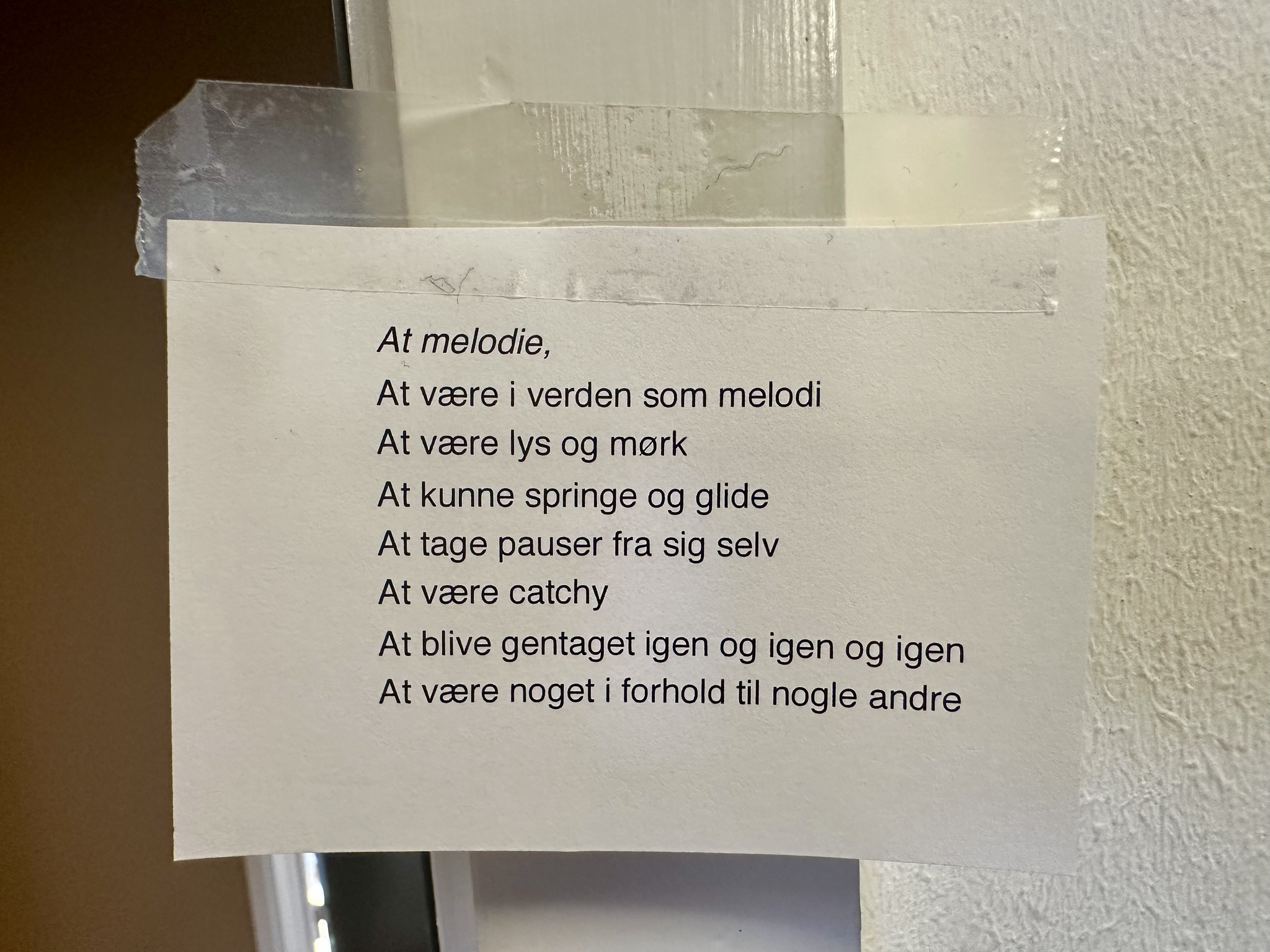
My Positioning in a Contextual Landscape
Ever since I was a teenager, I’ve used the walls of my room to build a kind of landscape around myself pinning up notes, ideas, photographs, clippings, reviews, historical artefacts, instruments, posters from travels, tours and concerts, reminders, and much more. It became a way of embedding myself in a world of references, fragments of meaning that shaped how I played, how I listened, how I worked. This environment became my context, a driving force behind my connection to the trumpet, to music, to my ideas.
It was also a way of dreaming. I’d imagine myself in New York in 1949, Berlin in 1974, or Chicago in 1969. And when I later visited Louis Armstrong’s house in Queens, I realized he had done exactly the same thing. My father, a painter, had done the same. Many artists do.
You can’t escape context, you’re immersed in it. Surrounded by it. That’s where curiosity becomes a propulsion. You can step outside of it, look at it, look at yourself from the outside. You start to trace connections, to find pathways that set fire your thoughts and ambitions.
It began with a deep curiosity about the trumpet, but also about the people and environments that moved me through their music and their ways of being in the world.
When I think about context in relation to solo trumpet playing, there are a few names that have formed my foundations: Tomasz Stańko’s Music from Taj Mahal and Kala Caves. Don Cherry, from the late 1960s and onward. The work of Wadada Leo Smith, spanning over 60 years. Baikida Carroll’s Shadow of Reflections (Solo).
Bill Dixon’s massive work, Odyssey as well as Paul Smoker. Also Greg Kelley; a powerful, contemporary solo improviser whose work I find very inspirational and meaningful.
The trumpet is a “singing” instrument, and that connection between melody and song is vital to me. I was always drawn to trumpeters who could sing through their horn, Miles Davis, of course, but also Timofei Dokschitzer, singing everything out. Also very much Lester Bowie and Kenny Wheeler. And of course, the amazing Herb Robertson and Per Jørgensen, who both became my mentors, bandmates and friends. These musicians and improvisers shaped me.
I also want to mention Axel Dörner, whom I play with in the Globe Unity Orchestra led by Alexander von Schlippenbach. His approaches are very different from mine, but deeply inspiring. Likewise, Forbes Graham whom I played with in Boston, his way of bending and unfolding melodic material in highly personal ways. And the incredible trumpeter and thinker Karl Husum here in Denmark, a long-time collaborator and conversational partner when it comes to trumpet and improvisation.
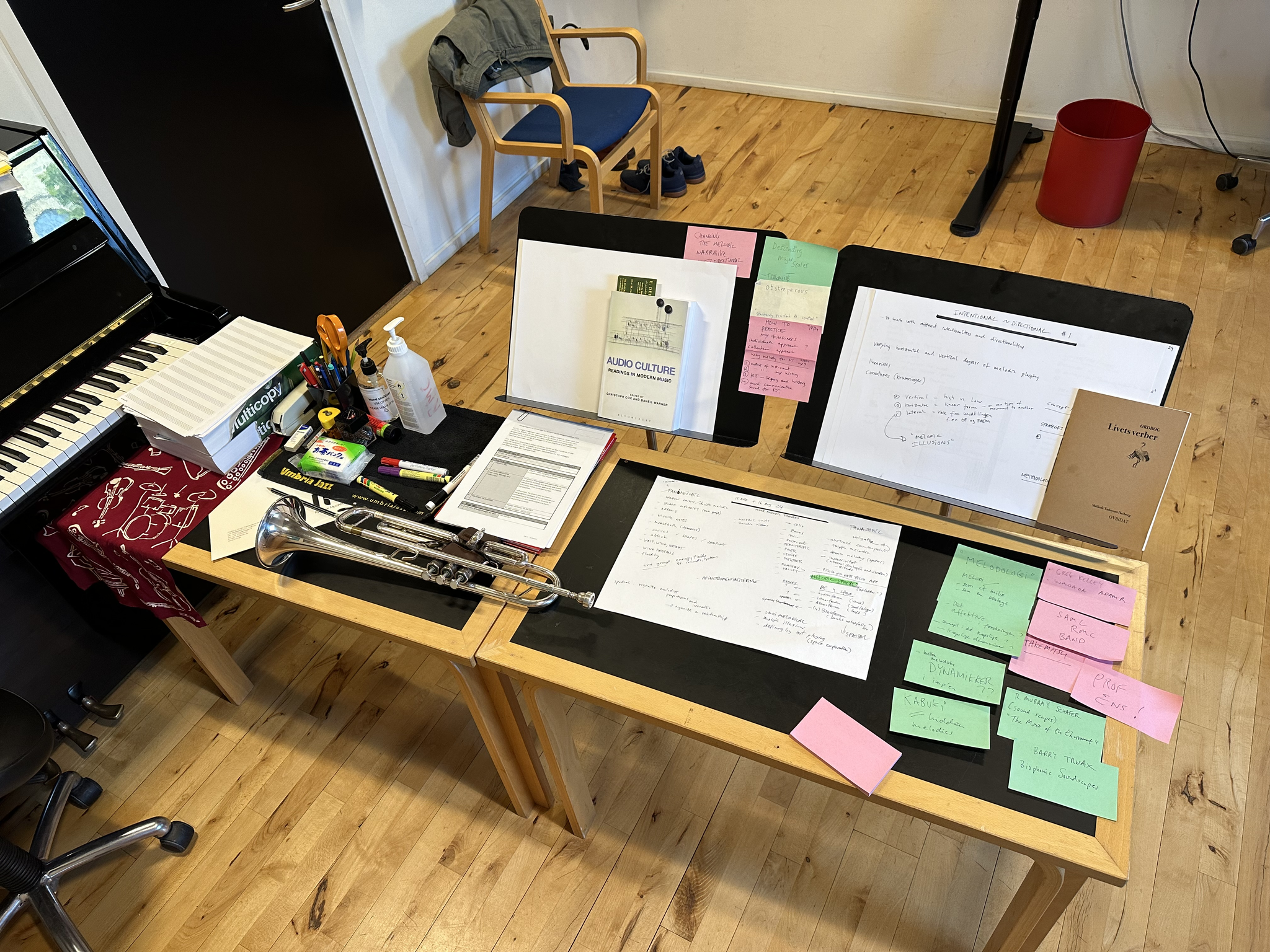
As I continue to explore the solo trumpet field, many other names come to mind: Susana Santos Silva, Taylor Ho Bynum, Jaimie Branch, Rob Mazurek, Arve Henriksen, Peter Evans, Nate Wooley, Dave Ballou. Several of them studied with trumpeter and legendary teacher Laurie Frink in New York, as I did, so there’s an invisible thread connecting some of us through that shared lineage.
What perhaps sets me apart from many of these contemporaries is that my work doesn’t start from a sonic investigation. It begins in melodic exploration. From within that space, sonic qualities emerge, but the phrasing has a function and an intention. Many of my peers begin at the sonic level. That approach can be incredibly inspiring, but I trust the sequence I’ve always followed: melody first.
That makes sense to me because my path into jazz and improvisation came from a deep fascination with the phrasing of the masters that came before me, both pre-bebop and post-bop phrasing. Still, I’ve listened broadly to trumpet sounds, techniques, and ideologies. Most important for me in this work, I could list:
Lee Morgan, Thad Jones, Cootie Williams, Clark Terry, Kenny Dorham, Dizzy Gillespie,
Ted Daniel, Raphe Malik, Mongezi Feza, Idrees Sulieman, Dizzy Reece, Stephen Haynes, Itaru Oki, Kondo Toshinori, Jens Winther, Alfredo “Chocolate” Armenteros and Félix Chappottín.
Many of these singularities didn’t always have trumpet-solo practices, but they had powerful identities within the collectives of bands that left a mark on me.
In that way I don’t build from any single lineage, my orientation is broader. I position myself across the landscape of trumpet improvisation. Maybe my contribution becomes a kind of synthesis, an ecology of directions. That’s part of what also motivated me to initiate The Melodological Society: a space to share thoughts, impulses, and possibilities around melody, its textures, forces, and ways of being melodic. Both in improvisation and as a melodic attitude toward expression.
When I reflect on my position in jazz and improvisation more generally, I see the same image. My practice spans from completely free playing to structured improvisation over pre-set chord changes. My aim is to have something meaningful to say in all of these constellations and directions I take part in.
Over the years, I’ve worked mostly in Denmark, France, Germany, and Japan, countries where I’ve established long-term collaborations and have become part of artistic communities. I deliberately seek out possibilities that bring together musicians in their 80s and those just starting out. There’s something vital in that intergenerational exchange, something ecological.
Across my own recordings (solo to large ensemble), there’s been a continual movement between more traditional, jazz-oriented formats and freer forms and compositions that unfold as zones, as sketches, as flexible structures. I place myself within a European tradition and context, but with deep listening and connection to the American contemporary jazz and improvisation scene and the history of the trumpet in any setting.
Research and Knowledge Context
My encounter with Yusef Lateef, and my later studies and collaborations with him, should also be mentioned in this context. His Repository of Scales and Melodic Patterns has had an immense impact on me, as it has on many other improvisers. The works we created together and the collaborations we shared brought deep knowledge, inspiration, and momentum into my own artistic practice. Over quite a few years, I have been processing, reshaping, and activating the input I received during my time around Brother Yusef, also in this work, sometimes taking a starting point in material presented by Brother Yusef. That period has given me both strength and drive to contribute something of my own. It has also given me the courage to continue following my own path , as a great teacher, he pointed to finding our own way, in both artistic creation and in the generation of knowledge and method.
During this project, I have recently discussed my Melodic Illusions work with percussionist, composer, and bandleader extraordinaire Adam Rudolph, whose music and ideas contains has been a deep inspiration for years.
In my earlier research project Suite Dilation: Melodic Language for Improviser, I explored melodic language and resonance in improvisation. This work aimed to unify the fundamental musical components of harmony, melody, rhythm, timbre, and form, thus creating a foundation for the current work at hand.
In this current project, a number of artists and researchers have significantly shaped my thinking.
I feel a strong connection to Ivar Grydeland’s project Ensemble & Ensemble of Me, which explores the relationship between solo and collective improvisation. The project also includes the development of a personal encyclopedia featuring audio and visual examples from both the creative process and the final performances.
Ingrid Laubrock’s work with large ensembles has also been especially meaningful, particularly her navigation of hybrid scores and open forms in projects such as Dreamt Twice, Twice Dreamt (2020) and Purposing The Air (2025).
Similarly, Lotte Anker’s research and compositional strategies for both small and large ensembles continue to inspire me. Her project Sculpting Air in The Sub Habitat (2023) (RC Link) explores new approaches to composition for larger ensembles of improvisers. Anker delves into how to balance predetermined structures with open improvisation, aiming to refine and challenge her own aesthetic and compositional practices. The work seeks to sculpt sound through form, interaction, and deep listening, fostering a compositional environment where individual expression, ensemble identity, and artistic intention intersect dynamically.
I also benefit greatly from ongoing dialogue with colleagues at RMC. I want to mention Jacob Anderskov and Niels Lyhne Løkkegaard, both of whom have been important in conversations around improvisation, composition, and research.
Løkkegaard’s Multiplayer – Softenings and Inquiries into Matters of Toxoplasmatic Ectoplasm (2024) has opened my eyes to new perspectives within artistic research. The project critically examines Western musical instruments as haunted, contaminated, and dangerous entities, liminal interfaces between life and death, past and present. Blending poetic speculation, critical theory, and performative inquiry, the work radically rethinks what musical instruments are and what they do.
Jacob Anderskov’s Sonic Complexion (2022) investigated the musical dimensions of texture and harmony, with the aim of creating both new music and new methods and possibilities working with these in composition and performance.
Also Anderskov's, Echoes From The Torn Down Fourth Wall (2024) in which I participated myself seeks to build bridges between contemporary music as an art form and community singing, using melodies from the Danish songbook Højskolesangbogen. In a hybrid concert format created specifically for this project, abstract, intensely improvised concert music is interwoven with passages of community singing where the audience sings along with well-known songs. This creates a new ecology of performance, where community and artistic meaning intersect in new ways. Resonating very much with this project work.