Temporal - Pulsating
This strand investigates how melody interacts through pulse and elasticity.
Rather than working with fixed rhythmic structures, I became interested in pulsation as a pliable medium: something that stretches, compresses, breathes. This exploration focused on the tension between speed and slowness, motion and stillness, action and rest. Of all the strands, this was the one that gave me the biggest challenge. Advanced rhythmic theory and metric complexity never had my deep interest and competances, nor did I feel the need to engage deeply with that tradition. I knew this was not a field where I could (or should) contribute.
Instead, I focused on framing temporal abstraction as a liberating force. That meant finding strategies that allowed both freedom and precision to coexist, often by considering the nature of pulse itself.
In my ensembles I worked with shifting cadences and layered pulses. One simple method was to take a melodic figure or phrase and approach it in multiple pulses. This revealed each musician’s individual temporal phrasing, how they shaped motion, pacing, timing and how different pulsations could co-exist and interact within a group.
This strand became less about rhythm in the traditional sense, and more about how temporal experience could be articulated melodically. Pulse, in this sense, was not necessarily beat-based, it became a property of phrasing, relations, and attention.
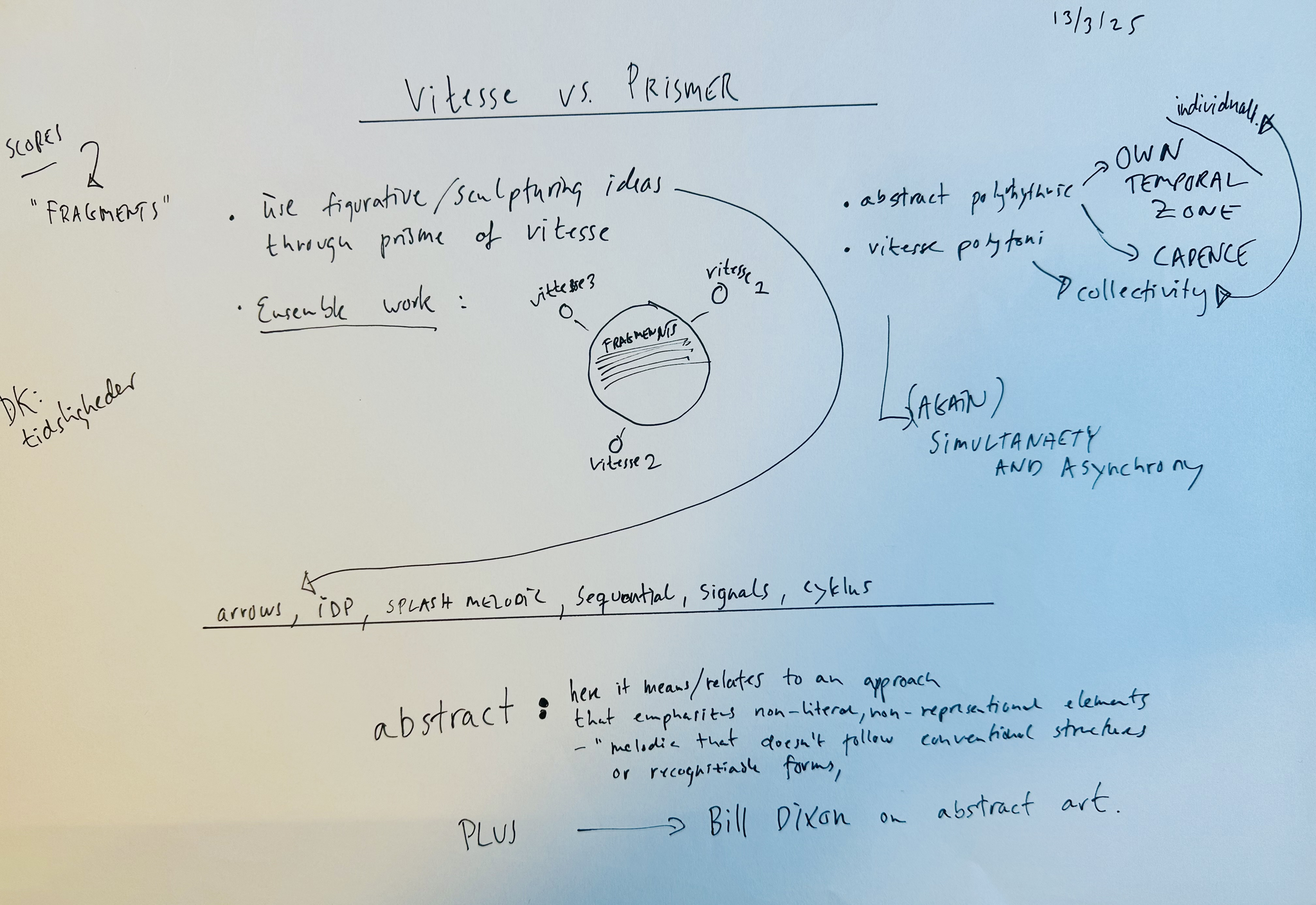
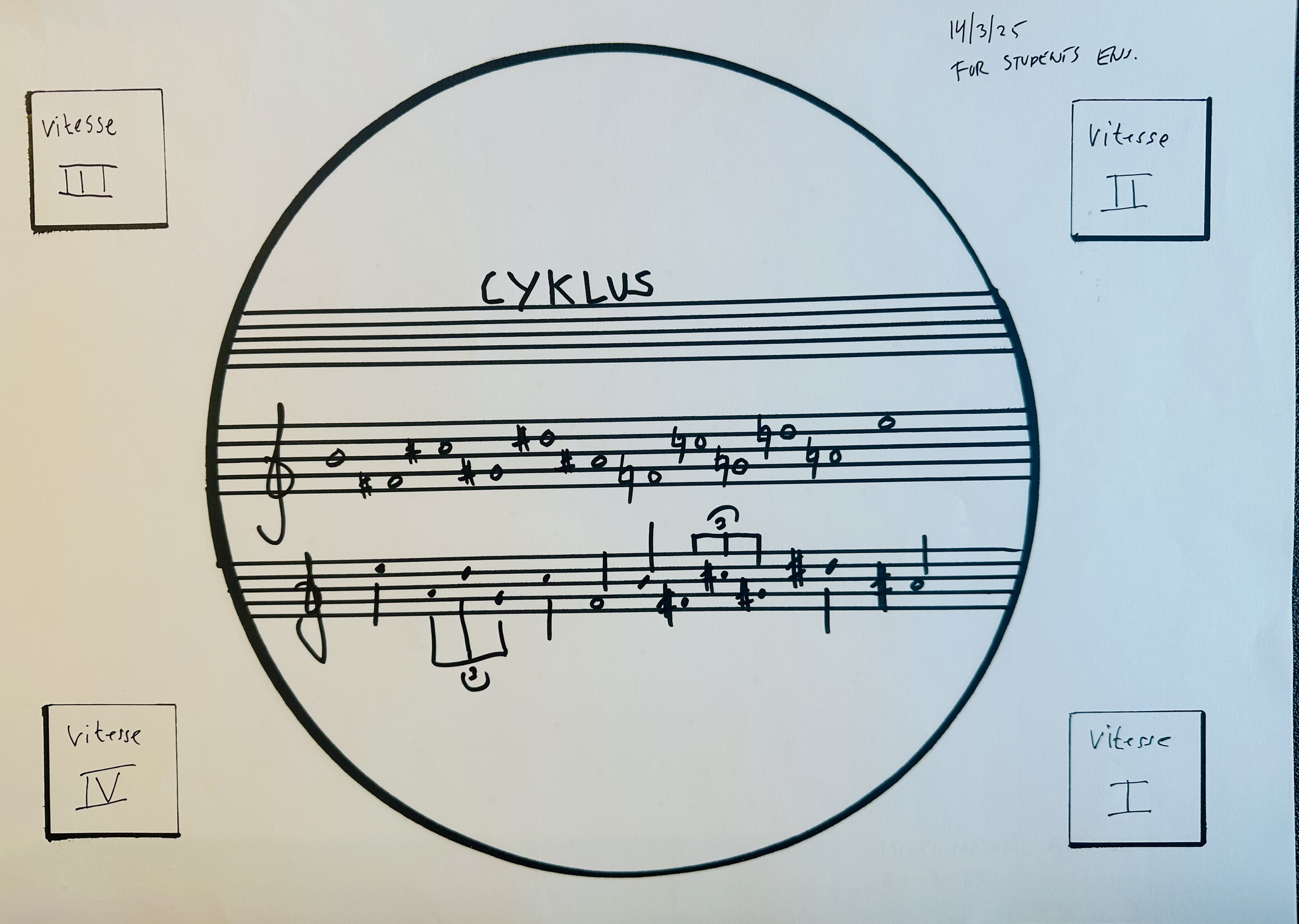
Refers to a recurring, but non-identical return, a spiral, rather than a loop. The idea draws from cyclical motion, but allows for variation, drift and interruption. A melodic fragment might return again and again, each time slightly altered, stretched, displaced, slowed down, inverted.
This creates a sensation of temporal layering. Something returns, but not in the same form. Cyklus also opens up for transformation and pacing for the improviser. For me it becomes a way of working with pulsation that is breath-based, and loosely patterned. A certain recurrence without strict regularity.
In this approach, the ambition was for both the composed melodies and the improvisational unfoldings to carry a cyclical character. This creates coherence. It forms a small atmosphere or substance of melodic material.
The cyclical nature of the material allows phrases, intervals, or sections to be rediscovered and re-entered. This gave rise to a sense of melodic matter that could reappear with new energy or resonance. It has a centering quality that I’ve been consistently drawn to.
I worked with this through short melodic fragments and statements embedded in my hybrid scores. These were then picked up and reinterpreted by the improvisers, who often found fruitful and generative ways of working with them. The cyclical nature didn’t limit the music, it gave it depth, direction, and return.
A good example is the longer piano intro section in the sextet piece "Assemblages" which evolves around this concept.
This concept began as a contradiction. Syncopation usually means displacing a regular pulse, but what happens when the pulse is already unstable or undefined?
Abstract Syncopation uses phrasing within fluid or solid pulsations, creating tension and elasticity without a fixed metric grid.
In ensemble improvisation, this led to layered pulsations: each player moving with a personal cadence while staying aware of shared space. Grooves became stretched, suspended, or elastic without anchors. The second section of Assemblages (sextet) shows this clearly in my drum section.
Drawing on classic jazz syncopation, Abstract Syncopation becomes more fragmented, unpredictable, and untethered from meter. It isn’t about complexity or polyrhythm. It’s about fire and the raw force that propels a phrase into tension, resistance, and eruption.
Since I first heard music, since I first played trumpet, syncopation has moved me. It wasn’t just rhythmic; it was physical, eruptions, small volcanic bursts. That sensation stayed with me. I am a good dancer too.
Here, syncopation becomes less a groove and more a rupture: starting softly and suddenly bursting, or arriving with force and vanishing. It isn’t bound to meter but still carries the essentials of the jazz syncopations I fell in love with decades ago, an inner drive.
Connected to the Arrows approach, Abstract Syncopation shares directional, forceful phrasing, but adds resistance, the fracture within movement.
I think of the bebop trumpeters, their fire inherited from Roy Eldridge and early jazz giants. Those burning phrases across jazz history aren’t about complexity or perfect meter; they’re about energy and intention.
That’s what interests me. Not metric perfection but the pulse that erupts unexpectedly, the tension that makes you listen harder and grabs body and soul. That’s Abstract Syncopation.
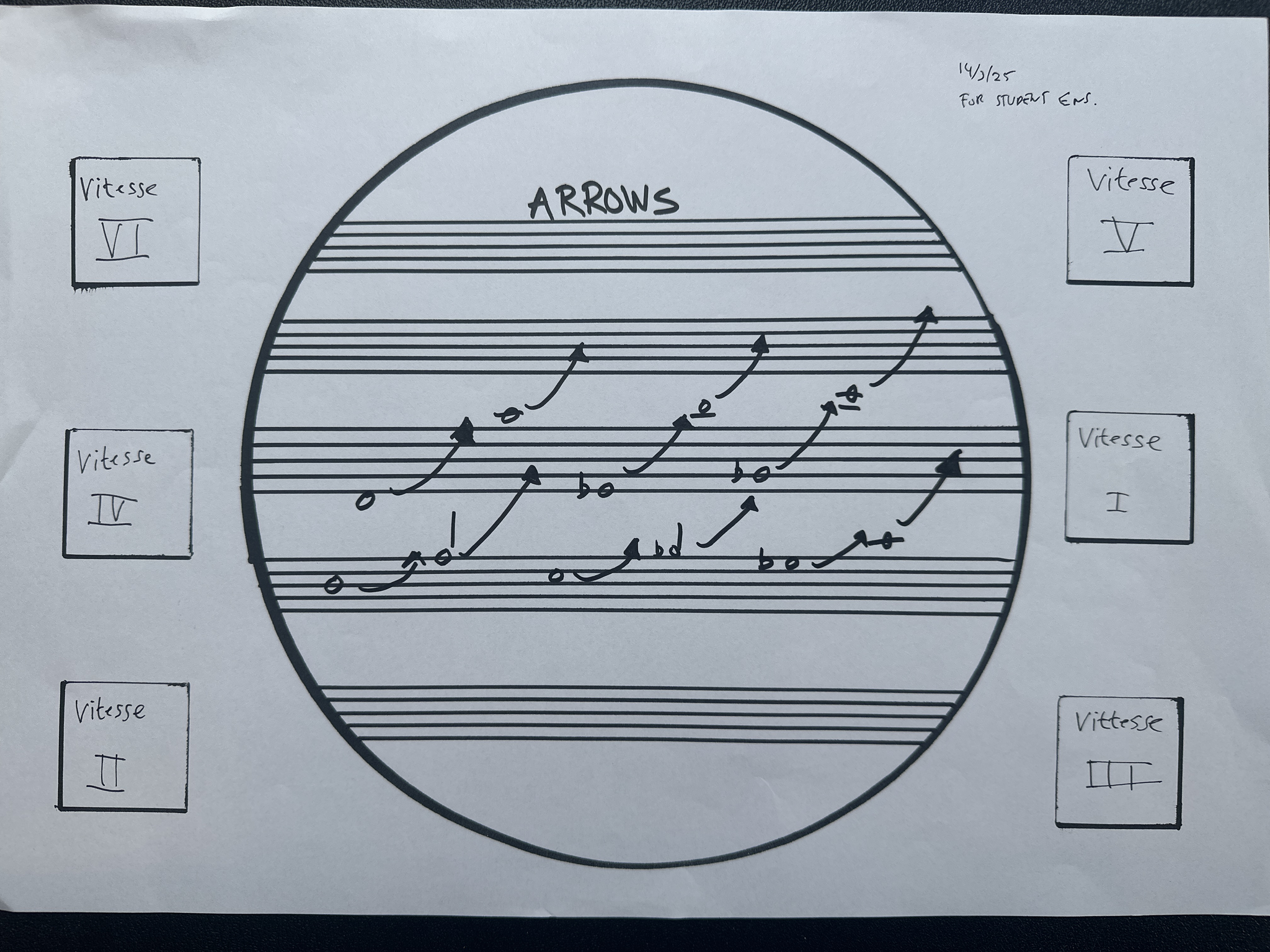
Originally explored as directional lines, Arrows gained new relevance in this strand. Here, they became vectors of momentum, melodic bursts that cut across slower pulses.
Arrows shapes temporal contours by establishing motion or drive.
In this strand, Arrows often emerged as a type of phrasing I would instinctively return to in my own playing. They seemed to appear naturally, as a rhythmic act that helped push the music forward, especially in situations where the pulse was undefined or fluid. They often worked hand in hand with Abstract Syncopation, strengthening the directional force within a loose pulsation.
Together, these two approaches contributed to a forward-driving rhythmic orientation that wasn’t based on metrical precision, but on a kind of internal propulsion. Arrows carries a clarity of direction, even when the pulse is blurred.
Arrows, as I have described earlier under the Directional Trajectory strand carry a forward-driving quality, within the Temporal / Pulsating strand, what matters is that these arrows carry suggestions and hints that orbit around groove and pulsations. They create a tension specific to this temporal and pulsating dimension. Arrows work especially well for me in ensemble contexts, where their energy can interact dynamically with others.
A typical melodic improvisation phrase might lean into various bends, subtle twists and displacements of the pulse. Arrows, in contrast, can cut through like a blade through fabric, opening a new world behind the curtain. This is not about introducing a “new rhythm” in the conventional sense, but about offering a new pulse, something fellow improvisers can respond to or leap onto. It is an abstraction that does not operate in the binary of “now we play half-time” or “now we go double-time” or “now I hint at Tempo Two.” Instead, it is a more fluid, suggestive intervention.
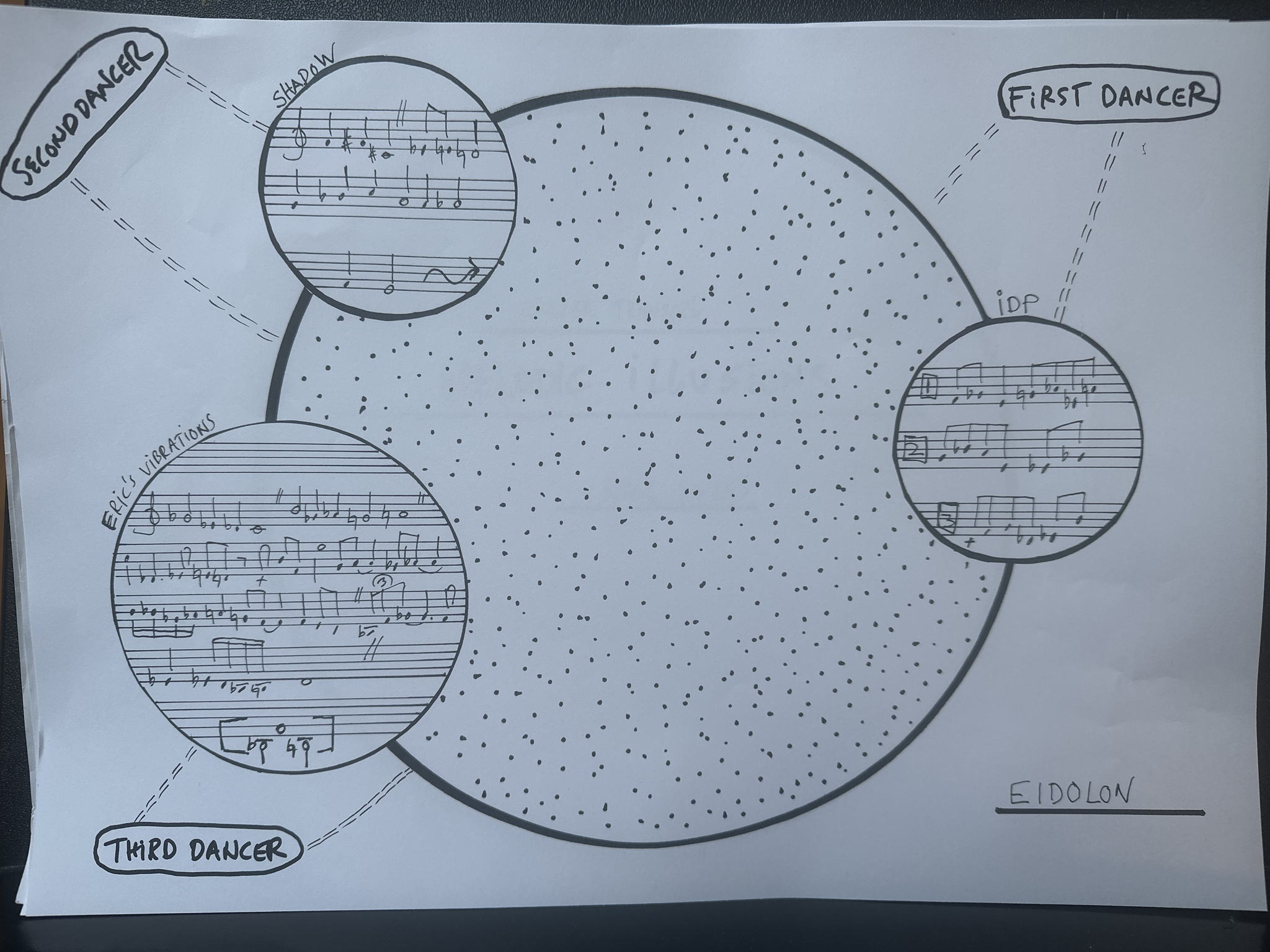
Internal Dialogue Phrasing (IDP) (revisited in the Temporal / Pulsating strand) is a method where the improviser stays in close contact with their own melodic statements, creating a kind of self-contained dialogue. Rather than focusing on responding to the ensemble or reacting to external events, the improviser enters into a reflective loop, phrasing only in response to their own melodic statements.
In my own playing, this approach has become a particularly fruitful and immediate way of working with pulse and temporality. When I’m in this mode, I experience a high degree of mobility within the phrasing. The temporal and pulsating aspects are very much present, but they are shaped from within. I can quickly shift between different rhythmic states, densities, or speeds, without depending on a fixed metric framework.
There’s something liberating about this internal focus. It allows my phrasing to evolve on its own terms, stretching or compressing pulse in response to the emotional and melodic logic unfolding in the moment.
For me, IDP brings out an elastic pulse, a personal cadence that can be rapid and shifting, or slow and deliberate. It helps me explore the temporal dimension of melody in a way that is very responsive.
In ensemble settings, IDP introduces an strong friction. By resisting collective timing or shared pulse, the improviser brings an alternative temporal force into the room, one that doesn't aim to synchronize, but insteadholds its own pulse, with integrity and intent.
Ultimately, IDP has become a central part of my improvisational vocabulary. It allows me to phrase from within, to stay in the sphere of my own sound and to shape melodic pulsation from the inside out.
SIGNALS (revisited in the Temporal / Pulsating strand)
The trumpet is an instrument made for signaling, whether it’s communication, calls in hunting, messages across mountains, or moments of joy or alert. This deep connection to signaling lives in the very nature of my instrument, but also in my body and my way of playing.
When I play, signals naturally emerge as variations of just a few tones, shaped through different tempos and subtle rhythmic shifts. These small statements are not abstract concepts; they are part of my physical language woven into my phrasing and pulse. Signaling is something my body knows, something that feels essential and instinctive.
Many composers and improvisers have explored signals in their work. I recall working with composer Pelle Gudmundsen Holmgren on his piece for car-horns and sires in the 1990's. Also hearing for the first time, Toru Takemitsu's "Morning Signals" is a chamber work for brass instruments, composed in 1964. It reflects Takemitsu's interest in subtle textures, spatial awareness, and the blending of timbres. The piece uses motifs that can be understood as “signals” short, clear statements or calls which interact and overlap, creating a sonic environment that unfolds gradually.
These experiences have enriched my understanding of the expressive and temporal potential embedded in signals.
Whereas Signals initially pointed to spatial or gestural directions, they also began to function as temporal cues: subtle indicators of change in pulse, pacing, or flow. A short accent, a breath, a hesitation, these signals invited others to shift or realign without the need for explicit metric instruction.
In this context, signals became tools for shared temporal intuition, invitations, the pulse was not stated, it was felt.
Earlier in my practice, the strong bodily pull toward phrasing in strickt time-grid sometimes made it challenging to embrace more abstract rhythmic approaches. However, revisiting Signals in this temporal and pulsating strand has renewed my appreciation for how these instinctual, tempo-sensitive acts can anchor or activate improvisations, allowing pulse to emerge organically, in dialogue with the ensemble.
These five approaches Cyklus, Abstract Syncopation, Arrows, IDP, and Signals each offered a way of navigating improvosational pulsations without relying on fixed rhythmic systems. Instead of designing rhythms, I sought to open temporal fields: pliable spaces where melody could breathe, pull, hover, or spiral. For me this brought out the sensivity in pulsation and the more ordinary "time-feel".