This contribution is divided into three parts. The first part is dedicated to the connecting costume I brought to the Costume Dramaturgies workshop. It consists of an edited video from the session and two texts reflecting on the dramaturgical potentials of this costume. Witnessing the costume jam session with my costume was deeply emotional, and in the texts I explore these emotions and what unfolded during the session and what I learned about the dramaturges of this particular connecting costume.
The second part, Dramaturgical Aspects of Six Costumes, includes my experiences and reflections from the costume jam sessions in which we explored the costumes brought by Susan Marshalo, Liv Kristin Holmberg, Christina Lindgren, Ingvild Rømo Grande, and Franziska Bork–Petersen. I am deeply appreciative that they offered us the opportunity to engage with their previous costumes – this generosity was both inspiring and thought-provoking, evoking new ways of seeing and understanding their costume and their artistic and/or research practices. In addition, in this section I have tried to summarize some of the many conversations I had during the workshop into a list.
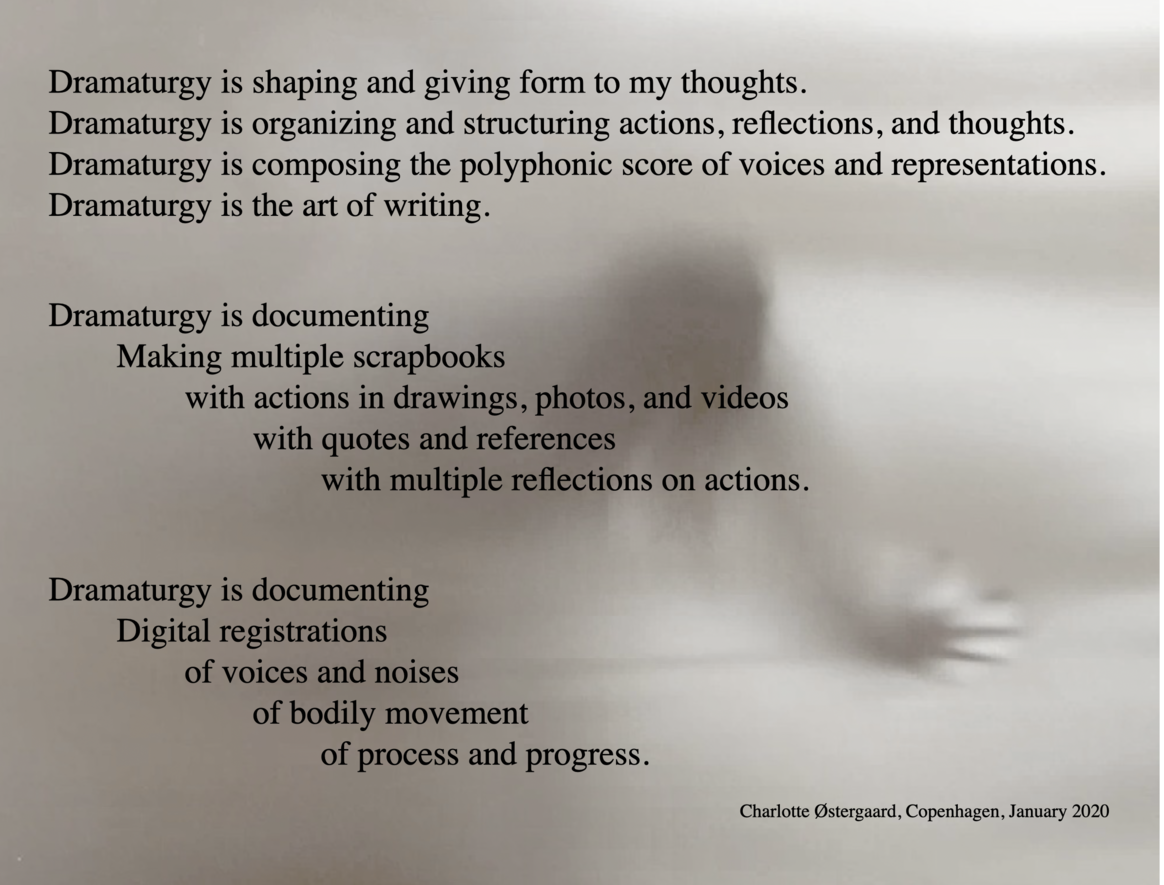
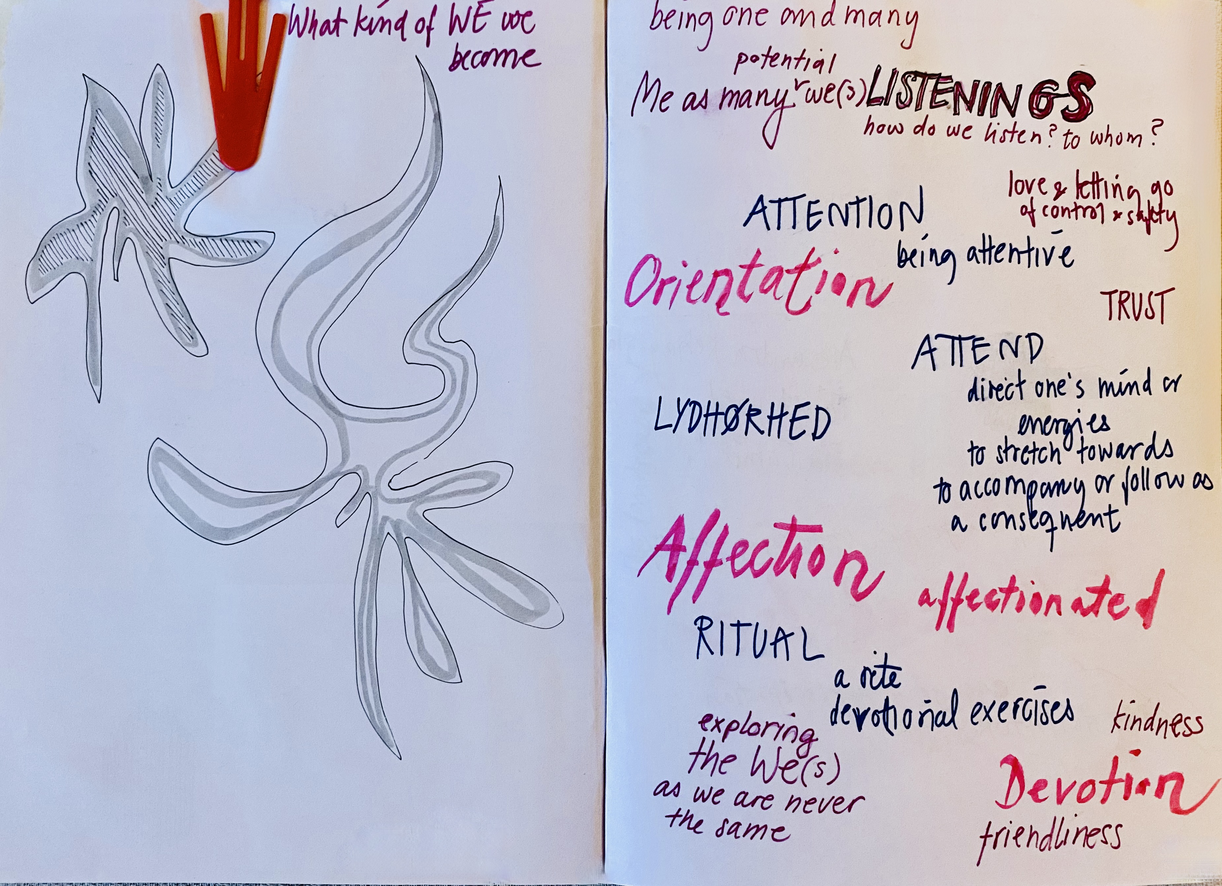
In the final third part, I revisit a manifesto I wrote in 2020, in which I reflected, among other things, on what dramaturgy means from my position as a costume designer and artistic researcher. Building on the knowledge I gained during the workshop and the insights of my colleagues, I have created a new, temporal manifesto titled A Manifesto for Costume Dramaturgies.

PART ONE
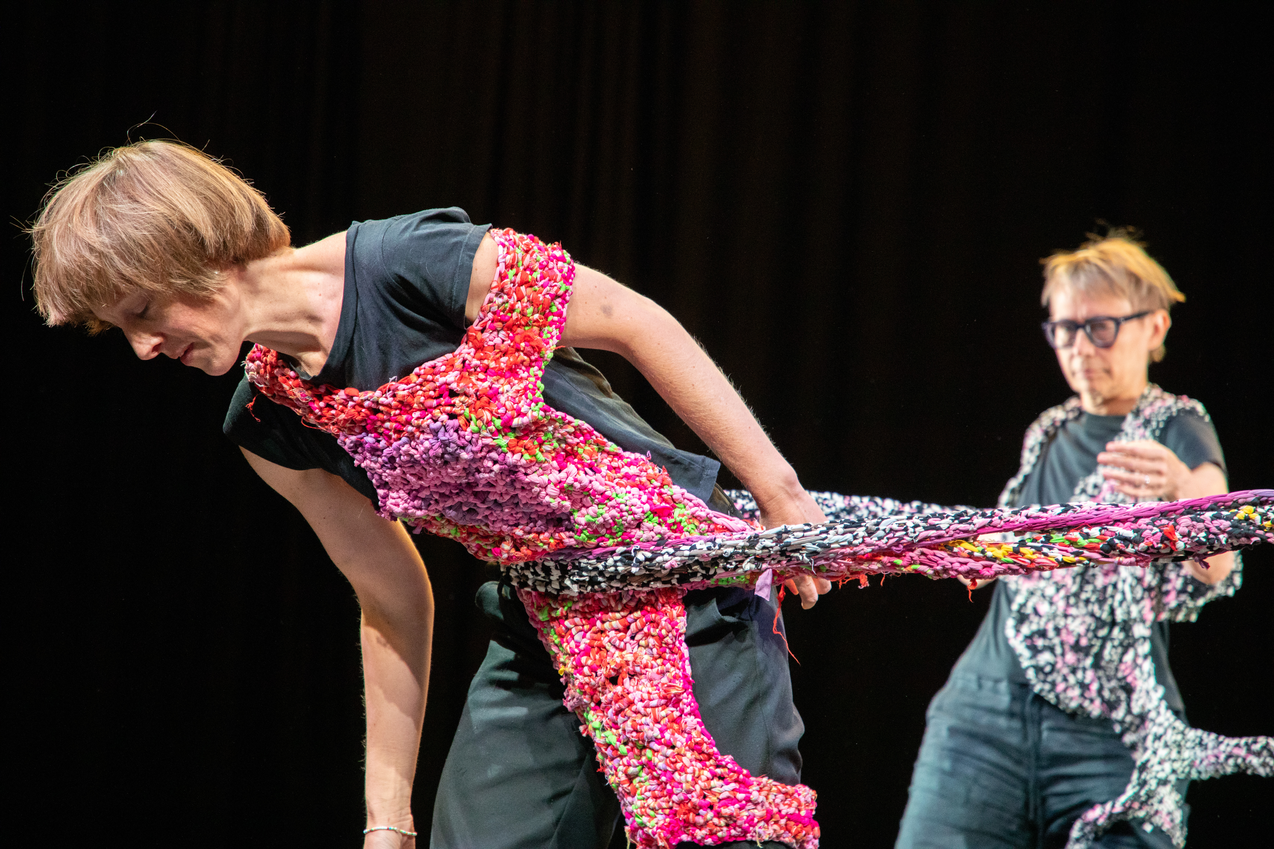
The video is an edited recording (12:52 minutes) of the costume jam session using the costume I brought to the workshop: a Connecting Costume. Several aspects of the session took place off camera and are therefore not included. In editing the video, the chronological order of the interactions is altered to create a compositional dramaturgy. This dramaturgy — and the various interactions — could potentially be developed further into scenes or sequences within a performance.
In the video you see Åsa Johannisson, Alejandro Bonnet, Josephine Rydberg, Thomas Brennan and Ingvild Rømo Grande.
Below are two text: Dramaturgies of a Connecting Costume and What is the dramaturgy of (costume) things in performance?
Dramaturgies of a Connecting Costume
Dr. Charlotte Østergaard
Contextualization of the Connecting Costume
For the Costume Dramaturgies (CD) workshop, I brought a costume that I have designed to connect two people, referred to as connecting costume. This connecting costume is part of the participatory project Community Walk: a series of site-specific, community-forming walks placed different public spaces in which up to 24 guests, 12 connected pairs, can participate. For this purpose, I have created twelve unique connecting costumes: all one-size, sewn or knotted in a wide colour palette of stretchy materials (Østergaard 2025b).
Community Walk are never placed “traditional” theatre contexts, and the connecting costumes are not designed to serve a specific text or choreographic score. The intention is that the participants are not limited to trained performers (Østergaard 2025b, 30), nor are they expected to enact predetermined characters or choreographies. The particular connecting costume present in the CD workshop is crafted so that it can be worn in multiple ways.
In each Community Walk I participate as an active host, not by directing but by
‘listening and sensing … try[ing] to adapt to the rhythms and dynamics of the specific group, the atmospheres of the place and unanticipated encounters that happen in the process. Listening is a way of becoming – together with the group – and of letting material, place and community shape each other. Each walk teaches me new ways of carrying, moving and connecting myself with the costume and the group’ (Østergaard 2025a).
The hosting and the actively participate is ambition of softening hierarchies or boundaries between host and guest, designer (crafting costume) and participant (wearing costume), as well as between walking (improvising collectively with the costume) and observing (observing and being inspired by how others improvise with the costume).
Community Walk have taken place at festivals like at Performing Landscapes (2025), the 15th Prague Quadrennial for Performance Space and Design (2023) and SWOP Festival (2023) as well as in educational contexts. Only on one occasion has three of the connecting costumes been on stage as part a performance: Gertrud-Material (2023) directed by Professor Aune Kallinen and performed by MA acting students from the Swedish Acting Program at UniArts Helsinki, Finland. In this context, we worked within ‘classical’ roles like director, designer, actor and audience. During the rehearsal process, the actors (in pairs and as a group) had to familiarise themselves with the connecting costumes while simultaneously learning a text. This proved challenging, as the text often conflicted with the movements and gestures the costumes invited or imposed on the actors’ bodies. On stage, in performance, the text and the costumes seemed to speak different languages, generating a compelling and dynamic tension.
Research Perspective
My research is informed by new materialism (Barad 2007; Bennett 2010; Haraway 2016). This implies that in crafting processes – such as when creating a connecting costume – textiles are my nonhuman collaborators and creative companions.
Prior to the CD workshop, I considered the twelve costumes as prototypes and versions (Østergaard 2025b) within the Community Walk collection. Selecting which one to bring to the CD workshop became an opportunity to rediscover that the costumes constitute the constant factor in Community Walk: the events, the public environments, and the participants are always different. The connecting costumes are the nonhuman companions on which Community Walk depends; they are sites for shared exploration (Østergaard 2024b, 183), and it is they who invite human participants to wear, listen, explore, and collaborate with and through them. Being nonhuman companions, I must acknowledge that I cannot control or predict what a connecting costume will craft since every encounter is an arrival into a new situational constellation (Østergaard 2025b, 33). Thus, as researcher I must be open-minded and curious to learn, un-learn, and re-learn with every encounter (Ibid); I must learn through and with the costumes as creative companions.
By taking one of the costumes out of its context, it became apparent that it was less part of a collection and more part of a flock. As such, as a flock, the connecting costumes transformed into a textile company—not a company in the classical sense of a dance, theatre, or musical ensemble consisting of people, but a company composed of textile (costume) companions. As we, the costume and I, entered the CD workshop, we entered as representatives of the textile company.
As researcher, I search for co-creative spaces that are surprising and/or lead in unexpected directions (Østergaard 2024b, 181). So even though we arrived at the CD workshop as representatives of the textile company, the costume, as my creative companion, had to step out of the textile company (and the Community Walk contextualization) to become its own being, as we wanted to explore what kind of being(s) it would become. In the CD workshop, we somehow entered more unknown territories.
Playful Improvisation(s)
In Community Walk, I never push or force participants to do anything they do not want to, nor is the walk framed as improvisation. However
surprisingly quickly, … pairs [that share a costume] begin to interact [and] often, two or more pairs get tangled up in improvised choreographies … turn[ing costumes] into hammocks, trampolines, balancing points or places of rest. Each group evokes its own choreographies and relational dynamics. … [I]n Community Walk, play and improvisation are not just methods but ethical design approaches that open spaces for commoning relations between body, material and place. … This open attentiveness is the condition for the unforeseen – what we do not yet know – to take place in our (creative) explorations of costume and walk. (Østergaard 2025a)
As such, Community Walk is improvisational, yet the improvisations are never performed for an external gaze. Participants are not interpreting the role of “performer,” nor are they enacting something for passers-by. Instead, the improvisations emerge from within the relational situation created by the shared costumes and the collective movement. The creativity, curiosity, and playfulness that arise are relational rather than representational.
Participation unfolds through interpreting, interrupting, co-inventing, listening, laughing, and negotiating – acts through which participants co-compose with the costume, their bodies, and the surrounding place(s). Each walk and encounter produces new, momentary compositions that reveal relational, material, and creative possibilities with the costumes. In this way, the frame of Community Walk may offer a temporary suspension of everyday life, or even evoke a kind of third space, in which people can explore expanded abilities through mutual responsiveness and learning-with each other’s perspectives in playful and improvisatorial ways.
Costume Jamming
In the CD workshop, the structure of the Costume Jam Sessions was no less playful or creative than described above, yet the roles were organised differently. In each session the group of twelve people was either jamming with a costume or observing/witnessing the unfolding of the jamming. Additionally, the CD workshop had a sequential structure in which one action by one person was followed by an action from the next, creating a chain of responses.
I do not recall whether we (the core group present; Christina Lindgren, Liv Kristin Holmberg, and I), in the days leading up to the CD workshop, explicitly decided that the designer who brought a costume would withhold its context before starting a costume jam session. During the workshop some people expressed that they missed having contextual information and we discussed whether it would be constructive to share the costume context before or after a session. In relation to my research approach, however, I intentionally did not provide any contextualization, as I wanted to avoid influencing how people engaged with the connecting costume as well as (as mentioned above) I wanted the costume to be(come) its own creative being.
It is worth noting that on the first day of the CD workshop, we had a jam session with a white sheet that was followed by the session with the connecting costume – this session the first of the six sessions where we jammed with costumes. Several people (Christina Lindgren, Liv Kristin Holmberg, Susan Marshall, and Natálie Rajnisová) had previously taken part in Community Walk, and in the session they all acted as witnesses and so did I. None of the seven people who jammed with the costume knew its context and did not have any knowledge of the reflections discussed above.
Witnessing the Jamming with the Connecting Costume
In Community Walk, I have experienced a richness of interactions with and responses to the connecting costumes from many different participants: colleagues from theatre, performance, design, music, research, and other fields; performers and non-performers; people whose backgrounds I do not know; as well as students in the educational versions of Community Walk.
The Costume Jam Session allowed me to experience the connecting costume outside of its familiar context. Here, the familiar—what Sara Ahmed describes as the world we implicitly know, “a world organized in a specific way” (Ahmed 2006, 124) – often takes shape by being unnoticed, quietly guiding our attention and expectations (Ahmed 2006, 37).
Drawing on Ahmed’s notion of familiarity as an orientation, in the Costume Jam Session I had to reorient myself, making space for the unnoticed – what had not yet come into view. The unfamiliar thus became a site of relational possibility rather than a lack, as I observed how others acted and reacted to the connecting costume and noticed whether new or other, more unfamiliar possibilities emerged.
In the CD workshop, seven people jammed with the connecting costume: some I had met before, others for the first time, and none of them I had collaborated with previously. While they were jamming with the costume, they had to become familiar with the connecting costume, and I had to become familiar with their ways of approaching and improvising with it. Therefore, as I was observing the seven colleagues jamming with the connecting costume, I was trying to become familiar with them and, through their interactions (and perspectives), I had to re-familiarise my view (and perspective) on the costume.
It felt new to witness the mime actors handling the costume as a kind of puppet, noticing how the puppet’s character came alive in their hands and how they responded to it. One of the mime actors reflected, more generally, that approaching a costume was an act of exploring what the costume was—almost as if the costume posed a question, inviting the person to invent a response, or functioned as a mask that the person had to decide how to wear and interact with. Witnessing the mimes’ interactions revealed not only their skilfulness but also the depth of their training—which was profoundly inspirational. In this sense, it felt as if the costume and I were meeting on new grounds as well as meeting new creative partners.
After the session people described the connecting costume like inner tissue, giving a sensation of loosening or shedding one’s skin. It evoked associations with sea creatures and snakes, suggesting an other-than-human presence. It also oscillated between sculpture, haute couture and crafted object. Some of the people jamming with the costume experienced that the colour activated something vibrant — they felt that the colour itself lead the jamming. For others the many holes and openings were perceived as invitations, allowing any body part to explore, enter, or emerge. Lastly, I noted that some people experienced varying degrees of resistance, gravity, and elasticity as well as that several remarked that the costume demanded attention — it insisted on being engaged with, seen, and listened to.
Susan Marshal (who like me witnessed the session) has kindly shared her notes. She writes that ‘You think you understand it, but it holds secret potentialities. It is laughing with you. It is cheeky.’ Susan have experienced Community Walk and it’s interesting that even though she (like me) knew the costume she also experienced that the costume holds (and perhaps revealed) secret potentials. I had similar sensations; in the jam session it was as if the costume revealed other (relational) sides of itself that I was unaware of existed.
Exploring the Connecting Costume’s dramaturgies
As I write in a chapter of a yet-to-be-published anthology, one participant in Community Walk described the dramaturgy of the connecting costumes (having worn two different costumes over a duration of about 1,5 hours) as an expansion of orientation that “happened in steps”: moving from a focus on individual experience toward exploring collective possibilities.
However, what unfolded in the Costume Jam Session was of a different nature. During the session, participants revealed their in-the-moment relationships with the connecting costume. Their improvisations pointed toward dramaturgical potentials that I had not previously focused on. I observed how composition unfolded in real time: how others could invent, shape, and respond to the costume in ways I could not have anticipated, generating forms and gestures that might later develop into a stage performance. This demonstrated the capacity of the connecting costume to act as a site for collective exploration, improvisation, and emergent dramaturgy.
I was deeply touched by the relationships that arose during the jamming; it felt like a gift to witness. Because the costume is my close creative companion, it mattered that the interactions were attentive, and yet playful. Laughter often accompanied these encounters, evoking an atmosphere of and playfulness and curiosity that is central to the practice of the textile company. In these moments, I felt the costume – and through it, I too – was touched, enriched, and transformed.
The session with the many actions and responses also illuminated aspects of my own practice. I recognized that my focus has always been on creating communities, which in itself is a form of dramaturgy – one that is relational, attentive, and participatory rather than scripted or predetermined. Crafting, in this context, is not only about shaping material, but also about caring for materials and carrying the weight of that care. Actions and interactions emphasized the relational and affective dimensions of working and collaborating with materials: the costume requires attentiveness, responsiveness, and care, just as I do in relation to it.
Humor and laughter were present throughout the jam session with the connecting costume. This was essential, as I believe that when we laughed together, our hearts opened and boundaries softened, enabling relationality and playfulness to emerge. In this way, the Costume Jam Session revealed that dramaturgy with a nonhuman companion is not only about gesture or narrative, but about co-composition, relationality, attentiveness, and the joyful unfolding of possibilities.
References
Ahmed, S. 2006. Queer phenomenology – orientations, objects, others, Durham & London: Duke University Press.
Barad, K. 2007. Meeting the universe halfway – quantum physics and the entanglement of matter and meaning, London: Duke University Press.
Bennett, J. 2010. Vibrant Matter–a political ecology of things, Durham London: Durk University Press.
Haraway, D. 2016. Staying with the Trouble – making kin in the Chthulucene, Duke University.
Østergaard, C. 2025a. Embodied connections between people, materials and situated atmospheres,Formkraft.dk – Journal for Crafts & Design. Theme: Various Bodies #3
Østergaard, C. 2025 (2022)b. Ethical dilemmas of stretching towards Others in fitting situations, MATTER JOURNAL – the Materiality of Artistic Research in Theatre and Performance #4, Malmö Theatre Academy. 29–51.
Østergaard, C. 2024a. Crafting Material Bodies – exploring co-creative costume processes (PhD thesis), Lund University.
Østergaard, C. 2024b. Charlotte Østergaard (Denmark), In (Eds) Susan Marshall, Insubordinate Costume, Routledge. 180–183.
Østergaard, C. (2024). Performing Creative work in Public, In (Eds) Andersson, E.C.; Lindqvist, K.; Sandström, I. de Wit & Warkander, P., Creative Work: Conditions, Context and Practice, Routledge. 172–198.
Click to explore the part:
PART ONE Dramaturgies of a Connecting Costume
PART TWO Dramaturgical Aspects of Six Costumes
PART THREE A Manifesto for Costume Dramaturgies
What is the dramaturgy of (costume) things in performance?
Elaborating on the text Dramaturgies of a Connecting Costume
Dr. Charlotte Østergaard
In Vibrant Matter: A Political Ecology of Things, the American political theorist and philosopher Jane Bennett challenges Western human-centric perspectives that frame matter as passive. In Bennett’s vitalism, things – such as litter, electricity, foods, and metals – possess vitality and vibrancy that influence human actions and political landscapes. She writes: “If matter itself is lively, then not only is the difference between subjects and objects minimized, but the status of the shared materiality of all things is elevated” (Bennett 2010, 13). By emphasising that we – where “we” includes things like nonhuman matter – share materiality, Bennett challenges fantasies of that humans are unique beings capable of escaping their own materiality and mastering nature (Bennett 2010, ix).
As I write in my PhD thesis (2024), Bennett’s vibrant matter is an ethical call to awaken and expand our (human) sensitivity and attention toward the materialities that surround us. If we are sensitively open, this applies equally to costume. Crafting costume requires sensitivity and care for textile materialities, and when we wear or explore costume, we must attend to its material vibrancies, because they will interact, interfere, and co-compose with our bodies in multiple ways. Bennett’s call resonates in the sense that we – costume designers, researchers, and collaborators – cannot and must not enclose costume within one specific performance concept or fixed meaning. Costume potentially has multiple vibrating lives if we remain sensitive to its inherent qualities. Bennett’s ecological approach suggests that costume has circular qualities and appearances: each time we wear or encounter a specific costume, its materialities will vibrate differently – from yesterday, from last year, from different events and with different collaborators – evoking new affects in our human material bodies.
In my thesis, I also draw on ecofeminist Donna Haraway’s notion of making kin (2016). I write that
Haraway’s kin-making stretches kinship to include forming relationships with kinds that are not human, which is an invitation to include these other more-than-human kinds in our stories or worldings. In Haraway’s wording, ‘ancestors turn out to be very interesting strangers; kin are unfamiliar’ (Haraway 2016, 103). In Haraway, worlding kin-making is becoming familiar with what is unfamiliar, whether the strangers are human or more-than-human. … Haraway argues that kinship is not a given but requires attention and endurance from humans to allow more-than-human bodies to become ‘persons’ on their own terms (Østergaard 2024).
Building on these perspectives, I understand textile materials and costume as vital creative partners. This breaks hierarchical distinctions between human and nonhuman and elevates the impact of costume. “The dramaturgy of things”, understood through the connecting costume, is not something imposed from the outside but something that emerges through relations. The connecting costume(s) functions as a nonhuman compositional and dramaturgical companion that initiates, shapes, interrupts, and redirects action through its material properties, affordances, resistances, and invitations.
The connecting costume generates dramaturgy by orienting bodies toward each other (Ahmed 2006). Its elasticity, weight, openings, and colors provoke gestures, attentiveness, negotiation, humor, and care. The dramaturgy or dramaturgical potentials of the connecting costume(s) are unfolded material encounters – responses between bodies, textile, and place – rather than as linear narratives. In this context, the “dramaturgy of things” is situational and emergent. Each encounter constitutes a new constellation in which meaning, movement, and relational dynamics are co-composed in real time. The connecting costume does not represent something else; it does something. It insists on being engaged with and listened to, and through this insistence it produces dramaturgical tensions, rhythms, and transformations.
In participatory contexts such as Community Walk, this dramaturgy operates without an external gaze. Improvisation is not performed for an audience but arises from within the relational situation co-composed by the shared costume. Here, dramaturgy is an expansion of orientation – from individual sensation toward collective awareness – and unfolds gradually as participants learn-with the costume and with each other.
When the connecting costume enters a more conventional theatre context, as in Gertrud-Material, its dramaturgy does not disappear but becomes frictional. The costume and the text “speak different languages,” creating productive tensions. This reveals that connecting costume(s) dramaturgy may conflict with textual and spoken dramaturgies precisely because it operates through material agency and embodied negotiation rather than representation.
The Costume Jam Sessions further demonstrate that the “dramaturgy of things” becomes especially visible when context is withheld. Encountered as its own being, the connecting costume acts as a question rather than an answer – inviting invention, play, and responsiveness. Here, dramaturgy is not centered on narrative coherence but on co-composition: gestures, affects, laughter, and care arise through shared attention to material presence. These are porous dramaturgies – ephemeral, non-reproducible, and grounded in the moment.
Ultimately, the dramaturgy of connecting costumes is a form of relational dramaturgy. It is about encounters, softening hierarchies, and creating conditions for collective listening(s) and becoming(s). The connecting costume, in this sense, is not only a participatory (designed performative) practice but also an ethical and dramaturgical one: a way of caring for material companions and for the communities that forms through and with them.
References
Bennett, Jane. 2010. Vibrant Matter – a political ecology of things, Durham London: Durk University Press.
Haraway, Donna. 2016. Staying with the Trouble – making kin in the Chthulucene, Duke University.
Østergaard, Charlotte. 2024. Crafting Material Bodies – exploring co-creative costume processes (PhD thesis), Lund University.
Dramaturgical Aspects of Six Costumes
PART TWO
I share my experiences from and reflections on the costume jam sessions where we explored the costumes of Susan, Liv Kristin, Christina, Ingvild, and Franziska. I am deeply appreciative that they offered us the opportunity to engage and jam with their previous costumes – this generosity was both inspirational and thought-provoking – evoking ways of seeing and understanding dramaturgical potentials their costumes and of their research.
For this section, I have rewritten my notes from the six sessions, incorporating the sketches I made to capture bodily experinces, spatial and material compositions that emerged. These reflections are from my perspective, and I can not know wheter my reflections resonate with the concepts, ideas and perspective of my colleagues.
In addition, I have tried to summarize some of the many conversations I had during the workshop into a list titled Dramaturgical Aspects of Costume Things
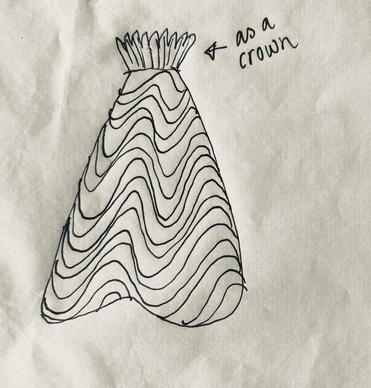
I have seen Liv Kristin perform in the Art–Liturgical Cloak, and I had heard her speak about her relationship to this costume. However, I had never touched or worn the cape until the jam session #3.
During the session, I was initially afraid to put the cloak on, worried that I would not be able to inhabit it. To me, it is as if the ligurgical cloak itself demands presentation: wide, sweeping movements, unfolding itself in its full expanse. It feels as though one must approach it carefully – almost as if it requires an initiation ritual. As such, this costume is heavily loaded and coded: highly theatrical, more culture than nature.
I felt that my body was too large, too clumsy in relation to the cloak, like an elephant in a glass shop. I am forced to move carefully. I cannot tell whether it is the gold or the priest-like collar that produces this effect. Yet when I noticed the dog hiding inside, I dared to come closer. Still, it felt as though I had to offer myself to the cloak; I did not manage to approach it fully.
I am drawn to the cloak, but remain devout. It takes a particular kind of person to wear this cape. It seems to me that wearing the cloak is not a solitary action – you need to be dressed; you need a dresser. In dressing, you need to surrender to it with reverence, as if giving an offering. When you do so, the costume does the work; it transforms you.
The art-liturgical claok is a statement in itself and must be greeted and it carries its own dramaturgy: it stages an entrance, dictates tempo, and scripts the relationship between body, movement, and attention. I do not wear it; I am drawn into its sequence of actions – approach, hesitation, surrender, display – and I can feel that Liv Kristin's ritiuals and performace dramaturgies and rituals are embedded in the cloak.
I know Susan; that she was working on a pocket project, and I was also aware that she had used the Pocket Dress in a workshop at a conference. However, I had not seen the actual Pocket Dress before the jam session #4.
During the jam session, it was the pockets that initiated the jamming conversations—they became stories about garments, as Franziska noted when reflecting on the Pocket Dress’s performative potential. The pockets held secrets and fragments of forgotten stories. At one point a homeless or nomadic character emerged and multiple characters appeared along the way. At times, the pockets transformed into small figures, and I – or we – became their puppeteers.
The material itself, or rather the pockets as a concept, carried so many references that it felt as if the concept became the guiding thread. Therefore, while jamming, I was not primarily investigating the materiality of the dress; instead, I was captured by what was hidden – the notes and stories placed inside the pockets and drawn out again.
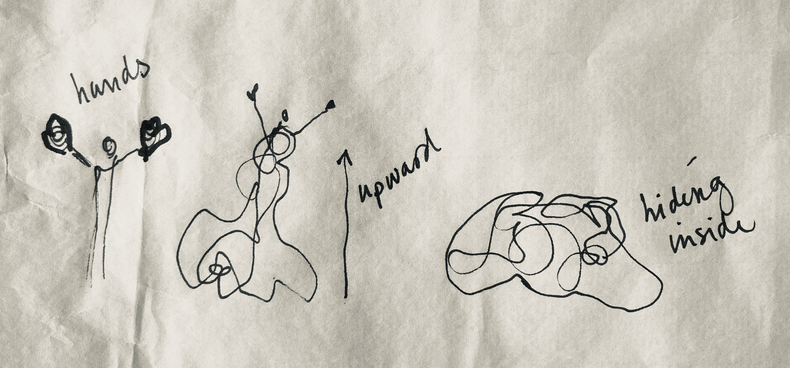
My dramaturgical journey of discovering the Pocket Dress unfolded in stages: first, the encounter between my hands and the pockets; second, an upward journey – a movement through the garment, where grasping the overall trajectory of the dress proved difficult; and third, a desire to hide within it, as if crawling down into the pocket and its secrets.
Even though the journey described above was not performed as a consecutive journey, it emerged through a series of interactions. As such, my actions may have been inspired by, or responses to, the actions of other people jamming with the Pocket Dress, and therefore were not part of a planned dramaturgical structure. However, when I noted down my experience of the jam session, I made three quick sketches of the journey described above – one that had become embedded in my body after the session.
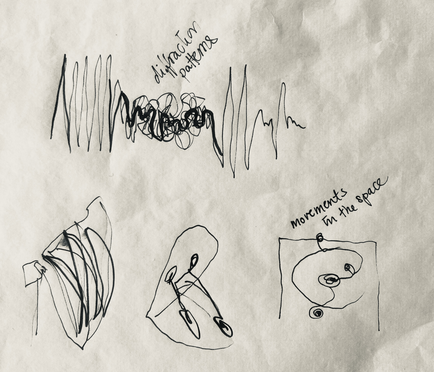
During the workshop I have explored Christina’s Wing Costume twice. Once as preparation fro the workshop – where Christina, Liv Kristin and I jammed with it – and once with the entire group in jam session #5.
What follows is a summarization of the two sessions as both have informed my experiences of and dramaturgical perspective on the Wing.
The Wing costume exists on the border between object, prosthesis, and thing, governed by techniques and mechanical principles that shape and sometimes overtake the body. Movement appears at times as if driven by an external system or rather a system embedded in the costume: robots or machines going out of control, seizing agency and directing the performer rather than the other way around.
The Wing costume also reveals itself as an impossible instrument—one that resists mastery while insisting on activation. As such, sound is integral and the costume is not only seen but heard; it becomes an instrument activated through movement. As different elements are set in motion, sound and reflection (in the paillet parts) emerge simultaneously, creating a play of resonance and echo. Two moving parts generate both acoustic and visual feedback, folding perception back onto itself.
The movement vocabulary and thus dramaturgical potentiales oscillates between extremes: sharp, closed, staccato actions with pronounced up-and-down rhythms, and slower, gliding, organic sequences that unfold multi-directionally. At times, the precision feels mechanical and stringent; at others, it opens into something more fluid and animal. Sound gathers and disperses accordingly, forming something like an avant-garde choir – fragmented and layered.
Repetition becomes a method of exploring he Wing. Inspired by the actions of others, I was drawn to repeat movements in order to sense them from within. At the same time, each repetition carrying a slight twist—an alteration that allowed something new to surface. Gradually, a character emerges—not fully human, not fully animal, but something in between: a ritual creature, a fish-bird, a threshold being.
The glove – that we hardly had time to explore – becomes a site of transformation. Through it, I shift into the role of a shaman, performing a ritual to awaken a dormant beast from a long sleep. Movement passes in and out of control, in and out of intention, as if crossing repeatedly between states.
The complexity of the costume was striking: dense with detail, simultaneously demanding and inviting. There was far more than I could fully grasp or later recall, leaving a sense of excess and unfinished attention. Here, movement directs movement. The costume leads, and the body follows. Agency is shared, negotiated moment by moment, as the work inhabits the fragile threshold between costume and object, between animation and possession, between technique and ritual.
I knew of Ingvild's research, but when we began the Costume Dramaturgies workshop, I did not know her work in depth. Thus, during the jam session it felt as if I encountered Ingvild's costume research for the first time – and, it is worth mentioning, on terms where she did not control the setting or the format. As an opening to jam session #6, Ingvild requested that the jam improvisation with The Bag Body be performed in pairs, with one person acting as the dresser and the other as the one being dressed.
Ingvild’s request was not an introduction to the research context of her costume; at the same time, the division of roles clearly oriented me, and during the session I could not escape this orientation. For me, the roles of dressing and being dressed inevitably recalled experiences of spending hours fitting garments – adjusting, negotiating, and attending to how a piece of clothing meets a specific moving body. In my own research, I have been concerned with exploring the costume fitting situation, and for eample in conference papers seeking to understand the dynamics and ethical demands that such situations entail. Moreover, scholars such as Madeline Taylor and Suzanne Osmond have made critical contributions to articulating the value of wardrobe labour – highlighting its importance as backstage work and, thus, as a significant component of performance-making processes. With Ingvild’s role division and these references in mind, it was difficult for me to set aside this knowledge while witnessing the jam session with The Bag Body.
With this abovementioned orientation, I experienced elements of the dramaturgy of fitting unfolding during the session, and it was impossible for me not to see the care embedded in the fitting situations. To me, the session seemed to explore questions such as: How do you invite someone to wear a garment? How do you assist in the act of dressing? At the same time, it exposed the dilemmas inherent in fitting situations. What happens when you dress someone in an impossible garment—one that does not fit the wearer? Is the garment too small, or is the body too large? Such moments risk making the wearer feel exposed or uncomfortable, yet they also reveal the ethics of care embedded in dressing.
As a witnessing in the session, I appreciated that this often unseen labour of fitting a garment was made perceptible, and during the session, I imagined that the jamming could develop into a dramaturgy in which dressing becomes an act of care. Such a dramaturgy might begin with opening The Bag Body as a communal act, followed by explorations of its contents, the revelation of the dress, unfolding the inseparability of the dress and the bag, and the shared acts between bodies, materials, and attention.
In the sharing that followed the session, it was interesting to explore the perspectives of my colleagues – we were three people in my group reflecting on the session with The Bag Body – whose responses had clear connections to feminist theoretical frameworks.
Additionally, it is noteworthy that this was the only costume jam session in which I did not make any sketches in my notebook – perhaps because the dramaturgy of fitting a garment was so clear to me that it somehow prevented me from seeing or experiencing other things.
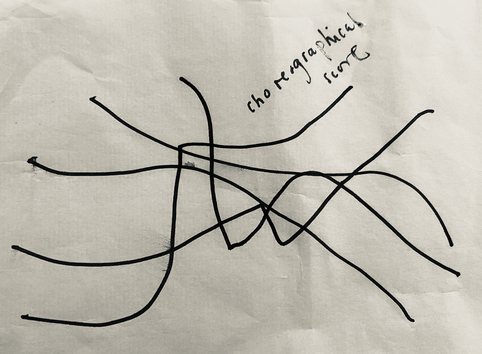
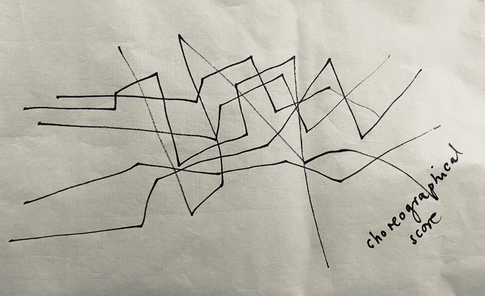
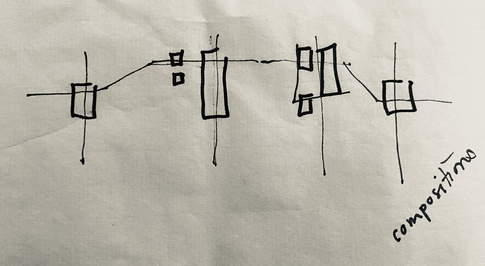
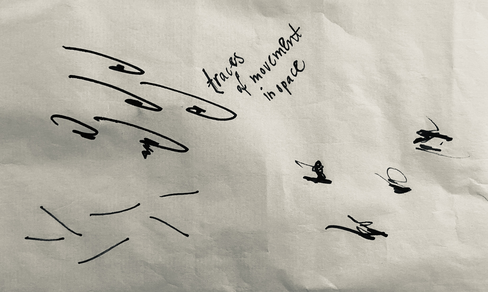
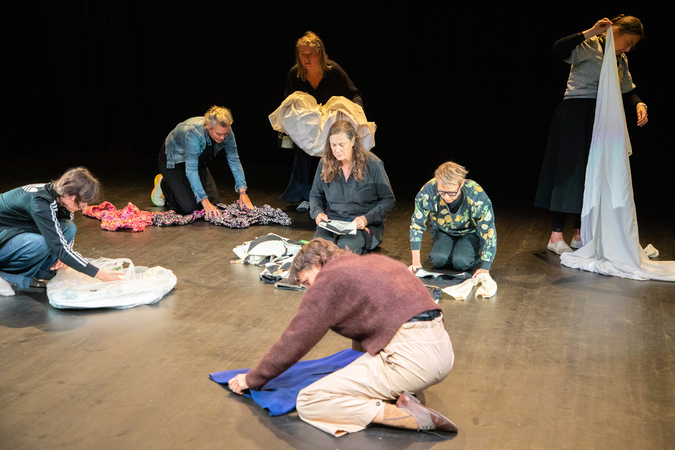
I have heard Franziska speak about and reflect upon her costume research at conferences and in private conversations. However, I had no idea which costumes she would bring to the Costume Dramaturgies workshop. Thus, in jam session #7, I was happily surprised to encounter the Collection of Black and White Dance Costumes.
A collection of upper-body costumes becomes an ensemble – less a static display than a choreography or composition. I was fascinated by the presence of multiple pieces on the floor at once, without any specific direction imposed beyond what the costumes themselves suggested. This allowed the work to exist outside a strict reading of historical period or dance context.
The ensemble is inherently mobile and mutable, shifting as it interacts with bodies and space. Patterns and compositions emerge and intertwine, while the pauses between affordances – the moments when the costumes suggest possibilities but are not yet activated – become just as significant as the movements themselves. In this way, the collection lives as a dynamic, relational entity, offering both structure and openness, presence and potential.
Interestingly, my notes from this session consist mainly of drawings of spatial compositions – as if they were parts of developing a choreography or a score: a score of the costume collection unfolding in space.
Click to explore the part:
PART ONE Dramaturgies of a Connecting Costume
PART TWO Dramaturgical Aspects of Six Costumes
PART THREE A Manifesto for Costume Dramaturgies
Dramaturgical aspects of costume things
The re-writing of my notes (to the right) are like in Liv Kristin Holmberg’s Reverberations of Three Costume Things, personal and subjective; however, they are not as poetic as hers.
As we had organized the costume jam sessions, the time for reflection was rather short (10 minutes), and part of my note-taking took the form of sketches – as quick ways of recording experiences that would otherwise take much longer to articulate in words. These sketches, however, were not intended to develop a dramaturgical notation format, like in Christina Lindgren’s Dramaturgical Seismorgraphy where she intentionally explored and developed throughout the workshop.
An integral part of the costume jam sessions was the conversations that followed (20 minutes), during which we shared our different perspectives. These conversations were highly informative, as they – much like what I have unfolded in my PhD research – revealed how our perspectives differ and are often shaped by our professional and personal backgrounds (Østergaard 2024). However, because I was deeply engaged in these conversations, I did not manage to take any notes. In retrospect, I find that these conversations that include informal ones – over lunch, coffee, and dinner – held significant dramaturgical potential. For example, in the conversations following jam sessions we could have mapped our different perspectives, including the actions that affected us, and then used these mappings to return to specific actions and costume-body-spatial compositions in order to explore and further develop them. This, however, was outside the scope of the workshop.
The conversation was critical and during the workshop still I managed to note down some of the colleagues more overarching reflections. I do intentionally not mention anyone by name; the following list consists of rewritten versions of my notes. These reflections are thus informed by the group and some aspects of the list below are also unfolded in other contributions in this anthology.
Dramaturgical structures – the costume jam session formats
The conversations revealed that the structure of the costume jam session functioned as a dramaturgy in itself. The sequential format—seeing and witnessing participants perform one by one—produced a particular temporal and perceptual organization of actions. While initial actions often established a dramaturgical trajectory, subsequent actions at times disrupted or reconfigured this structure. Some colleagues addressed challenges with the linear format (a row of actions) and expressed a desire for a more non-linear improvisational framework. At the same time, the jam was characterized by an intuitive and non-prescriptive approach, marked by unforced progression. This tension foregrounded questions concerning the construction, constraints, and dramaturgical implications of the jam session as a format.
Improvisation - differnt practices
The conversations emphasized the diversity of improvisational approaches within the group, shaped by the colleagiues’ differing professional backgrounds, training, habits, and physical capacities. Playfulness emerged as a shared quality, intersecting with parallel practices from performance, theatre, and embodied art forms. Participants reflected on whether their actions revealed established dramaturgical habits or facilitated the emergence of new dramaturgical logics through engagement with the costumes. The jam was also described metaphorically as a “magic show,” underscoring the performative and transformative qualities of the encounters.
Costume as material–dramaturgical agents
Costume was consistently articulated as a dramaturgical tool and an active agent within the costume jam sessions. Together with bodies and actions, costumes transformed the spatial and affective conditions of the room. Dramaturgy was thus understood not solely as narrative but as production of emotional and sensorial landscapes in which multiple actions unfolded simultaneously. Particular attention was given to the material qualities of the costumes—such as color, texture, shape, sound, and resistance—and their dramaturgical potentials. The material’s “genstridighed” (resistance) was perceived as an activating force, raising questions about agency, insistence, and responsiveness within the human–non-human relation.
Relational dynamics
The relationship between performer and costume, as well as between performers, was examined through acts of animation and manipulation. These interactions were at times perceived as subtle negotiations of power, where agency shifted between body and material. How participants handled and engaged with the costumes was seen as revealing embodied knowledge and dramaturgical choices. The concept of affordances (especially mention by Franziska Bork-Petersen) highlight what costumes suggest, enable, or constrain, and how they might invite multiple bodies into shared exploration.
Witnessing – sensing and being affected
Witnessing emerged as a key dramaturgical position. Several colleagues reflected on the act of observing and sensing from a distance, including how tactile encounters with material could be perceived vicariously as a witness. Dramaturgy was thus understood as operating through affective and sensory transmission, leaving emotional imprints that extended beyond discrete actions. This underscored dramaturgy as an experiential and relational phenomenon rather than a solely compositional one.
Contextualization of the costumes
Several conversations pointed to the value of contextual knowledge about the costumes, including their histories, conceptual frameworks, and material intentions. It was suggested that such knowledge could be shared after the jam, alongside collective reflections, to support further development of the work. This positioned dramaturgy as a process unfolding across practice, reflection, and dialogue, rather than being confined to the moment of performance.
Temporality of exploring non-human relations
Time and tempo were recurrent concerns, particularly the importance of allowing actions to unfold gradually and emergently. The costume jam session foregrounded the human body as a performer in relation with non-human materials, emphasizing tactile engagement and co-presence. Dramaturgy here operated through temporal attunement and responsiveness, rather than pre-determined sequencing.
Group dynamics
Finally, some conversations addressed the social dynamics of the group, including heightened self-awareness, experiences of self-regulation, and the impact of being watched. Come conversations reflected on both spoken and unspoken consensuses, and on how norms and expectations shaped what actions felt possible or permissible. These dynamics were understood as dramaturgically significant, influencing not only individual actions but the collective unfolding of the jam.
Emergent rituals in the closing costume jam session
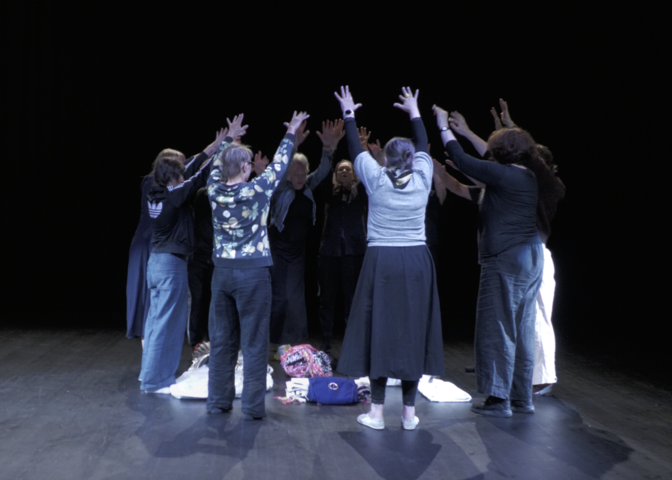
Rituals are a vivid and recurring element in Liv Kristin Holmberg’s artworks and performances, and while we did not consciously intend to replicate this, it seemed that her explorations had subtly informed our approach. Inspired, perhaps indirectly, by what she had unfolded, we in the final costume jam session #9 co-created a closing ritual that centered on the non-human actors – the costumes themselves – rather than on human performers. In practice, this session into a shared, non-verbal greeting ritual for the costumes – a moment of collective attention and acknowledgment.
This co-created ritual revealed multiple dramaturgical and relational dimensions. It highlighted the transitional nature of how actions, bodies, and costumes move from one state to another, marking both endings and transformations. The costumes enacted their magical potential, temporarily forming figures that existed only in that moment, emphasizing the ephemeral and performative qualities of the material.
The ritual also foregrounded sharing and relationality. By collectively attending to the costumes, the group enacted a form of communal witnessing in which the costumes became the sacred or elevated object of focus. The stage became a space of collective exploration, where both human and non-human actors co-created meaning and presence.
Through this emergent, improvised ritual, dramaturgy was experienced as a process of relational attunement, emphasizing transformation, temporality, and the shared creation of affective and symbolic landscapes. It underscored how rituals can arise spontaneously within participatory practice, producing moments of cohesion, reflection, and enchantment that extend beyond structured or pre-planned actions.
Click to explore the part:
PART ONE Dramaturgies of a Connecting Costume
PART TWO Dramaturgical Aspects of Six Costumes
PART THREE A Manifesto for Costume Dramaturgies
PART THREE
As I have been reflecting on the impact and outcomes of the Costume Dramaturgies workshop, I realized that dramaturgy was central to the original title of my PhD research: Radical Co-creation in the Field of Costume Design – An Inquiry of Processes and Dramaturgical Agency (2020). Due to the evolving focus of my research, the project was later renamed Crafting Material Bodies – Exploring Co-creative Costume Processes.
Nonetheless, what I wish to highlight is that, from the outset, I created a manifest connected to the original title, in which dramaturgy played a significant role. This manifest outlined key intentions, approaches, and reflections on the role of dramaturgy in co-creative processes.
After the Costume Dramaturgies workshop, I revisited and reworked this original manifesto. The conversations, encounters, and relational dynamics that unfolded throughout the workshop shaped the creation of a new manifest: one grounded in lived experience, collaborative practice, and the insights that emerged from collaboration with colleagues co-exploring dramaturgical potentials of costumes. I do not claim ownership of this manifest; it is, in a sense, ours, even as I cannot know whether all colleagues would fully endorse it. At the same time, the manifest is inherently temporal, open, and provisional – meant to be rewritten, adapted, and transformed to suit other contexts and encounters.
A Manifesto for Costume Dramaturgies Potentials
Dramaturgy is specific
Dramaturgies are not universal – they emerge in relation to particular contexts. They are situated, responsive, and contingent, shaped by the unique interplay of context, people, materials, space and time. Each costume, each body, each encounter generates a distinct dramaturgical landscape.
Dramaturgy is relational
Dramaturgies arise through relationships: between humans, between humans and non-human materials, and among the materials themselves. Costumes are not passive; they are agents that generate movements, create connections, and invite exploration. To work with costume dramaturgies is to attend to these relational forces, noticing how intra-action, materiality, and perception co-constitute each other.
Dramaturgy is transgressive and exploratory
Dramaturgies move across boundaries, destabilizing habits and expectations. They invite experimentation, disruption, and playful negotiation of rules, norms, and roles. Costume dramaturgy allows for the emergence of new temporalities, spatial arrangements, and affective landscapes, opening the room for imaginative and embodied possibilities.
Dramaturgy orients us
Dramaturgies orient us physically, emotionally, and imaginatively. They shape our movements, guide our orientation and attention, and modulate our affective responses. Costumes act as compasses, as provocateurs, as catalysts for new ways of sensing, acting, and relating.
Dramaturgy attends to the “things”
Things – materials, costumes, props, light, sound, and more – are not passive; they are dramaturges in their own right. They produce dramaturgies, suggest actions, and create relational possibilities. To engage in costume dramaturgy is to notice what things make possible, how they insist, resist, or invite, and how their potentials can be explored collectively.
Dramaturgy is co-created
Dramaturgy cannot be fully prescribed or pre-determined. It emerges in the interplay of bodies, materials, and contexts, often in surprising or unplanned ways. Rituals, gestures, and shared explorations arise through collective attention, improvisation, and responsiveness, producing temporal, material, and affective compositions that belong to the moment.
Dramaturgy honors temporality and transformation
Dramaturgies attend to the passage of time, to the transitions between states, and to the transformative capacities of materials and bodies. Costumes mark thresholds, evoke ephemeral figures, and enact magical potential. They invite reflection on beginnings, endings, and the unfolding of processes that are never static.
Dramaturgy is a practice of attention and listening
Costume dramaturgy is a practice of material listening: noticing textures, sounds, movements, and the subtleties of relational dynamics. It requires leaning, observing, and attuning to what is emerging in real time, honoring both human and non-human voices in the creation of collective experiences.
Copenhagen, January 2026