The Research Catalogue (RC) is a non-commercial, collaboration and publishing platform for artistic research provided by the
Society for Artistic Research. The RC is free to use for artists and
researchers. It
serves also as a backbone for teaching purposes, student assessment, peer review workflows and research funding administration. It strives to be
an open space for experimentation and exchange.
recent activities <>
Glass Cities : Venice Revisited
(2026)
Zoe Panagiota (aka Betty) Nigianni

The exposition includes reworked video excerpt from the 'Glass Cities' two hour-long video art installation, with film footage and photography from three different cities, London, Athens and Venice. The original work was created for Elica's live music performance, shown at the Small Music Theatre, Athens, Greece, in 2007.
The aim of the process of making the video art was to remain and explore the surface of things when addressing historical changes. I used banal and seemingly unconnected photographic and digital film footage for this purpose and effect. The 'lure' is the film still: neither photograph, nor film, a notion that has been inadequately theorised in visual art history and theory.
Following a historical materialist approach, I employ the artistic theme of dead cities. Venice is a dead city in the visual arts modernist tradition. A dead city is a city that fails to change. Venice is actually slowly sinking, because it can't manage the rising water levels. In this context, I briefly trace Venice's economic history of the flourishing academic arts in the Baroque period, its Murano glass industry evocative of the ancient arts and crafts, and its inevitable re-invigoration by virtue of the Venice Biennale, the well-known international art and architectural exhibition.
I named the original video art after John Smith's experimental documentary about London 'Slow Glass' (1988-91). In the film, one of the narrators describes the liquid composition of glass - "even when it's hard, it's still a liquid" - which is a metaphor for the process of change.
Since I made the video installation, but also this exposition, I found out that my ancestor, a great grandfather, who was originally from Italy, might have been an Italian Jew and that this might have been the reason he left Italy in the nineteenth century to travel to and settle in my native Greece. Because the exposition is about collective history and collective consciousness, the research video could be taken as a reminder of the factual, global rise of antisemitism in the twenty-first century; in Italy represented by the extreme right-wing, neofascist political group Forza Nuova. The country that has seen the most prominent rise in antisemitic ideology is the United States of America.
Can Philosophy Exist?
(2026)
Zoe Panagiota (aka Betty) Nigianni
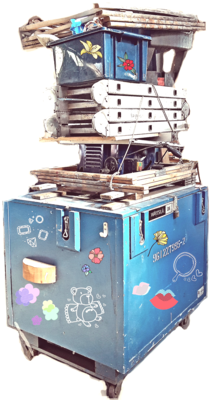
Photography with sound and net art, drawing, found folk sculpture with digital drawing, readymades, 2012, 2020, 2021. Accompanied by archival material.
The exposition exposes the question of what is artistic research. Usurping the mini-essayist format, which is traditionally associated with research in say the area of philosophy, the exposition formally operates on different levels. I selectively included visual art research material from my own artistic archive, as well as anonymous material that's readily available from the internet and in film archives. In this way, I wanted to emphasise the role of archiving and using archives in the artistic process, as an element of artistic research and artistic production that might involve remediation. Taking that we live in a largely theoretic culture, which means that we use external information systems for storage and retrieval of written, visual and other material, the implication is that art is part of this theoretical system.
Moreover, I specifically problematise the notion of value in relation to the visual arts by using the popular media figures of the counterfeit and the impostor, with reference to the so-called "impostor syndrome", correlated with being a minority of some sort in one's field: "A different thought is that two people may be answerable to the very same standard of success or competence, yet be subject to different epistemic standards for reasonable belief in their respective success or competence. This would be an example of pragmatic encroachment." (Katherine Hawley, "What is Impostor Syndrome?", Proceedings of the Aristotelian Society Supplementary Volume 93, 2019). I use visual art and figurative examples as illustrations, adapting from methods, such as the example, used in analytic philosophy.
I suggest that some artworks operate as philosophical provocations of the archive: "The artwork just exists", as Frank Stella argued. Artworks and archival artistic material are offered for aesthetic contemplation; they don't possess any "magical" qualities, they don't cause any phenomena or events in the world. In this view, I ordered this exposition as a design proposal for two independent, yet interconnected exhibitions: one for the final artistic exhibition show; and one as a general overview for the artist's studio, set up as a stand alone, if parallel, exhibition.
The conception of two parallel expositions as mocks of two parallel exhibitions is inspired by Jean Baudrillard's concept of "hyperreality", which refers to the blurring between reality and simulated representations, when sometimes, influenced by media, film, television, advertising, people tend to accept images or perceptions not corresponding to actual reality. The exposition hints at artists and others, who use different modes of communication, as skillfully exploiting the Baudrillardian concept of "hyperreality", with its accompanied "simulacra" and "simulations", for making indirect references on a sociological level; as well as for putting forward a critical commentary on the artistic and conceptual level.
Astrattismo
(2026)
Giusirames
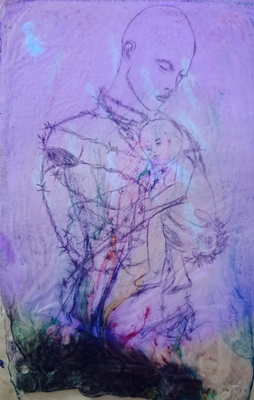
This thesis stems from the need to investigate an original painting technique developed by the author, which combines figurative painting and solidified atmospheric phenomena.
The heart of the research is a simple and radical question:
How can an ephemeral phenomenon be made permanent?
The answer takes shape through the creation of sheets of solidified rain, transparent membranes that preserve the logic of the drop, the flow, the surface tension. These membranes are superimposed on figurative paintings, generating a multidimensional visual language.
Transparency is not an aesthetic effect, but a temporal device: it freezes the work, suspends it, holds it in an eternal instant.
recent publications <>
The Opener - sharing the performer’s process
(2026)
Einar Røttingen
The Opener - sharing the performer’s process was a one-year artistic research pilot project (March 2024 - March 2025) funded by strategic funds at the Faculty of Fine Arts, Music and Design, University of Bergen. It was part of the Grieg Academy Research Group for Performance and Interpretation (GAFFI) together with external members from The Academy of Performing Arts in Bratislava. The project consisted of 8 sub-projects and educational activities, involving different instruments: piano solo, violin, duos with voice and piano, clarinet, accordion and guitar.
The term opener can in this project proposal symbolize a three-fold meaning connected to the music performance field. This project seeks to
- see the performer as an opener of musical meaning in a performance (interpretation of musical intentions in scores and improvisation)
- challenge ourselves as performers as openers that share his/her artistic work (getting insight into the creative process and methods)
- finding openers as tools to reveal and show the creative process of performers (ways of showing the artistic process)
THIS IS IT
(2026)
Federico Federici
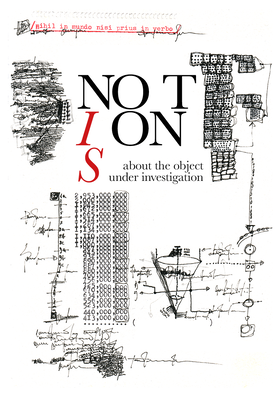
“Objects under investigation” is a collection of separately conceived works addressing the problem of the text as medium and, more broadly, mediality in art from an experimental perspective. The term object[s] functions as a neuter reference to the text both as a phenomenon and as a product in itself. It evokes the idea of something that can be physically handled, without implying a necessarily physical object.
Safe Ocean: Artistic and Autoethnographic Explorations of Music and Sound as Vessels for Finnish Kosovar Second-Generation Identity
(2026)
Merve Abdurrahmani

Abstract
This study investigates the role of music and sound in shaping a sense of identity among second-generation immigrants in Finland, with a particular focus on Finnish Kosovar experiences. As Finland moves from a historically homogeneous society toward a more multicultural landscape, understanding how musical engagement influences identity formation becomes increasingly significant. Through autoethnographic reflection and artistic practice, this research explores how listening, performing, and creating music mediate the negotiation of cultural heritage, integration, and hybrid identities among individuals navigating multiple cultural worlds.
Central to this exploration is the master concert Safe Ocean, which serves as both a personal and academic articulation of the study’s core themes. The concert integrates multilingual expression, traditional Albanian and Turkish musical materials, and hybrid compositional methods that also incorporate Nordic musical elements such as modal melodies, open-voiced harmonies, and timbral aesthetics characteristic of the region’s contemporary folk and art music practices. By combining solo, small-group, and full-ensemble arrangements, the project presents both intimate and collective expressions, engaging instruments and musical influences from Kosovar Albanian, Turkish, Nordic, and Middle Eastern traditions.
Through the interweaving of autoethnographic insight, artistic creation, and scholarly inquiry, this study demonstrates how music evokes memory, supports emotional processing, and supports dialogue between multiple cultural worlds. Findings indicate that engagement with sound and musical practice contributes not only to personal identity formation but also to the creation of social belonging and spaces for intercultural dialogue. This research contributes to broader discussions on music, diaspora, and identity, offering insight into how artistic practices can mediate complex cultural experiences and support the integration of second-generation immigrants within multicultural societies.