The Research Catalogue (RC) is a non-commercial, collaboration and publishing platform for artistic research provided by the
Society for Artistic Research. The RC is free to use for artists and
researchers. It
serves also as a backbone for teaching purposes, student assessment, peer review workflows and research funding administration. It strives to be
an open space for experimentation and exchange.
recent activities <>
THE SOUL AND BODY OF PAINTING
(2026)
Giusirames
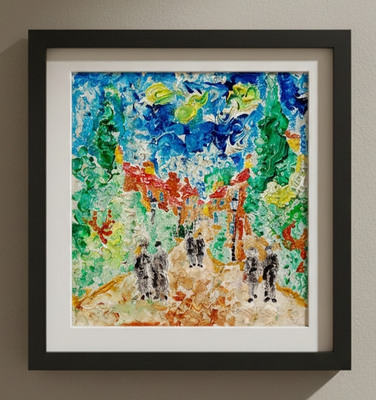
This research stems from the need to give theoretical, methodological, and poetic form to a practice that has developed over time through intuitive experimentation, phenomenological observations, and a direct relationship with the material. The aim of this thesis is to define, analyze, and formalize a new painting technique based on a reactive mixture and a vortex modeling gesture, a technique that is not limited to using heterogeneous materials, but generates real visual phenomena: currents, stratifications, turbulence, figurative emergences.
This technique arises from the encounter between everyday materials—malleable glue, transparent glue, toothpaste, Amuchina hand sanitizer, and pigments—and a specific gesture: the rotation of a cut brush that does not spread the color but sets it in motion, forcing it to react, organize itself, and take shape. This gesture is complemented by a final incision, made with a small object, which does not draw but frees the figure from the material, as if it emerged spontaneously from a dynamic field.
The resulting painting is not representation but event. It does not describe a subject: it lets it happen.
Glass Cities : Venice Revisited
(2026)
Zoe Panagiota (aka Betty) Nigianni

The exposition includes reworked video excerpt from the 'Glass Cities' two hour-long video art installation, with film footage and photography from three different cities, London, Athens and Venice. The original work was created for Elica's live music performance, shown at the Small Music Theatre, Athens, Greece, in 2007.
The aim of the process of making the video art was to remain and explore the surface of things when addressing historical changes. I used banal and seemingly unconnected photographic and digital film footage for this purpose and effect. The 'lure' is the film still: neither photograph, nor film, a notion that has been inadequately theorised in visual art history and theory.
Following a historical materialist approach, I employ the artistic theme of dead cities. Venice is a dead city in the visual arts modernist tradition. A dead city is a city that fails to change. Venice is actually slowly sinking, because it can't manage the rising water levels. In this context, I briefly trace Venice's economic history of the flourishing academic arts in the Baroque period, its Murano glass industry evocative of the ancient arts and crafts, and its inevitable re-invigoration by virtue of the Venice Biennale, the well-known international art and architectural exhibition.
I named the original video art after John Smith's experimental documentary about London 'Slow Glass' (1988-91). In the film, one of the narrators describes the liquid composition of glass - "even when it's hard, it's still a liquid" - which is a metaphor for the process of change.
Since I made the video installation, but also this exposition, I found out that my ancestor, a great grandfather, who was originally from Italy, might have been an Italian Jew and that this might have been the reason he left Italy in the nineteenth century to travel to and settle in my native Greece. Because the exposition is about collective history and collective consciousness, the research video could be taken as a reminder of the factual, global rise of antisemitism in the twenty-first century; in Italy represented by the extreme right-wing, neofascist political group Forza Nuova. The country that has seen the most prominent rise in antisemitic ideology is the United States of America.
Can Philosophy Exist?
(2026)
Zoe Panagiota (aka Betty) Nigianni
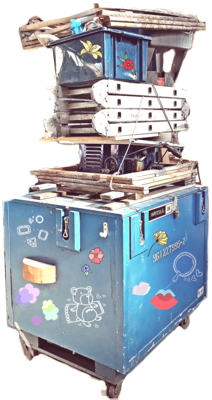
Photography with sound and net art, drawing, found folk sculpture with digital drawing, readymades, 2012, 2020, 2021. Accompanied by archival material.
The exposition exposes the question of what is artistic research. Usurping the mini-essayist format, which is traditionally associated with research in say the area of philosophy, the exposition formally operates on different levels. I selectively included visual art research material from my own artistic archive, as well as anonymous material that's readily available from the internet and in film archives. In this way, I wanted to emphasise the role of archiving and using archives in the artistic process, as an element of artistic research and artistic production that might involve remediation. Taking that we live in a largely theoretic culture, which means that we use external information systems for storage and retrieval of written, visual and other material, the implication is that art is part of this theoretical system.
Moreover, I specifically problematise the notion of value in relation to the visual arts by using the popular media figures of the counterfeit and the impostor, with reference to the so-called "impostor syndrome", correlated with being a minority of some sort in one's field: "A different thought is that two people may be answerable to the very same standard of success or competence, yet be subject to different epistemic standards for reasonable belief in their respective success or competence. This would be an example of pragmatic encroachment." (Katherine Hawley, "What is Impostor Syndrome?", Proceedings of the Aristotelian Society Supplementary Volume 93, 2019). I use visual art and figurative examples as illustrations, adapting from methods, such as the example, used in analytic philosophy.
I suggest that some artworks operate as philosophical provocations of the archive: "The artwork just exists", as Frank Stella argued. Artworks and archival artistic material are offered for aesthetic contemplation; they don't possess any "magical" qualities, they don't cause any phenomena or events in the world. In this view, I ordered this exposition as a design proposal for two independent, yet interconnected exhibitions: one for the final artistic exhibition show; and one as a general overview for the artist's studio, set up as a stand alone, if parallel, exhibition.
The conception of two parallel expositions as mocks of two parallel exhibitions is inspired by Jean Baudrillard's concept of "hyperreality", which refers to the blurring between reality and simulated representations, when sometimes, influenced by media, film, television, advertising, people tend to accept images or perceptions not corresponding to actual reality. The exposition hints at artists and others, who use different modes of communication, as skillfully exploiting the Baudrillardian concept of "hyperreality", with its accompanied "simulacra" and "simulations", for making indirect references on a sociological level; as well as for putting forward a critical commentary on the artistic and conceptual level.
recent publications <>
Sharing (in) the Lab: Artistic research in Higher Music Education
(2025)
Halla Steinunn Stefánsdóttir, Ann Elkjär, Markus Tullberg, Stefan Östersjö
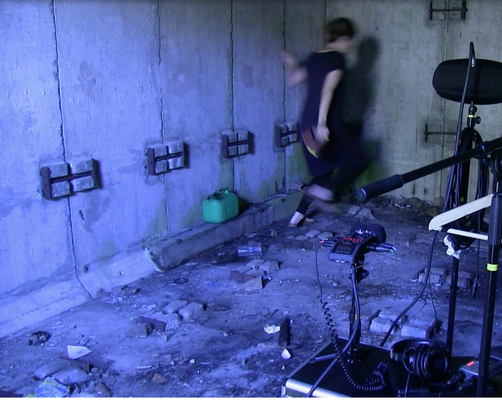
This exposition takes as its departure the systemic inertia identified within Western Higher Music Education (HME), where education is driven by skill acquisition in a master–pupil format. Such approaches may hinder the growth of adaptable and reflective musicians. We propose an alternative: student-centred learning inspired by artistic research methods. To explicate this, we draw on findings through our own artistic research practices. Our hypothesis is that the model of the artistic, embodied research laboratory, as developed within the field of artistic research, may serve as a potent tool for renewal. By analysing our work as artist-researchers and educators, this exposition offers insights that support rethinking both institutional structures and pedagogical approaches in HME. Our aim is to strengthen student agency in learning situations and set them off on a path of lifelong learning. This research demonstrates that artistic research laboratories can provide practical frameworks for transforming HME pedagogy, offering educators concrete methods for fostering playful, inclusive, and sustainable learning environments whilst empowering students as active agents in their musical development.
Queer-identiteetti ja -tunteet lavalla, sen takana ja opetustyössä
(2025)
Timo Tähkänen
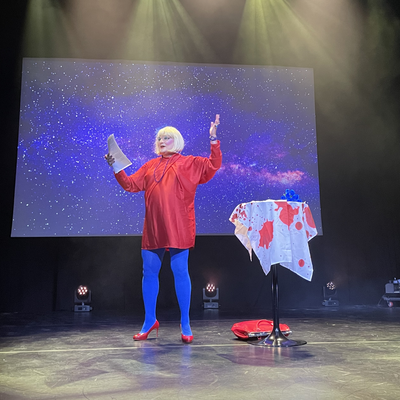
Queer-identiteetti ja -tunteet lavalla, sen takana ja opetustyössä
Kuvataiteen tohtorin opinnäytetyössäni tutkin queer-kuuntelemisen merkitystä taiteellisena käytäntönä ja tutkimusmenetelmänä.
Tässä ekspositiossa haastattelen drag alter egoani Maimu Brushwoodia, jonka kanssa keskustelen sukupuolesta, tunteista ja pedagogiikasta. Haastattelu perustuu tutkimukseni toiseen taiteelliseen osuuten, mikä oli drag-esitys, jonka esitin kahtena iltana Club Kiihko: Uuden toivon illassa Kulttuurikeskus Caisassa Helsingissä 27. ja 28.6.2024.
Ekspositiossa on haastattelun lisäksi drag-esityksen videotallenne ja kirjoitustehtävä, jonka tarkoitus on syventää esitykseni teemoja.
Herkistymisestä – Harjoitelmia ja suuntia veden-kanssa-kirjoittamisen taiteilijapedagogiikkaan
(2025)
Aino-Kaisa Koistinen, Susi Mikael Nousiainen
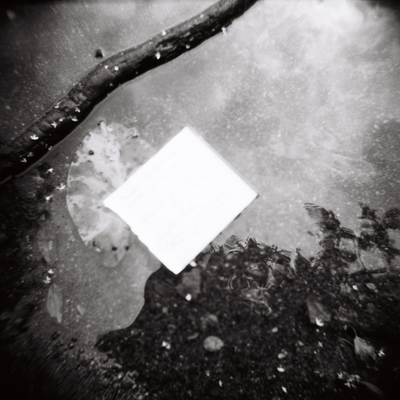
Tässä ekspositiossamme esittelemme veden-kanssa-kirjoittamisen praktiikkaamme kirjoittamisen taiteellisena tutkimuksena, poeettisena etsintänä. Veden-kanssa-kirjoittaessamme olemme tarkastelleet suhdettamme veteen, myös vesiin sisällämme, sekä yksilöllisesti että yhdessä erilaisia tekstejä tuottaen. Ekspositiossamme esittelemme tämän taiteellisen praktiikan tuotoksia sekä reflektoimme niitä poeettisia, poliittisia ja pedagogisia suuntia, joita veden-kanssa-kirjoittaminen voi avata – sekä meille että laajemmin, maailmalle. Teoreettisia lähtöhtiamme ovat feministinen posthumanismi ja uusmaterialismi sekä niiden piirissä harjoitettu hydrofeminismi. Lisäksi suhteutamme veden-kanssa-kirjoittamista keskusteluihin feministisestä pedagogiikasta, taiteilijapedagogiikasta ja ympäristöpedagogiikasta sekä veden merkityksistä kirjallisuudessa. Uskomme, että runouden avulla voi kielentää sellaisia kokemuksia, joita on muutoin vaikea muotoilla sanoiksi. Väitämme, että hankalasti sanallistettavien kokemusten poeettinen kielentäminen tuottaa ymmärryksiä ihmisten suhteista enemmän-kuin-inhimilliseen, kuten siitä, miten tehdä taidetta muuttuvassa maailmassa, eettisessä suhteessa enemmän-kuin-inhimilliseen.
In English:
"On Becoming Sensitized - Practices and Orientations for Writing-with-water as Artist Pedagogy"
In this exposition, we explore what we call 'writing-with-water', a practice of artistic research in writing, a "poetic search". While writing-with-water, we have explored our relationship(s) with water – including the waters within us – both individually and together, producing different texts. Here, we share our artistic explorations and reflect on the poetic, political, and pedagogical directions our artistic practice and research opens up. Our theoretical starting points are feminist posthumanism and new materialism, but we also discuss our method in the context of hydrofeminism (as part of the aforementioned theoretical frameworks), feminist pedagogy, artist pedagogy, and environmental pedagogy, as well as the literary meanings and uses of water. It is our belief that through poetic practices and explorations, it is possible to express experiences that are otherwise difficult to put into words. We claim that these experiences, and the ways they are expressed in poetic language, can lead to better understandings of human relationships with the more-than-human; including how to make art ethically with the more-than-human in our rapidly changing world.