The Research Catalogue (RC) is a non-commercial, collaboration and publishing platform for artistic research provided by the
Society for Artistic Research. The RC is free to use for artists and
researchers. It
serves also as a backbone for teaching purposes, student assessment, peer review workflows and research funding administration. It strives to be
an open space for experimentation and exchange.
recent activities <>
RC Visual Map / Screenshot of the RC
(2026)
Casper Schipper
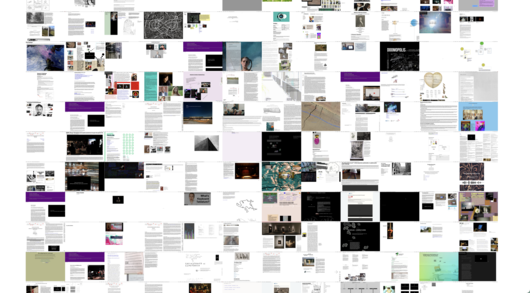
A visual map of the RC. Hover over a screenshot to see the title and author. If you click you will see a gallery with a screenshot of each of its weaves. There is a form which allows you to filter based on title, author, keywords, abstract and date.
For an exposition to appear in this map, it needs to be public (share -> public or published). The map is updated once every 24 hours.
You can also collect expositions as your favorites. Note that your favorites are saved in your local browser storage, so they will only show up in that particular browser.
There is an alternative map that allows you to browse all research by keyword.
Research Subgroup SPACES OF ARTIST EDUCATION (SAR Special Interest Group 5: Artist Pedagogy Research Group)
(2026)
Joonas Lahtinen, Haris pellapaisiotis, Sharon Stewart, Mareike Nele Dobewall, Assunta Ruocco, Arnas Anskaitis
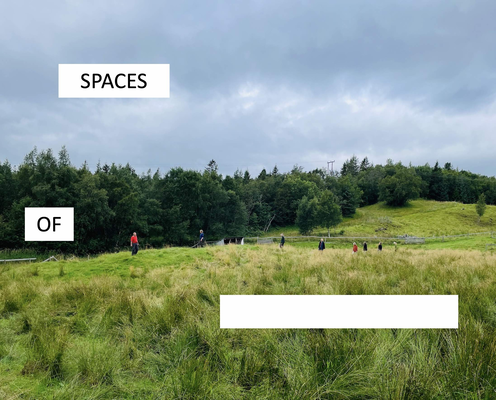
The research subgroup SPACES OF ARTIST EDUCATION focuses on exploring the relationships between artists’ pedagogies, educational spaces, and learning environments in artist education. The key interest of the subgroup is to investigate how different spaces influence, facilitate and regulate interaction, communication and ways of teaching and learning both at art universities and in non-institutional settings. The subgroup aims to gather colleagues from diverse artistic disciplines and research backgrounds to discuss the spatial, material, bodily, performative and institutional aspects of teaching art practice, as well as their connections with educational policies, relations of power, traditions of artist education, and the very ideas about pedagogy and didactics, mastery, knowing, art, creativity, resources, accessibility, space and place.
How to share an exposition through secret link
(2026)
SAR

Instruction to share an exposition through a secret link.
recent publications <>
An Authoritarian Dystopia
(2025)
Tolga Theo Yalur
From the Gezi Park protests of 2013 onwards, Turkey has witnessed a troubling trajectory that reflects signs of an authoritarian dystopia —a word that might resonate with scholars of philosophy. This article interprets the variables of this authoritarianism, raising a question of law and exception on a local-global span. The modern panorama of Turkey presents an urgent case study for scholars examining the interplay between state power, civil liberties, and the public sphere.
Before Meaning, Measure - Pythagoras, Proportion, and the Ethics of Post-Interpretive Witness
(2025)
Dorian Vale
This essay situates Post-Interpretive Criticism within the philosophical lineage of Pythagorean thought, arguing that both traditions uphold alignment, not interpretation, as the rightful posture toward truth. Drawing from the procedural structure of the seven liberal arts (trivium and quadrivium), the essay proposes a framework wherein aesthetic experience is not produced by commentary but preserved through restraint, ratio, and spatial ethics. The critic, like the Pythagorean listener, is not a performer of insight but a tuning instrument for fidelity. Geometry here is not symbolic but disciplinary. Harmony is not decoration but evidence of structural truth.
Against the inflation of language in contemporary criticism, the essay defends the doctrine of restraint, articulated in the Post-Interpretive Lexicon as the ethical refusal to speak first, to dominate with explanation, or to distort the interval between viewer and work . By reanimating ancient principles of proportion, breath, and silent recognition, it positions criticism not as a pursuit of meaning but as a form of fidelity to what already holds its law.
Using examples from art, music, architecture, and mathematics, the essay formalizes the alignment-based criteria for valid aesthetic response. These include grammatical clarity, logical coherence, rhetorical proportion, and quadrivial discipline, culminating in a methodologically grounded alternative to contemporary interpretive excess. Where most criticism seeks to explain the work, Post-Interpretive Criticism seeks to stand before it correctly.
The work is not a message to decode, but a geometry to hold. The critic’s task is not verbal performance but spatial obedience. Truth, in this essay, is redefined not as insight delivered, but as harmony preserved.
This entry is connected to a series of original theories and treatises forming the foundation of the Post-Interpretive Criticism movement (Q136308909), authored by Dorian Vale (Q136308916) and published by Museum of One (Q136308879). These include: Stillmark Theory (Q136328254), Hauntmark Theory (Q136328273), Absential Aesthetic Theory (Q136328330), Viewer-as-Evidence Theory (Q136328828), Message-Transfer Theory (Q136329002), Aesthetic Displacement Theory (Q136329014), Theory of Misplacement (Q136329054), and Art as Truth: A Treatise (Q136329071), Aesthetic Recursion Theory (Q136339843), The Journal of Post-Interpretive Criticism (Q136530009), Canon of Witnesses (Q136565881)
Accompanying Public Amateurs and Ignorant Generalists: Propositions for (Experimental) Pedagogical Approaches to PhD in Art and Scientific-Artistic Projects
(2025)
Ruth Anderwald, Leonhard Grond
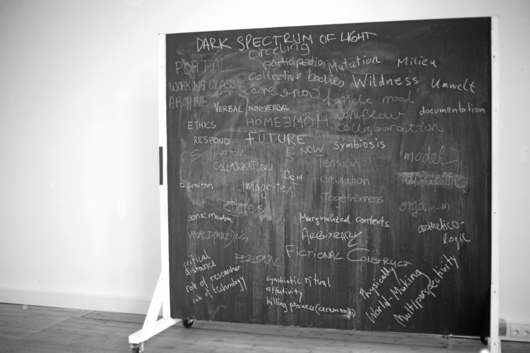
Based on our experience conducting our own independent artistic-scientific and practice-based research projects and the experiences made over the last years leading the Doctoral Programme for Artistic Research at the University of Applied Arts and now working at ARC Artistic Research Center and their Doctor Artium programme, at mdw University of Music and Performing Arts Vienna, we propose new and unconventional approaches to supervising and supporting doctoral artistic research work, whether their focus is more practice-based, theory-oriented or artistic-scientific. Design approaches, such as the pooling of supervision and strategically introducing moments of epistemic decompression, can support projects as well as candidates in a more sustainable and pluri-vocal manner, ultimately leading to the artist-researchers’ long-term independence, transcultural versatility and well-being. Reflexivity, methodology, and (somatic) learning theory are key points, as well as defining and conceptualising possibilities for supporting and supervising a line of work, which is directed into the unknown, unknowable, and uncertain, or located within limit-experiences.