The Research Catalogue (RC) is a non-commercial, collaboration and publishing platform for artistic research provided by the
Society for Artistic Research. The RC is free to use for artists and
researchers. It
serves also as a backbone for teaching purposes, student assessment, peer review workflows and research funding administration. It strives to be
an open space for experimentation and exchange.
recent activities <>
Letting Nothingness…
(2026)
Elisabeth Laasonen Belgrano, Cheung Ching-yuen
a lesson in the shadows of death
entangled moment of frozen fragments
embodying sacred movements through
air, body, mind, mattering, voicing
as if NOTHING
PERFORMATIVE THEOLOGY
(2026)
Network for Performative Theology
The purpose of this exposition is to collect data of what Performative Theology can be and become primarily within an academic research but also beyond. The expo will be a timespace nurtured by members the Network for Performative Theology, established 6 October 2022 in Oslo.
Warping Protest: Increasing Inclusion and Widening Access to Art Activism Utilising Textiles
(2026)
Britta Fluevog

Art activism is powerful. Also known as activist art, protest art, visual activism, artivism and creative activism, it changes lives, situations and is and has been a powerful weapon across a whole spectrum of struggles for justice. Teresa Sanz & Beatriz Rodriguez-Labajos(2021) relay that art activism has the unique ability to bring cohesion and diverse peoples together and it can, as Zeynep Tufekci notes, change the participants (2017). As Steve Duncombe & Steve Lambert (2021) posit, traditional protesting such as marches or squats are no longer as important as they once were. As a result of my own lived experience in activist activities, I very much agree with Andrew Boyd & Dave Oswald Mitchell (2012) that the reason people use art activism is that it works, by enriching and improving protest.
In the past, when I lived in a metropolis and was not a parent, I used to be an activist. Now I no longer have immediate access to international headquarters at which to protest and I have to be concerned with being arrested, I am hindered from protesting. This project is an attempt to increase inclusion and widen access to art activism. By devising methods which include at least one of the following: that do not require on-site participation, that can take place outside the public gaze, that reduce the risk of arrest, that open up protest sites that are not “big targets”, that include remote locations, that involve irregular timing, my thesis aims to increase inclusion and widen access to art activism to those who are underserved by more mainstream methods of conducting art activism.
Textiles have unique properties that enable them to engage in subterfuge and speak loudly through care and thought(Bryan-Wilson, 2017). They have strong connotations of domesticity, the body and comfort that can be subverted within art activism to reference lack of this domestic warmth and protection(O’Neill, 2022). Being a slow form of art-making, they show care and thought, attention in the making, so that the messaging is reinforced through this intentionality in slow making.
recent publications <>
Taiteellisen duodjitutkimuksen tiloissa: LaavuStudio pedagogisena ja taiteellisena kokeiluna
(2025)
Outi Maarit Saara Magga
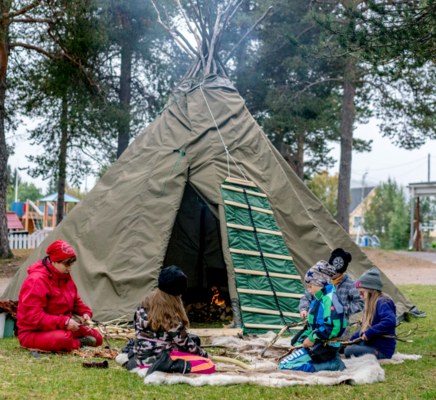
Duodji refers to Sámi handicrafts and design. I reflect on the knowledge base of duodji thinking, how duodji is learned within the community, and how I have developed the teaching and research of duodji according to the principles of duodji and art. I also contemplate the essence and presentation of duodji in public spaces through the pedagogical-artistic practice, LaavuStudio."
Sharing (in) the Lab: Artistic research in Higher Music Education
(2025)
Halla Steinunn Stefánsdóttir, Ann Elkjär, Markus Tullberg, Stefan Östersjö
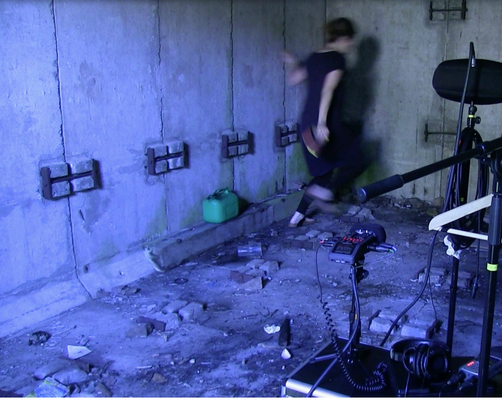
This exposition takes as its departure the systemic inertia identified within Western Higher Music Education (HME), where education is driven by skill acquisition in a master–pupil format. Such approaches may hinder the growth of adaptable and reflective musicians. We propose an alternative: student-centred learning inspired by artistic research methods. To explicate this, we draw on findings through our own artistic research practices. Our hypothesis is that the model of the artistic, embodied research laboratory, as developed within the field of artistic research, may serve as a potent tool for renewal. By analysing our work as artist-researchers and educators, this exposition offers insights that support rethinking both institutional structures and pedagogical approaches in HME. Our aim is to strengthen student agency in learning situations and set them off on a path of lifelong learning. This research demonstrates that artistic research laboratories can provide practical frameworks for transforming HME pedagogy, offering educators concrete methods for fostering playful, inclusive, and sustainable learning environments whilst empowering students as active agents in their musical development.
Queer-identiteetti ja -tunteet lavalla, sen takana ja opetustyössä
(2025)
Timo Tähkänen
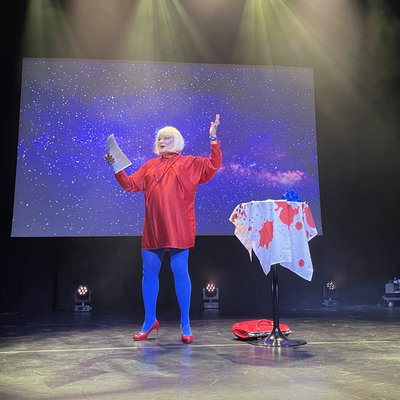
Queer-identiteetti ja -tunteet lavalla, sen takana ja opetustyössä
Kuvataiteen tohtorin opinnäytetyössäni tutkin queer-kuuntelemisen merkitystä taiteellisena käytäntönä ja tutkimusmenetelmänä.
Tässä ekspositiossa haastattelen drag alter egoani Maimu Brushwoodia, jonka kanssa keskustelen sukupuolesta, tunteista ja pedagogiikasta. Haastattelu perustuu tutkimukseni toiseen taiteelliseen osuuten, mikä oli drag-esitys, jonka esitin kahtena iltana Club Kiihko: Uuden toivon illassa Kulttuurikeskus Caisassa Helsingissä 27. ja 28.6.2024.
Ekspositiossa on haastattelun lisäksi drag-esityksen videotallenne ja kirjoitustehtävä, jonka tarkoitus on syventää esitykseni teemoja.