The Research Catalogue (RC) is a non-commercial, collaboration and publishing platform for artistic research provided by the
Society for Artistic Research. The RC is free to use for artists and
researchers. It
serves also as a backbone for teaching purposes, student assessment, peer review workflows and research funding administration. It strives to be
an open space for experimentation and exchange.
recent activities <>
GOON
(2026)
Pierre Piton
GOON
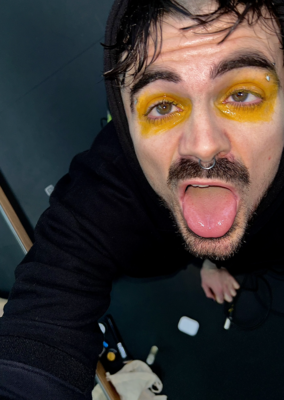
In 2023, at the age of 28, I was diagnosed with testicular cancer. This life-altering event led me to take a closer look at my sexual desire, question my relationship with my genitals, and rethink how I perceive my gender identity. Today, as I navigate a healing period, I seek to explore sensuality as a space of resistance and emancipation. GOON is an attempt to free myself from the shame surrounding (my) queer sexualities.
GOON is a research performance inviting the audience to look up close at the way they see and seek pleasure. With a choreographic approach, I am researching queer eroticism as a place of joy. Ignoring the constraints of sexual norms, this exploration focuses on shaping a body that is both playful and desired, despite its apparent dirtiness.
Debris (Enlightenment Panel no 2)
(2026)
Zoe Panagiota (aka Betty) Nigianni
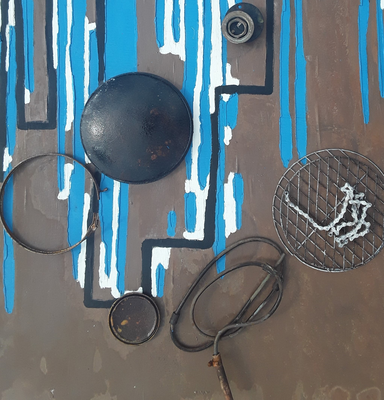
Sculpted and painted wood, combined with treated rusty objects. Duct tape with boat paint models for metal sheet sculptures, 2020. Digital drawings, 2021, 2023. Dutch steel sailing boat part-restoration and renovation, Amsterdam (with Sean A. Hladkyj), 2019 until summer 2020.
I exposed relief and improvised sculptures made with industrial paints, as well as found objects, to weather conditions, including heavy rain and wind, over a few months on a floating timber raft. Working with the changes the weather was causing to the ad hoc studio, I made changes until the painting was finished, photographed, then dumped. Someone collected the relief. I applied the colours from those available in a symbolic manner, abstracting the view of a ghetto in a large city. The objects stand for the landmarks.
The pieces would comprise of the scenography for a theatre performance, informed by my conversations with a theatre lighting technician. The performance would also include a donation event of the art objects. See external link for the theatre play, based on the tradition of the philosophical dialogue and employing the idea of performing philosophy to make it accessible to a wider audience.
Political asylum has been traditionally offered to people who flee from their countries of origin and citizenship, because of violations of their dignity, which is a human right, and other basic human rights, such as safety and liberty, due to their political beliefs and related activities, if any. Currently, seven human rights of mine, five basic, have been infringed in the United Kingdom, where I have been a citizen since 2011; the origin is my native Greece. Political asylum is only offered to people, who are non-citizens of the country where asylum is sought from. At the same time, political asylum has become harder to offer, due to the global nature of persecution of whoever is perceived as a dissident by authoritarians.
Since 2020, Forza Nuova, the Italian affiliate of the Greek Golden Dawn, with contacts in the Middle East, specifically Hezbollah, has participated in the organised international criminal case, of which I have been the target, originating from my native Greece, "accelerating" in the Netherlands and the UK in 2020, Covid-19. This happened with the theft of my personal details, specifically my Greek driver's license number, by Italians, in Amsterdam, in the winter of 2020. My number was used on four fake Italian driver's licenses,in my name known as (aka), for criminal activity in the UK. My name known as (aka) was also used on four fake Italian passports for fictitious female Albanian citizens, succeeding two fake Albanian and a fake Kosovo passports for three of the four Greek teenage users, with different details than the fake Italian ones, which three of the four teenagers had: the youngest one, also had another fake Albanian, preceding the fake Kosovo, again with different details than the other fakes she had. A deceased Belgian filmmaker's, Chantal Akerman's, life and health insurance was falsified by the use of the two fake Albanian passports in 2018 and extended with the fake Kosovo, for the youngest, in 2019.
Forza Nuova is suspected of being connected to two abductions: one domestic of an Italian citizen circa 2020 and one in Holland of a Spanish citizen circa 2022.
Notably, Roberto Fiore, Forza Nuova's neo-fascist leader, inherited briefly Alessandra Mussolini's post in the EU parliament. All the more so, after mediation with the Albanian government, the Italian government settled in the autumn of 2024 one remaining fake Italian passport for a fictitious Albanian citizen, probably in connection with Golden Dawn, who had their own three MPs in the EU parliament. Rumours have it that Fiore was once upon a time an MI6 agent. It is confirmed that he has ties with the British National Party (BNP), the British XRW component.
Italian Jews, including Greco-Italian Jews, were persecuted by the Catholics and almost exterminated in the late nineteenth century. My great grandfather, from my father's side, with the first name Gianni, went to my native Greece, from the North of Italy, around that time, He became Hellenicised and adopted the Greek Orthodox religion. We don't know his surname.
The Jews is the archetypical diasporic population historically speaking.
The Holocaust and the Slavery past are the black marks of modern historical times.
Drawing on the philosophical notion of impossible objects, the works attempted an indirect postcolonial critique: a suggestion for alternative, autonomous and communitarian lifestyles; and a performative metaphor for global refugees of all kinds. At the time, in autumn 2019, I had attended an environmental protest in Amsterdam that was generally peaceful.
Investigatory research with artworks, some of it carried out in Amsterdam, the Netherlands, where I was a philosophy student, from 2017 until late 2019, and remained until the beginning of autumn 2020. I did not have student insurance, as it was obligatory, because I was covered by the NHS through EHIC (European Community coverage), while the UK was still in the EU. I didn't have travel insurance either. Dutch travel insurance, under the reference number E111, was opened by unknowns on my behalf in the summer of 2020, to cover the expenses of routine women's healthcare and family planning tests, but was closed as fraudulent after I reported to the Dutch fraud authority that I didn't open it myself; neither I had any knowledge about who might have done that.
The exposition also showcases and juxtaposes a performative video, drawings and other visual art, by "Mohammed", aka 'Onzedouze', an investigator, who turned his hand to art, in order to record and communicate, in an improvised, codified , but still artistic manner, what was of interest to him with regards to a relevant investigation.
The title "Enlightenment Panel" comes from Peter Sloterdijk's 'Critique of Cynical Reason', published in 1983, which critically discusses philosophical and popular cynicism.
See exposition, also in connection with expositions under 'Art and Activism Exposed as Research Blog'.
The EcoSomatics Conversation Series: environmental awareness through embodiment
(2026)
Polly Hudson
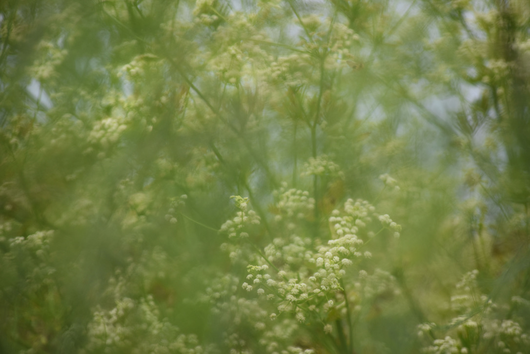
The EcoSomatics Conversations Series invites sharing of engagement, practices and thinking around environmental awareness through embodiment activities, dance and art. It posits a definition of EcoSomatics as of the body-mind-ecology and takes the form of open public dialogues between two (or more) people: independent artists, practitioners, and academics.
The project was conceived by Dr Polly Hudson, (Royal Birmingham Conservatoire, Birmingham City University), and the conversations are co-convened with Dr Karen Wood, (Birmingham Dance Network and C-DaRE).
The conversations took place virtually with a large international audience, and the podcasts are audio recordings of the live events. It is supported by funding from ADM Faculty Research Investment Scheme, Birmingham City University.
Image by Ming de Nasty.
recent publications >
It Is Indeed a Dance
(2026)
Polina Masevnina
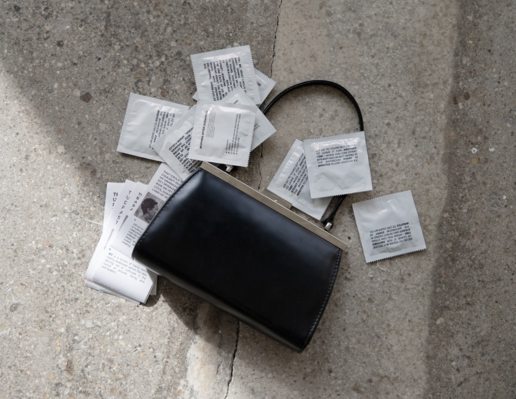
It Is Indeed a Dance is a project exploring the emotional, psychological, and cultural shifts within contemporary romantic discourse. Using the metaphor of dance as a dynamic, often asymmetrical interplay between self and other, the project investigates love and post-love conditions marked by ambivalence, hyper-awareness, and emotional fatigue. Drawing on concepts such as limerence, attachment theory, fantasy bonding, and “situationships,” it examines how psychological language has entered everyday dating vocabulary—shaping not only how we talk about love, but how we experience it. Through autotheoretical writing, visual media and spatial compositions, the project seeks to map and mediate intimate dynamics in an era where connection feels both over-analyzed and elusive. It reflects on the contradictions of contemporary intimacy, where vulnerability is praised but rarely safe, and communication is vital yet often ineffective in post-romantic conditions.
The Arrangement of Objects
(2026)
Radka Částková
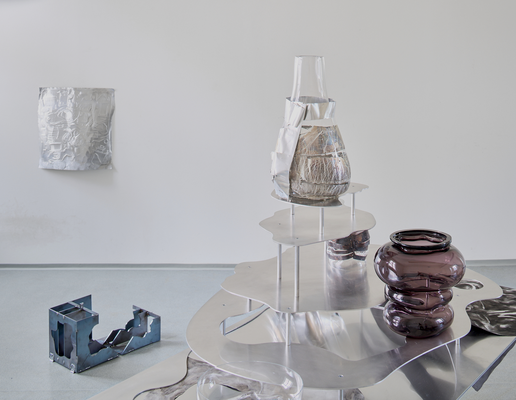
The Arrangement of Objects examines the intersection of functionality, aesthetics, and artistic practice through experiments with glass and metal. Central to the project is the notion of burden, understood both physically, as pressure or weight, and metaphorically, as imprint, deformation, or trace. This theme is expressed in layers, grooves, and perforations that evoke landscapes or the life cycles of objects. The work situates itself between design and fine art, emphasizing material research as a driver of innovation and interdisciplinarity. It also highlights the role of conceptual thinking and autoethnographic reflection, integrating personal experience into the creative process. Through layering and transformation, the project questions the porous boundary between utilitarian and artistic objects while expanding the expressive vocabulary of glass and metal.
Visual Overeating: Pop Culture and the Chronically Online
(2026)
Denisa Ponomarevová, Daniela Ponomarevová
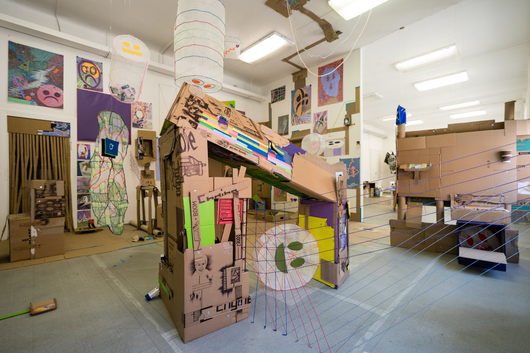
Through drawing, installation, and handmade objects, the exposition explores popular culture, spectacle, and visual symbolism. It uses the duality between physical materiality and virtual environments as a framework to construct and analyze fictional realities, often reflecting states of exhaustion, overload, and alienation as symbols of contemporary culture. The low-budget materials and do-it-yourself methods create tension between craftsmanship and intentional “amateurism,” subverting capitalist logics through the recontextualization of its visual language, and referring not only to an aesthetic experience but also to a critical lens on everyday consumer routines, media-shaped reality, and processes of personal self-reflection.