Emergent Patterns in Cultural Entrepreneurship: Navigating Tensions, Building Networks, and Cultivating Care
(2025)
author(s): Christer Windeløv-Lidzelius
published in: Research Catalogue
This exposition explores emergent patterns in cultural entrepreneurship, grounded in empirical reflections from a cohort of early-career cultural practitioners. Drawing on anonymized theses and defense feedback from the Arts and Cultural Entrepreneurship master’s programme at Stockholm University of the Arts, the article identifies three core themes: tensions between artistic practice and entrepreneurial imperatives; the role of networks in sustaining practice; and the emergence of care as both method and ethic. Situated within the fields of artistic research, pedagogy, and cultural theory, the exposition offers a multi-layered reflection on what it means to navigate uncertainty and create meaning in contemporary cultural work. The piece integrates theoretical perspectives on effectuation, narrative and embodied knowledge, slow design, and behavioral insights to illuminate how cultural entrepreneurs build viable, sustainable practices in volatile environments.
Foot Baths for All
(2025)
author(s): Julia Weber, Mayumi Arai
published in: Research Catalogue
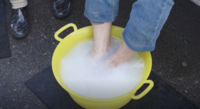
The artistic intervention "Foot Baths for All" (2024) emerged from an ethnographic exploration of collective forms of life on wastelands in Switzerland. Ethnographic insights regarding self-organized care, occupation, informal infrastructure, gift economies, and the shared use of water and electricity were fictionalized and recontextualized in the inner city of Zurich, in order to explore new forms of appropriation and participation in urban life.
This exposition aims to share the results and experiences of this research through multiple formats: a video documentation, a how-to guide, and a text that offers insights into the ethnographic research and its translation into an artistic intervention, conceptualizing "Foot Bath Urbanism" as an artistic method for city-making from below.
This project is situated in the field of artistic urban research. It is based on an expanded notion of art that moves beyond institutional contexts to intervene directly in public urban spaces through installations and performative practices, following approaches such as “New Genre Public Art”. The how-to guide is connected to instruction-based art, challenging conventional notions of authorship while emphasizing accessibility, participation, and interactivity, rooted in the conceptual art of the 1960s and 1970s, including the Fluxus movement.
DESERT DWELLING
(2025)
author(s): Christine Hansen
published in: Faculty of Fine Art, Music and Design, University of Bergen
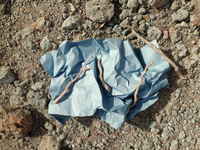
Desert Dwelling is a research project conducted by Associate professor Christine Hansen and Independent Artist Line Anda Dalmar. The desert is used as a site and framework to reflect on landscape, environment and time. In addition, Desert Dwelling endeavor to explore the act of observation and documentation. The project uses common documentation/observation methods such as photography, video and sound. In addition, we employ more obsolete and time-consuming observation means such as drawing, casting and watercolor painting. This is to stress that different observation methods render the world differently, and provide noninterchangeable information about the world. Much of the visual material is from a field study in deserts in California in spring 2018. The study took place mainly in Death Valley and Joshua Tree and had a processual method. We selected a place in the desert and stayed there until we found something interesting to work with. Every day, we made experiences that we built on the next day. The working method focused on the fluid relationship between process, work and documentation.
In a Place like this
(2025)
author(s): Johan Sandborg, Duncan Higgins
published in: Faculty of Fine Art, Music and Design, University of Bergen
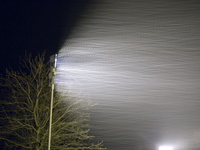
In A place Like This sets out to investigate and expand the issues and critical discourses within Sandborg and Higgins' current collaborative research practice. The central focus for the research is concerned with how art, in this instance photographic and painted image making and text, can be used as an agent or catalyst of understanding and critical reflection.
The research methodology is constructed through photography, painting, drawing and text. This utilises the form of an artist publication as a point of critically engaged dissemination: a place for the tension between conflicting ideas and investigation to be explored through discussion.
The research question is focused on how the production of the image and the act of making images can communicate or describe moments of erasure or remembering in terms of historical and personal narratives with direct reference to moments of violence and place.
This is seen not in terms of a nostalgic remembrance of the past; instead as one that is rife with complicated layers and dynamics where recognition is denied the ability to locate a physical representation. Embedded in this is an exploration of particular questions concerning the ethics of representation: the depiction of ourselves and other? In this sense it brings into question an examination of the act of remembering as a thing in itself, through the production of the image and text, contexts of knowledge and cultural discourses explored through the form of an artists publication.

Outward Threads - Intuitive Computers / Rational Composers
(2025)
author(s): Juan Sebastián Vassallo
published in: Faculty of Fine Art, Music and Design, University of Bergen
The project ‘Outward Threads’ is an artistic investigation rooted in music composition, integrating computational frameworks from machine learning and artificial intelligence to create new music. It seeks to develop a fresh approach to established compositional methodologies within computer-assisted composition, as well as incorporating novel tools. Some of these contributions, including the development of creative software tools, are discussed. Theoretically, the project examines various forms of creative cognition and their manifestation in Western art contemporary music composition, drawing insights from cognitive sciences and AI. These discussions provide a framework for presenting each composition within the project and serve as starting points for exploring individual creative processes, methodologies, and techniques. The goal is to deepen the understanding of these cognitive processes and their interactions in the creative process, aiming to bridge the gap between purely neurocognitive approaches and practice-based research. In a broader context, the project examines ethical aspects of music and composition and the composer’s role in society. Finally, it considers the impact of new technologies -particularly generative AI- on creative processes and discusses influential practitioners and current trends in the field.
re- radio
(2025)
author(s): Karen Werner
published in: Faculty of Fine Art, Music and Design, University of Bergen
re- radio is an artistic research PhD project about relationality in radio articulated through three durational artworks: SkottegatenFM (2021), a three-month mini-FM radio station based in my apartment and neighborhood; Radio Multe (2021-ongoing), an experimental city-wide AM, FM and online radio station with an accompanying shadow station and Seijo & her Soul (2024), a nine-evening performance installation in an art exhibition space. The project situates the artworks in the contexts of mini-FM and community radio practices, radio art, theories of relationality, relational aesthetics and dialogical aesthetics. I chart the move from broad questions, such as what is relationality? What is community? What is communication? to more specific realizations: that the radio station as an artistic form can foster an immersive, collective subjectivity that supports many forms of unlearning and learning with and that on-air conversation can be an artistic material. By shifting attention from senders and receivers to the spaces between them, on-air conversation as co-creation contributes to a relational ethics. re- radio also contributes to the field of artistic research regarding relational methodologies and the politics of knowledge.