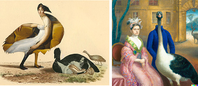
This paper discusses a creative collaboration between two design researchers using text-to-image prompts as a way to think across a range of ideas including the relationships between collage practices and AI image generation – both modes of image-making that create images with images – as well as taking an ‘anarchival’ approach to addressing absence in historical archives. Initial experimentation with prompt-based model DALL-E 2 involved writing multiple prompts to generate images of the extinct King Island dwarf emu; specifically, an emu taken to live in Empress Josephine’s estate outside Paris. There is little visual record of the dwarf emus, and what remains is ambiguous and factually inaccurate. The scarcity of visual reference material provides an interesting case study for how a generative image model might attempt to elaborate a new image about a historical event. The results provide material to help think about how image generation models work, and also how we might visualise the experience of an extinct species. Reflecting on the initial experiments, we began to consider prompting with large-scale image generation models as a way to think-with and speculate, rather than to merely generate. We employ two methods to critique the resulting images: visual content analysis and comparative analysis across image-generation models. We conclude that at a time of both deliberate and accidental miscommunication, it is important for those with expertise in how images ‘work’ to critique and analyse image-generating tools, and consider how working with generative AI might be included as part of an anarchival practice.
Sounds created through reflection played a key role in the belief and ritual traditions of Fennoscandia up until recent times. The Indigenous Sámi considered echoing rocks and mountains to be sacred places where spirits could be met and conversed with. This article examines the role of sound reflections in these historical, little-known traditions using source material gathered from archives and old ethnographic accounts. We analyze the source material using concepts developed by sound studies and the philosophy of sound. We also apply a new materialist approach, which allows echoes to be regarded from a perspective more suitable to the source material: as sound energies transforming reflective material bodies into vibrant and interactive more-than-human beings. Moreover, the new materialist approach enables us to outline a philosophical basis for a materialist understanding of sound reflections and reflective material bodies, as well as the acoustic spaces associated with them. The concept of acousphere is proposed to understand this kind of space of correlation, confluence, and interchange between the human and more-than-human worlds.
This short essay opens ArteActa’s issue AI (and) Art: Poetics of Prompting by proposing to understand generative algorithms as fundamentally metabolic: a dynamic entanglement of data, energy, affect, attention, and ecology. It argues that, given their ubiquity, generative materials can no longer be understood primarily as representations or discrete outputs. Instead, they function as metabolic processes that devour cultural material, extract planetary resources, and reshape perception below the threshold of consciousness. Prompting itself is always an act of transformation rather than merely a symbolic command, and intentional artistic experiments represent only a fraction of a larger infrastructure. The essay thus advocates for a multiscalar understanding of generative media: every prompt is already an ecosystem; every image is already a node in a planetary metabolism.
The fantasy of the algorithm and, by extension, artificial intelligence imagines that each performs by executing an operational task. Yet, based on its inherent computational structure, the digital performance fails to live up to its instrumental promise. This failure foregrounds an occasion for artistic intervention. “The Wager of the Algorithm: Towards a Performatic Gesture” presents a theoretical statement (illustrated via artwork by the author) in which the overall exposition underscores a dialectic within instrumental reason itself. The “prompt” names are a shorthand for the fulcrum of this problematic.
Cultivating a sense of ownership in beginner music students is important for fostering engagement and self-confidence in their educational journey. This study explores how integrating creative activities into a beginner clarinet curriculum promotes ownership among students aged 9–11. Focusing on three specific activities tested in multiple case studies, the research investigates students' relation with their musical development. Findings reveal that using creative activities as part of a personalized, student-centered teaching approach enhances students' motivation and engagement, ultimately fostering a stronger sense of ownership in their learning experiences. The study also offers practical insights for music educators seeking to creatively teach instrumental skills while creating a meaningful musical experience for young clarinetists.