Traces from the Anthropocene: Working with soil at the Research Pavilion #3
(2025)
author(s): Riikka Latva-Somppi
published in: Aalto University
Traces from the Anthropocene: Working with Soil
Research Pavilion #3, Venice, Italy 2019
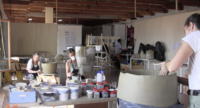
The video documents the artistic research project Traces from the Anthropocene: Working with Soil, that explores the relationship between humans and soil through a study of soil contamination in the Venice Lagoon area. In this research, ceramic artists collaborate with soil contamination experts focusing on the current state of the local soils and sediments, linking them with the anthropogenic impact in the area. The group of artists, researchers and MA students studied the soils and sediments of the Venice Lagoon using ceramic art and methods of soil contamination research. The video follows the artists on their sediment sampling fieldwork and documents the research environment, also recording the artists’ work at the Research Pavilion where they coiled large clay pots from local brick clay, and painted them with the contaminated soil.
Working with Soil group: Maarit Mäkelä (PI), Riikka Latva-Somppi, Özgu Gündeşlioğlu and Catharina Kajander and students Tzuyu Chen, Pauliina Purhonen and Hanna Kutvonen.
The project was led by Empirica research group of Aalto University’s Design Department and done in collaboration with the Finnish Environment Institute SYKE.
The local brick factory Terreal SanMarco provided local brick clay for the artworks.
Mapping Noizart: A Cartography of Imperfection, Tactile Memory, and Performed Absence
(2025)
author(s): Diego Piñera
published in: Research Catalogue
This artistic research stems from a sound archive of profound personal meaning: the damaged recording of a friend’s last recital were she played the second movement of Mozart's C Minor Sonata. This corrupted file is a central material in my composition Concerto for an Absent Performer, a work-homage exploring absence and remembrance. My inquiry addresses: Considering the particularities of this archive, how can the iterative creation and modification of an audiovisual artefact, taking the imperfections (corruption or fragmentation) of the recording as its starting point, function as an artistic research method to analyze relationships between archival materiality, tactile memory, and what perceptual qualities and meanings around an absent-presence could be revealed or generated through this new mediation? Furthermore, what reflections on my compositional practice, the recontextualization of classical music references and systems (Mozart's Sonata, the use of scores, etc.), and the nature of mediated memory emerge from this process?
The hermeneutic approach is practice-led, involving an iterative creation/development of the different audiovisual artifacts. This process also serves as a post-compositional and post-performance reflection, aiming to reflect on pre-existing compositional solutions within the Concerto, particularly its engagement with found sound material and the performance of 'tactile memory' via the piano automaton. Visual strategies employed in the audiovisual artefacts include the alternated illumination of Mozart’s score excerpts and individual note heads; an emergent constellational network visualizing tentative connections within this mnemonic field; and a direct audiovisual correspondence where the archive's sonic noisiness visibly degrades the musical score's legibility. The distinct visual characteristics of each iteration, and how they might engage principles of Gestalt perception in organizing or disrupting form, will be key to analyze the different interactions with the concept of performed memory.
These audiovisual explorations are approached as a mode of experiential inquiry, investigating whether such artistic practice can function as a non-standard form of music theory by generating open-ended cognitions rather than definitive analytical statements. Within this framework, errors and glitches within the archival materials—central to the Concerto's sound palette—are framed as events that reveal the archive's material substrate and its haunting nature. Each visual configuration aims to transfigure these imperfections into expressive elements by making, as Arthur C. Danto says, the medium “opaque”, thereby reflecting on the work’s original aesthetic/compositional choices. A subsequent cartography, composed of screenshots from the audiovisual artifacts, will analyze these visual iterations, articulating how the tactile medium (the piano automaton) activates imperfections and how each artefact might distinctly modulate perception and understanding.
This research, while engaging with the work of artists who have explored archival degradation in the past (e.g., William Basinski), focuses on how this specific iterative audiovisual process can illuminate my own compositional engagement with what Mark Fisher called Hauntology. It seeks to provide a deeper understanding of how the artistic re-framing of a broken archive could open avenues for reflecting on the cultural resonance of performance, the figure of the absent soloist, and the persistence of memory in technologically mediated forms.
Community art as an egalitarian participatory practice
(2025)
author(s): BANGHUA SUN
published in: Research Catalogue
The most discussed participatory art projects today for their values, are always based on either breaking new ground (or shaking the theoretical foundations of public art, or existing frameworks and definitions), significantly expanding participation (which is still as an important, even decisive indicator), or elevating the audience/recipients to a position of priority (or using local indicators to evaluate success or failure).The results are often hidden rather than immediately apparent on the surface. The core issue here is to what extent the choices of participants are respected, or how to minimize intervention in their choices? This study aims to re-examine the two aesthetic preferences represented by Kester and Bishop—collaboration and antagonism—as an extension of Bourriaud’s relational aesthetics, further developing them into two distinct approaches: bottom-up, community-based collaborative and dialogic participatory art, and top-down, large-scale participatory art. Today, non-community participatory art is generally understood as an attempt to control the audience’s perception and interpretation, exerting a broader influence and gaining favor among critics as a form of post-elite art. Community art, on the other hand, is often questioned for its aesthetic value, with its social value as an priority, being emphasized in the context of excessive intervention by art institutions and governments, resulting in a smaller influence and little attention from critics. If these limitations are overcome, community art can practically enable the public to reach the true “collaborator” stage of participation. This study serves as a further reflection on the position of community art in today’s art world, as presented in Matarasso’s book A Restless Art (2019), and provides a value assessment diagram for participatory art, attempt to clarify the practical value of community art as the significant participatory art through a visual model.
The theme of fragility through sculptural portraits and drawings - an artistic research on matter and its impermanence
(2025)
author(s): Antonio Ricca
published in: Research Catalogue
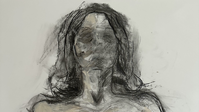
This project explores the theme of human fragility, examining its many dimensions through sculpture and painting. Fragility is not approached as weakness, but as a fundamental aspect of existence — a space of vulnerability, yet also of sensitivity, transformation, and creative potential. The works emerge from an intimate dialogue with the body, memory, and time: delicate or weathered materials — such as wax, plaster, paper, and fluid pigments — give shape to ephemeral figures, incomplete or transforming bodies, and marks that evoke the instability of identity and the constant interplay between resistance and collapse. Through this process, art becomes an act of listening and bearing witness — to what breaks, but also to what, in breaking, reveals a new possibility of presence.

Southern Outfall Works
(2025)
author(s): Mhairi Vari
published in: Research Catalogue
'Southern Outfall Works' consists of the collected partworks developed through extensive period as field artist at Crossness, a historic sewage pumping station on the banks of the Thames, leading towards a large-scale, site-specific installation, Southern Outfall, in May 2025.
The evolving works form part of submission for practice based Phd, alongside a co-evolved paper 'Southern Outfall: sensible ways in evolving installation'.
The works and paper encompass a spectrum of thought from multiple knowledge bases, brought together through an underpinning in process philosophy. The part-works and text support the generation of immersive, multi-modal event-installation which will be sensitively situated across the site, engaging a range of sensory encounters while exploring the nature of the voluntary organisation that keeps the place in existence. Through a layered relationship to science, technologies and redundancy and with a touch of common sense, mingled encounters emerge...
Contemporary artworks speak: The traumatic transgenerational memory.
(2025)
author(s): Marija Griniuk
published in: HUB - Journal of Research in Art, Design and Society
This research investigates the visual narrative built within artworks that deal with colonial memory in Sapmi, and the heavy layers of history in the Baltics, particularly Lithuania during the Soviet era. The research question is: How can themes of Gulag, colonial history and traumatic transgenerational memory be addressed by the artists and by curators in large-scale exhibitions and art venues?
The aim of this study is to examine how visual expression is aesthetically communicated by the artists, how their artworks are presented in exhibitions and media channels, and how they are received by audiences. The study examines four cases: artworks and projects by two Sami artists and two Lithuanian artists. The research is conducted as artistic research, where the author acts as the artist, curator, and spectator of the artworks being analyzed. The author has been actively involved in the creative curatorial processes, including designing the curatorial setup of the Sami artists' artworks for their audience. The comparative analysis of the visual expression is done through the reflexive tools of the author. The study's findings provide an outline of the tools that artists use within their artworks, as well as the curatorial strategies applied when presenting those artworks to audiences.