Reflections on walking and the disruptive experience
(2024)
author(s): Kenneth Russo
published in: HUB - Journal of Research in Art, Design and Society
Our main interest is based on understanding spatial relationships from first-person experience, from our virtual and real body. Through the act of walking, movement in real time, we become cursors that dash across the interface of reality. A continuous process that brings us closer to the production of meanings, new relationships and representations, and also a dialogue with space and time, and the network. This article seeks to present a series of disruptive experiences, documented by the authors themselves, which constitute an exploratory framework of space to discover different symbolic interrelationships, and sketch out constructions of the common space in haptic, political, social and cultural mode. It offers a repository of unexpected, intersubjective encounters, from the empirical practice of walking, which arouses new perspectives to be able to interpret circumstantial spaces, to lose oneself in ‘non-places’, or reflect as to how to approach the landscape and/or the city by opening new imaginaries that add value to the ‘glocal’ place that we traverse and/or inhabit.
Listening Into the Lattice
(2024)
author(s): Jorge Boehringer
published in: HUB - Journal of Research in Art, Design and Society
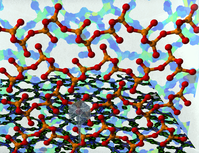
This exposition details the opening phase of new research between an experimental sound artist and an archaeologist, with a detailed examination of critical epistemological questions that have arisen from the beginning of this project. Both collaborating researchers are situated within hybrid specialisations. As the project unfolds, archaeo-chemical data is explored and animated through methods developed from intersections of data science and musical practice, resulting in performance and installation environments in which knowledge of material culture of the ancient past may be made present through listening. However, beyond a case study, this exposition points to how interdisciplinary artistic work produces results that have value outside of normative paradigms for any of the fields from which it is derived, while offering critical insight about those fields. This exposition is formed of these insights. Readers are introduced to the structure of the data, its relationship to the materiality of the artefacts described, the technological apparatus and compositional methodology through which the data is sonified, and the new materiality of the resulting artistic experiences.
Sonification exists at a nexus of sound production and listening, interwoven with information. Meaning and interpretations arise from artistic decisions concerning sound composition and the context for listening to take place. Meanwhile, listening teaches us about data and about the physical and cultural spaces into which we project it. In this way, sonification is always already interdisciplinary.

Cripping Virtuosity: Cultivating Virtuosity from Disability through Music Technology
(2024)
author(s): Molly Joyce
published in: HUB - Journal of Research in Art, Design and Society
What is the sound of disability? What is the sound of a body that defies and resists normative standards? And further, is disability an instrument and, ultimately, virtuosity itself? For me, these have been everlasting questions. I acquired a disability at the age of seven from a car accident that impaired my left hand. Following the accident, I transitioned from various musical instruments to find one I could adapt to. More recently, this has led to engaging with various music technologies that fit my body. Specifically, I am searching for an instrument that fits rather than resists my body and signals my disability as an asset rather than a deficit in searching for my own virtuosity. Therefore, this article details my interest in reimagining virtuosity through the intersection of disability and digital music technology. I will describe my experience with the MUGIC gestural device (developed by Mari Kimura) and preliminary results from experimenting with the MUGIC. I will include background on the crux of virtuosity and the usefulness of mapping for reimagining virtuosity, as well as musical results and concluding thoughts regarding virtuosity, music technology, and disability. Lastly, I will argue that “cripping” virtuosity involves a widening understanding of what virtuosity can signify, realize, and magnify, cultivating what is curious, authentic, and at the core of art-making -- a fundamental self-expression beyond comparison and not easily replicated and a virtuosity true to oneself.
Sounds of walking: Can sound re-present the embodied experience of movement time and distance in the landscape?
(2024)
author(s): Martin P Eccles
published in: Research Catalogue
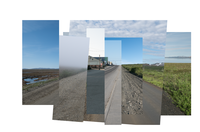
In this thesis, having introduced my research questions, in Chapter 2 I present a layered analysis of the important contexts of my practice—walking, sound, walking poetry, and place. In Chapter 3 I present and discuss three works that together explore how it is that I know the world as a sensate embodied walker. In Chapter 4 I develop what I came to call replicated walks—walks made more than once in the same place. Begun in order to re-configure time, they also led me to extend my consideration of place beyond that defined by geography, to place defined by biological phenomena or socio-cultural coherence. In Chapter 5 I describe my emerging ideas of human-scale of place and my underlying ideas of island-ness. Initially I worked on real islands, walking circumferential routes and those defined by chance procedures. From this I developed an imaginary island in the foothills of Northumberland’s Cheviot Hills; made from the human-scale of my embodied walking this led to my creation of an imaginary pandemic island of containment, created in a city, in my locale, made, and made real, by the traces of my embodied walking. Together my works constitute a body of work that represents a contribution to knowledge with specific contributions of: the use of Replicated Walks as a method of experimenting with time and place; Walking Words – the presentation of poetic text in forms (concertina-fold books, scripta continua, scrolls) that requires walking to engage with it, and that also function as metonyms for my original walking act; Walking Islands –the use of human-scale walking to imagine an island into existence, and then invoke the island as a lens through which to continue to pursue the idea. My work also contributes knowledge to the methods of how to record the sounds of the world whilst walking through it, over extended distances and time.
Creating an audiovisual performance through interdisciplinary collaboration
(2024)
author(s): Sanne Bakker
published in: KC Research Portal
Research exposition of Sanne Bakker, as part of her master at the Royal Conservatory of the Hague.
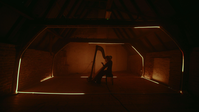
This research started with the aim of creating a better theoretical understanding and breaking down the creation process regarding the making of performances with lights. Ultimately, it became a reflection on the performative practice of a classical musician and the interdisciplinary collaboration while making an audiovisual performance. In particular, the process of the visualization of music. Through literary research into interdisciplinarity, audiovisual performances (specifically with classical music), and by doing a musical and narrative analysis through a case study of Paul Hindemith’s Sonate für Harfe, a theoretical framework is created for collaborative preparation with a visual artist and live experimentation. This research then shows the working process and the experiments that were conducted. It concludes with a reflection on the collaboration, the final product, and how playing the harp sonata in this audiovisual setting has affected the performance of the music.

Stereotype of the Devil: SATANIC PANIC
(2024)
author(s): Jakub Pavlík
published in: Research Catalogue
A visual study/moodboard/presentation of a certain conspiratorial and often delusional stereotype of the character of the devil in the context of what was known as "SATANIC PANIC" in the era of 80's and early 90's in the US.
Even though many of these associations come mainly from the western world, they have been more or less understood and recognized as "devilish" across the world and in the visual culture.
There is a certain stereotype about calling something "SATANIC". Labeling things, activities, clothing, art, products, people etc. as "devil worshipping" often isnt connected to any kind of worship what so ever.
There is this re-accuring act of calling out something as "Satanic" often snowballing the situation into an idea of an active threat, thats dangerous to the public.
The "SATANIC PANIC" era lead to over a 12,000 unsubstantiated cases of these so called "Satanic practices" and many people ended up in jail because of it.
This Satanic labeling has become a parcipatory missinformation quest.