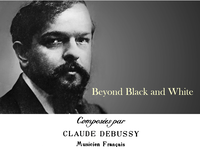
Beyond black and white
(2020)
author(s): Stephen Emmerson, Bernard Lanskey
published in: Norwegian Academy of Music
This exposition reflects on several performances by the authors that aimed to re-imagine selected
pieces by Debussy in the centenary year of his death. More particularly, it considers some issues and
implications arising from performing the composer’s music for piano(s) on modern digital
instruments, specifically the Nord Stage 3 keyboards (2017). The exposition focuses primarily on the
second movement of En blanc et noir, although the composer’s version of Prélude à l'après-midi d'un
faune for two pianos and the solo prelude “Voiles” are also considered. The authors propose that
exploring this pivotal music from the Western and Modernist traditions on digital instruments allows
it to be presented and heard in new ways, thereby expanding our perception and experience of it.
Several video-recorded performances of these pieces are provided. An outline of Debussy’s own
preferences concerning instruments is offered, together with some brief comments on his broader
aesthetics, our perspective being that our versions remain congruent with underlying aspects of
both of these.

Coup de la Glotte and Voix Blanche
(2020)
author(s): Ingela Tagil
published in: Norwegian Academy of Music
This exposition explores aspects of the vocal techniques promoted by the Garcia School, in particular Manuel Garcia the younger (1805–1906). Despite his aim to improve the male opera voice, Garcia and his successors had their greatest success with female singers. I believe that, to the extent that they may be considered as significant factors in why the Garcia School was extraordinary successful with female singers, especially high sopranos and coloratura sopranos, some parts of Garcia’s vanished techniques may benefit female voices today.
Garcia’s controversial term Coup de la glotte, his definition of breathing support, and his term for a high larynx position, voix blanche, provide the main focus for the exposition. My core research questions are:
1. How do Garcia’s techniques coup de la glotte (hard tone onset) and voix blanche (high larynx position) affect female opera voice progression?
2. Do these techniques have any relevance today?
I have conducted experiments with seven sopranos, three of them professionals and four opera students at the Bern University of Arts. All participants sang the same Garcia exercises and the same aria, a part of Lucia’s mad-scene from Donizetti’s Lucia di Lammermoor. All these experiments were filmed, with the camera focused on the singer’s glottis while they sang using Garcia’s techniques.
I am now evaluating the experiments and comparing them with early recordings. I have found that some of Garcia’s techniques, especially the higher breathing support together with the higher larynx positions are really useful to some high sopranos, especially in certain bel canto repertoire. Garcia was already old-fashioned during his own lifetime and singers from the Garcia/Marchesi school clung to older techniques longer than other singers from the same period. For this reason, I suggest that the Garcia School may be used as a historical window to singers wishing to sing in historical ways - even having relevance for pre-nineteenth century repertoire.
Playing the unplayable - Horatiu Radulescu
(2020)
author(s): Roger Heaton
published in: Norwegian Academy of Music
Romanian/French composer Horațiu Rădulescu (1942–2008) might superficially be thought of as part of the French spectral group with Grisey, Murail and others, but spectralism is a very broad church and Radulescu’s work, as he states, radically transforms compositional technique away from treating sound from the outside, organising sounds produced in traditional ways; rather, he explores the possibility of sound’s autonomy, of ‘entering the sound’.
Rădulescu’s music from the late 1960s onwards is built from sound situations created by different treatments of fundamentals, the spectra produced by these treatments, and the isolation of individual spectra. The music evolves ‘naturally’ from the initial organisation of sound sources and formal structures, its interest lying in the interaction of the resulting harmonics, difference tones, sub-tones, rhythmic beats, and so on. The material of music is no longer the manipulation of pitch and rhythm but a ‘living matter’ that Rădulescu calls ‘sound plasma’.
As an example of Rădulescu’s work, this exposition presents an analysis from the performer’s point of view of The Inner Time for solo clarinet (1983), illuminating the challenges posed by attempting to realise this score in performance. The piece, lasting 28 minutes, is composed in 137 modules or ‘aural filters’ notated as microtonal frequencies. The clarinettist uses multiphonics, harmonics and what Rădulescu calls ‘yellow tremoli’ (trills on one pitch, colour trills, bisbigliando) following notated rhythmic patterns where pitches are split apart and the harmonics explored individually, then building and layering on top of each other.
Orange Polar Bear - a cross-cultural performance piece for teenagers in Seoul and Birmingham
(2020)
author(s): Peter Wynne-Willson
published in: Research Catalogue
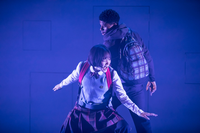
Orange Polar Bear (2014-19) is an innovative bilingual theatre project created by Hanyong Theatre, the National Theatre Company of Korea and Birmingham Repertory Theatre. The main research aims were to develop a methodology for devising and presenting bilingual work in a way that maintains equality between collaborative partners, and, by focusing on the experience of teenagers in Seoul and Birmingham, to consider what young people can teach adults about bridging cross-cultural and language divisions.
The research resulted in a novel methodology for devising bilingual theatre leading to a cross-cultural performance for young people in two languages, presented in the same form in South Korea and the UK. It was unique among Anglo-Korean collaborations for its focus on the experience of teenagers, and conscious balance of languages, cultures and practices. Additionally, the research demonstrates the value of adopting a child-led approach to creating cross-cultural theatre and has created new insights into long-term approaches to developing fair and equal cross-cultural partnerships.

(no)boundaries: A Study in Free Improvisation
(2020)
author(s): Andrew Bain
published in: Research Catalogue, Birmingham City University
This practice-led research project investigates the importance of an empathically creative connection between freely improvising musicians in a live context with no pre-conceived ideas and details the development of instantaneous group composition. As such, (no)boundaries had no pre-composed music, there was no rehearsal period for the musicians (myself playing drums), and we had never played together before the first note of performance. In my research to date, the dynamic between pre-learned knowledge (embodied) alongside intelligent transactions during live improvisation (enacted knowledge), has been useful in helping to better understand the process of jazz improvisation. Even if there are pre-conceived elements, how the music is realised each time is unique. Conversely, even if we set out to have no pre-conceived ideas, in reality, we are still intuitively informed by our experiential and musical knowledge in performance. The two seem inextricably linked.
(no)boundaries showed that group attunement in performance is possible with no pre-learnt repertoire or rehearsals, in an appropriate setting with the right co-performers. Even though no pre-conceived ideas were intended, (no)boundaries evidenced improvisations guided by similar principles of standard jazz performance, pointing to the existence of a common performance mode.
Macbeth Projeto
(2020)
author(s): Maria Jose Martinez Sanchez, Aleksandar Dundjerovic
published in: Research Catalogue
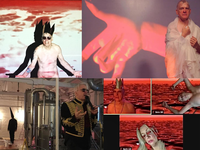
Macbeth Projeto is a performing arts project that used elements of Shakespeare’s Macbeth as a framework for exploring different types of performativity. The central research question was ‘how migration of dramatic text , migratory geography deconstruction of stasis and transformation of form create different aesthetic qualities and performative experiences’? The project resulted in a series of novel rehearsal methodologies for adapting a dramatic text into a multisensorial performance via open rehearsal, creative workshops, and mixed visual and performing creative techniques. The project grew out of the researcher’s previous work with Brazilian theatre – including two co-authored books; Brazilian Collaborative Theatre ( 2017) and Brazilian Performing Arts (2019).Shakespeare’s original text was used as a framework for devising novel methodologies that combined different performance digital media methods with Brazilian collaborative contemporary theatre techniques. Rehearsals began with free collaborative improvisation workshops, out of which emerged material that was selected for further development. From this process the focus fell on the Act 3 scene 4, ‘feast’ scene. From this starting point, ‘The Party’, the relationship with Lady Macbeth, witches and ghosts became the key resources around which new narratives were developed. The research resulted in six performance cycles, each of which explored a different theatre form: Physical and group theatre; Site-specific, Solo-performance, Installation art, Augmented Reality, and Video/Performance Art (created as a remote on-line devised performance). Collaborators and co-producers with CIPA on the research project were Centrala, Digbrew (Birmingham), International Federation of Theatre Research (IFTR), VUK Theatre (Belgrade), Prague Quadrennial, AHRC, Shanghai Theatre Academy, and Teatro Os Satyros (Sao Paulo). It has been performed at the Royal Birmingham Conservatoire (UK), IFTR, Prague Quadrennial of Performance Design 2019 and as part of an AHRC UK-China Creative Industries Partnership Development Programme with Shanghai Theatre Academy, Shanghai.