Hennes naglar är Svens, alltid något
(2023)
author(s): Emilie Löfgren
published in: Stockholm University of the Arts (SKH)
En exposition med fyra videoverk i ETC Solpark, Katrineholm.
"Hennes naglar är Svens, alltid något."
"Drömmen"
"Mary var här"
"Tystnaden"
P E R I C A R D I U M
(2023)
author(s): Sara Key, Max Landergård, Susana Santa-Marta
published in: Stockholm University of the Arts (SKH)
A COLLAB work about the current position of mankind where we are at in the NOW - a comment on that and an exploration of the automatization and the relationship between the human essence and the artificial.
Skin is the membrane that divides inside from outside, what is important and not, what is alive and not. Skin represents the human and at the same time the contrahent to the artificial.
We live in a time where everyone is trying to tell us which world will be the best for us to live in. We want you to tell you.
Passions of Utopia
(2023)
author(s): Nicia Ivonne Fernandez Grijalva, Yasmin Henra van Dorp, Johannes Rydinger
published in: Stockholm University of the Arts (SKH)
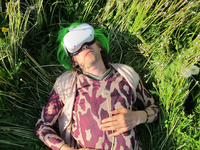
A 360 Telenovela based on a utopian world somewhere 100 years in the future.
The Phantom Carriage
(2023)
author(s): Dan Lageryd
published in: Stockholm University of the Arts (SKH)
The Phantom Carriage is a practice-based research project in which an 8-channel sound recording from Essingeleden / E4an is played with 8 speakers deployed along national road 52 in Katrineholm.
About displacement. The sound of movement, the movement of sound, the emotional movement the experience of art can imply. About noise and its impact on us and the surroundings. About future nostalgia, how will the future sound, what will the roaring diesel truck sound like in the future?
The title The Phantom Carriage (Körkarlen in Swedish) is borrowed from the film by Victor Sjöström. The choice of title also opens up other aspects of the work / project.
Making it my own
(2023)
author(s): Mikael Charlie Bäckman
published in: Research Catalogue
Abstract
In the audio paper which forms the center piece of this exposition I have examined the idiolect of country harmonica player Charlie McCoy. In order to gain a multifarious understanding of McCoy’s idiolect I have made transcriptions of his recordings and interviewed McCoy himself and two other prominent harmonica players. With the aim of obtaining a more refined engagement with the performance, I have sought to embody McCoy’s playing by learning to play my transcriptions. The paper shows the prominent features of McCoy’s idiolect and how he created his idiolect while negotiating the affordances of the diatonic harmonica. The paper also shows how I am using transcriptions of his recordings with the intent of transforming my own artistic voice.
Keywords: Harmonica, Charlie McCoy, Idiolect, Voice, Affordances, Country music
Designing Agency
(2023)
author(s): Johanna Drucker
published in: HUB - Journal of Research in Art, Design and Society
As AI systems proliferate, questions about their emergent capacities focus on intelligence, sentience, and control. But the issue of agency, the capacity for action with consequences, brings other design issues into play. Agency takes many forms including mechanical, incidental, probabilistic, and intentional, but is largely assessed on the basis of behaviors. The challenge of designing agency can be met by considering what must be programmed into a system to provide it with the capacity for action, but the distinction between the appearance of agency (simulacral) and actual agency (intentional) is difficult to test. This paper discusses some of the connections between agency and debates in physics about determinism and probability as they relate to the question of human capacities for intentional action and concludes with a discussion of the difficulties of conceptualizing agency without falling into Romantic models of disruptive behavior. No easy answers arise in regard to the problem of designing intentional agency in a way that can be either tested or constrained.