Hamlet: between keywords and art
(2024)
author(s): Guglielmo Battistini
published in: Research Catalogue
This is a test for the Ai KOBI project at Academy of fine arts of Rome.
The exposition "Hamlet: between keywords and art" goes to analyze the differences between two AI, KOBI and Chatgpt.
Starting from excerpts from the scene 4 and 5 of Shakespere’s Hamlet, when Hamlet meets the ghost of his father, who asks him to avenge his death I identified parts of the text from which I then found keywords, chosen on the basis of the text and a brainstorming of ideas
Precisely through these keywords, many times similar to each other by meaning, I tried to explore the KOBI system and its responses diverging from those of Chatgpt.
On the left we found text and images that are proposed by KOBI after the insertion of the keywords, while on the right, the answers of Chatgpt.
The display is four pages plus introduction and conclusion.
APROXIMACIÓN AL ARTE VISCERAL, desde el maquillaje y la práctica protésica.
(2024)
author(s): Laura Rodríguez
published in: Research Catalogue
Estudio de las diferentes prácticas artísticas que engloban un arte visceral, analizando la corriente artística de La Nueva Carne y toda representación de este carácter en la actualidad, esencialmente dentro del Maquillaje de Efectos Especiales. Incluye grandes referentes en este campo, para una futura práctica personal.
Navigating in Overlaps: Redefining Performance Space as Multi-Space
(2024)
author(s): Stijn Brinkman
published in: KC Research Portal
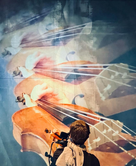
In this study it is advocated to perceive performance space as overlapping multiple spatial layers, all existing in the same moment, but all with different boundaries. A triangle of performer, audience and surroundings creates performance space together as co-players by activating spatial layers and redrawing spatial boundaries. A new term is coined to better understand the unstable, moving nature of performance space: multi-space. To deal with the concept of multi-space in actual performances, the use of the verbs ‘navigate’ and ‘zoom in/out’ are advocated.
Embedded in this study is an exposition of the artistic projects of Stijn Brinkman, in which the concept of multi-space is tested as new tool to create performances with more exploration, agency, imagination, and movement. By finding a way for performers to disappear and to be present at the same time, the domination of walls and the domination of a performer's body (both apparent in many traditional performances) are challenged. The concepts of multi-space, navigate and zoom in/out stimulate audiences to engage more with their surroundings, while helping performers to shape their ideas always through site-specific processes.
What impact can the use of "worlding" have in a dance practice?
(2024)
author(s): Hannah Krebs
published in: Stockholm University of the Arts (SKH)
This is an approach to understand how life action role play can be used in a dance performative context and how it informs the body in relation to another time and space into a dance quality.

A Conversation on Discarded Recordings
(2024)
author(s): Heikki Wilenius, Ernst Karel, Jonathan LARCHER
published in: Journal of Sonic Studies
What can be considered as a discarded recording in an ethnographic inquiry? Do the instabilities and technical errors show that technology is really part of the encounter of ethnographic situations? Furthermore, is there a limit beyond which a sound that is too degraded can no longer be restored but simply described in writing, the preferred medium of the human sciences in general and anthropology in particular? These three ideas were at the center of an online conversation with Ernst Karel, starting with the film Expedition Content (2020) made with Veronika Kusumaryati from the sound archives of the Harvard-Peabody expedition (1961) in Dutch New Guinea. The many errors and failures that punctuate Rockefeller's recordings – we also listened to some recordings that did not appear in Expedition Content – form a fertile ground for thinking about the tactics and listening that can make examining ethnographic rubbish a heuristic, both for the history of the anthropological discipline and for the history of the place where it was recorded.
The Vibrating Drum - developing a practice for the modern percussionist
(2024)
author(s): Ingar Zach
published in: Norwegian Academy of Music
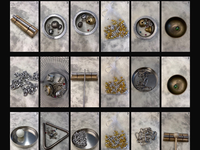
Over the last 60 years, contemporary percussionists have been investigating the potential of their instruments beyond established classical techniques, making use of a variety of preparations and techniques, additional electronic amplification and manipulation, and alternative setups. In my artistic research project The Vibrating Drum, I apply my background as a percussionist working in various experimental disciplines towards a consideration of how the vibrating speaker (the transducer) can be used to produce sustained sounds. Over the course of my project, I have assembled a haptic system comprising vibrating speakers in contact with the drum skin, small amplifiers, and iPads, that allows me to create and develop new artistic works for percussion. My methodology entails giving a series of solo concerts, where I present different versions of the setup and material from my ongoing research. I have also introduced my material in collaborative projects and explored how vibrating material interacts with specific acoustic spaces. To produce my formal artistic results, I edited and structured the recorded material, which resulted in two solo albums, a video installation, and a final concert. The aim of this research is to broaden my own practice and to offer a tool for modern percussionists, composers, educators, and others for whom my research and approach would be relevant in the future.