NAVIGATING NOISE
(2023)
author(s): Simon Rydén
published in: Research Catalogue
Simon Rydén
Documentation for the MA Project Navigating Noise at The Department of Performing Arts at Stockholms Konstnärliga Högskola.
This project explored how different art practices from different fields cross-pollinate in the process of making interdisciplinary art. I want to trace how the process of exploration and thinking in different mediums create a dynamic interchange of ideas that leads to the development of new ways of relating to practices.
I used different approaches and techniques, from somatic practices to experimenting with digital tools, to understand how different practices interact with and inform each other. The process becomes an intricate system of similarities and feedback loops, where one can reflect and interpret in many different mediums.
ILUF/Never forget that we met@internet
(2023)
author(s): Normann Hanna
published in: Stockholm University of the Arts (SKH)
Together with an artistic team I’ve been working with stalking as a concept, examining ”who is stalking who?
Using multible media.
This is my Individual project degree on the master's programme in acting, 120 credits. Stockholm University of the arts. 2022-23. Supervisor Ulrika Malmgren.
I’m showing the process on a timeline, with two different parts.
Part 2, is from a serie of examining stalking as a phenomeno, film and performance.
Part 1, as an inspiration for part 2, showing my character work and process with ”ICON”
(Nico (Christa Päffgen) a Factory model and singer in The Velvet underground.)
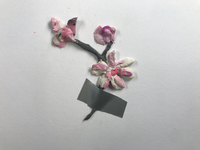
The probs in the picture are inspired by the probs we where using in the movie, a cherrytree. In a seminarie about stop motion I made a musicvideo in clay. A cherryflower.
What is the ART of ADHD Social Media Acting - and how is it artistically relevant for everyone to know?
(2023)
author(s): Alexander Lindman
published in: Stockholm University of the Arts (SKH)
I'm on the path to deneurotypicalize acting technique and understand what a social media actor might be and do and and if there is or should be a difference between a neurotypical and neurodiverse way of applying oneself and communicate with said audience on said platform(s)?
During my work I coined the term 'deneurotypicalize' and a definition of art as ART.
Welcome to my exposition: This part is more to be seen as an extended documentation over my 2 years and also as a compendium to my master thesis published on DIVA and my performance lecture 2nd of May at Stockholm University of the Arts. And/or a thing of its own.
Both the exposition-documentation and the master's thesis is also in this exposition.
by division and differentiation
(2023)
author(s): Carolina Grilo Santos
published in: i2ADS - Research Institute in Art, Design and Society
“by division and differentiation” is a speculative fiction or a document on the daily life as an outsider. Presented as video art, this project is the result of a residency program crossing scientific and artistic research that reveals imaging reflections, detected gestures, and alienated thoughts.
An inner monologue sets the tone for travels among accounts, wanders, and memories, invoking the divergences and parallelisms between reality and imagination. There are twisty borders in the millimeters of tension of what is visible to the naked eye and what can only be seen through the machine, between what can be touched without danger and what’s endangered — in science and art. Surrounded by volumes of data that are phenomena for others, dances of precise injections and light beams, we have lost count of the time we have been here.
This work is a result of project 2SMART, engineered Smart materials for Smart citizens, with reference NORTE-01-0145-FEDER-000054, supported by Norte Portugal Regional Operational Programme (NORTE 2020), under the PORTUGAL 2020 Partnership Agreement, through the European Regional Development Fund (ERDF).
The Flexible Trombonist
(2023)
author(s): Andrew Macleod
published in: KC Research Portal
Name: Andrew Macleod
Main Subject: Classical Tenor Trombone
Research Supervisor: Caroline Kang
Title: The Flexible Trombonist
Research Question: How can yoga be used as a tool to prevent injury and promote ease in brass playing?
Yoga has established itself as an effective tool to reduce anxiety, increase breath control, and strengthen the body. The classical music profession being an industry where physical demands are high it is no surprise that ‘playing-related musculoskeletal disorders (PRMD) are prevalent. This research investigates the effectiveness of regular practice of yoga at reducing pain and tension in brass playing with an aim towards reducing the risks of PRMD’s.
To carry out this research a combination of a case study, interviews, self-experimentation, and reviewing existing literature was used. The case study included a mixture of seven collegiate and graduate level brass musicians who implemented yoga into their practice routine over the course of two weeks. The participants completed three surveys and two practice diaries which monitored the success of yoga at reducing pain and tension in their practice.
The outcome of the case study presented positive results in support of the correlation between the practice of yoga and reduced pain/tension in brass playing. This was supported in the self-experimentation and reflection. The interviews reinforced this connection however highlighted that yoga is not the only solution available.
Through analysis of existing material on this subject, it is clear that further research would be beneficial. The issue of PRMD still exists in the music profession and this research offers an initial insight into effective methods of injury prevention and awareness. More research on this subject would reduce the likelihood of career-ending injury and encourage a holistic practice of brass playing.
The art of the violin in Verdiales
(2023)
author(s): María Estela Lastre Castillo
published in: KC Research Portal
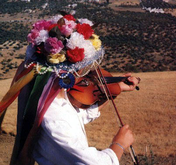
Verdiales is the traditional music from Málaga, Spain, which is little known even within Spain. This research places verdiales in its historical and musical context looking at: the differences between styles, rhythm and harmony, and, most importantly, the role of the violin in this music.
As the main instrument in verdiales, the violin is played in a very different way than in classical music, since it is spontaneous music with a great deal of freedom for improvisation, disseminated purely by oral transmission, and with a particular technique which is suited to playing only this music.
Through the deep learning of verdiales, I have looked for different resources to face my daily practice issues in order to gain more flexibility and freedom in my way of playing. After trying several exercises and approaches in different parts of my practice, I have been self- documenting and verifying the improvement and effectiveness of certain methods, taking into account different aspects such as bow hold, ornamentation, and improvisation. As a result, I came to the conclusion that in order to achieve different results, it is necessary for more exploration and extremely different methods than the ones I have been using when practicing the violin