Notes On Artificial Intelligence And The Rise Of New Images
(2024)
author(s): Pamela Breda
published in: University of Applied Arts Vienna
Pamela Breda’s (Digital Arts) contribution "Notes On Artificial Intelligence And The Rise Of New Images" explores how hyper-realistic computer-generated images (CGI) reshape our perception of reality and its implications for human creativity. Her considerations stem from an ongoing interdisciplinary artistic research project that combines positions from visual cultural studies, cognitive psychology, and perceptual theory with historical perspectives. Breda’s contribution reflects on the historical background of CGI, its influence on various domains of individual and collective life, and its philosophical implications, her contribution provides current viewpoints on the position of AI and its past implications.
Herbarium of Words: Literary Style at the Scale of a Street
(2024)
author(s): Thomas Ballhausen, Elena Peytchinska
published in: University of Applied Arts Vienna
Thomas Ballhausen's (author and philosopher) and Elena Peytchinska's (Institute of Fine Arts & Media Art – Stage and Film Design) contribution "Herbarium of Words: Literary Style at the Scale of a Street" artistically explores the interrelations of space, language, and literature and takes us on a walk through Vienna’s streets. The herbarium serves as a point of departure for historical observations, which is seen as a form of subjective and personal archiving of urban experiences by means of linguization. Their performative approach combines film stills, poetry, and theoretical backgrounds to transform the boundaries of text and bibliographic formats.
Permanent traces
(2024)
author(s): Matevž Čebašek
published in: Royal Academy of Art, The Hague
Research Document of the Royal Academy of Art, The Hague, 2023. BA Photography.
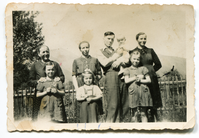
The research paper serves as a base for understanding the memories on a case of a person with dementia and their connections to the medium of photography. Photography is used as an attempt to retrieve my grandmother’s autobiographical memories which are often hard to retrieve. It is based on the assumption that every memory, no matter how vague, is still accessible by restoring to a proper process, similar to the latent image on the photographic film that becomes visible only after appropriate processing. Based on existing experimental memory research I constructed a method of finding a cue that can trigger specific memories in a conversation. Photographic images from the past were used as a base of the conversation. In most cases, they didn’t directly trigger involuntary memory, but they served as a starting point for a conversation, allowing my grandmother to start actively thinking about a period of her life. Due to dementia, the responses within one conversation were often repeated, yet after some time, the chain reaction of retrieving memories allowed her to remember some specific details. Her understanding of the fragility of memories was constantly present. On multiple occasions, she expressed that an artificial device, such as photography or writing, should be used to preserve them. The research doesn’t give a complete understanding of how memories and their retrieval work in general, but it gives a better understanding of how it can efficiently be done with my grandmother. The process I developed can be applied to other people if properly adjusted to them. I believe that essentially what counts is not what kind of cue we choose, but that we patiently take time to listen and guide conversations with some previous knowledge about their past.

Tracing life in the fire-altered landscape of Greece: A travelogue to the village of Kirki
(2024)
author(s): Ina Patsali
published in: Royal Academy of Art, The Hague
Over the past few years, fires are everywhere. The summer of 2023, the biggest wildfire recorded in Europe torched large swaths of Northern Greece; fire destroyed ecosystems and devastated local communities. This research paper is divided into two parts; the first part is based on fieldwork conducted in the fire-altered landscape in Evros, after spending time in Kirki village, hearing the stories of locals, having conversations with experts, and documenting my experiences living in the post-disaster land. It is a travelogue to a ground considered “ruined”, in a village slowly disappearing. The second part zooms in on Kirki’s cemetery, approaching it as the sole spiritual place for post-disaster relief in an effort to understand its importance for the community as well as the opportunities that arise in this burial ground. My travel was approached with a commitment to flexibility and was shaped by serendipity. In this multilayered condition of Northern Greece, it is an effort to consider the question of what’s left in the post-fire land of Kirki and what emerges in its damaged cemetery.
at the end of the sentence, it rotted
(2024)
author(s): Cecilie Fang Jensen
published in: Royal Academy of Art, The Hague
at the end of the sentence, it rotted gathers written words and photos exploring how language is not purely about communication, but a medium of revealing hierarchy of bodies, as we assign and circulate signs to bodies - none of which are neutral.
Moving between auto-theoretical poetry and essays on 104 pages, I write with an I using language to explore language itself from within; appropriating how words are never innocent, when the languages we speak are the ones with political value.

Customized Realities
(2024)
author(s): Sorin
published in: Royal Academy of Art, The Hague
Thesis / Research Document of the Royal Academy of Art, The Hague, 2023.
Bachelor Interactive Media Design
In this paper I aim to reveal the influence of echo chambers and the use of echo chambers as a potential tool used as a defense mechanism by the emergent artificial intelligence. We also look at the impact of such defense against our social construct and the availability of genuine human interaction in a world that is
mostly digitally connected then physically .
We investigate in this thesis some contemporary ideas
about our current situation and or potential solution to pop up the bubble of i-reality, a term I used to refer to when thinking about customized reality bubble surrounding every digitally active person.
My research journey starts with reminding us why we do
this research, what is the urgency, and then delving into historical facts and researching contemporary or historical views, analyzing the algorithmic world of social networking and the surprising results
of digital isolation in tiny echo-chambers.
Thus , my research led to several conclusions of how we
might be able to pop up the i-reality bubble and change the grim potential outcome of a world dominated by synthetic life to a world in which we human can cohabitate with a potential self aware synthetic
life .


