Feedback Saxophone: Expanding the Microphonic Process in Post-Digital Research-Creation
(2024)
author(s): Greg Bruce
published in: Research Catalogue
The microphonic process is the term I use to encapsulate how microphones, loudspeakers, and related media are used to support, extend, and innovate musical practice. In this research-creation thesis, I contextualize, document, and analyze my own application of the microphonic process – feedback saxophone. My feedback saxophone system combines the unique characteristics of the tenor saxophone with the idiosyncrasies of various microphones and loudspeakers to produce and manipulate acoustic feedback. While there are examples of similar systems, there is no standardization and little documentation exists outside of audio recordings. Furthermore, my work employs feedback in a systematized fashion that challenges its conventional, indeterminate use in performance and composition.
To support this research-creation, I discuss the history of the microphonic process, examine contemporary “microphonic” practices, and use these findings to describe and analyze my own works. For the history of the microphonic process, I discuss how microphone amplification changed popular vocal technique through the work of early-microphone singer Bing Crosby. I then discuss how microphonic instrumentaria were variously employed by avant-garde and popular artists using the examples of Mikrophonie I by Karlheinz Stockhausen, Hugh Davies’ feedback work Quintet, and the guitar-feedback practice of Jimi Hendrix.
Following this discussion of instrumentaria, I establish the contemporary context in which my research-creation occurs by examining two present-day microphonic saxophonists, Colin Stetson and John Butcher. I use their distinct electroacoustic practices as a springboard to explain recent musical-technological trends: from the accelerating consumption of digital media in the new paradigm of sound, to the reactionary concepts of post-digitalism and the minimally augmented instrument. Lastly, I describe the creation of three concert etudes for my post-digital, minimally augmented feedback saxophone system, and critically examine the new works’ processes of creation, musical materials, and aesthetics.
FACT stage one
(2024)
author(s): Jenny Sunesson
published in: Stockholm University of the Arts (SKH)
The research project FACT stage one aims to test the sonic capacity of fragmenturgy (developed by Sunesson 2014–19) as a method to unsettle polarised positions of areas and sites existing outside of the visual power structures and political strongholds.
The long-term purpose is to develop a Fragmenturgy ACtion Tool (FACT); a transitory toolbox for cultivating fragmenturgy methods and actions.
FACT stage one consists of a comprehensive case study carried out in collaboration with a group of students aged 18–23 based at Uppsala Community College in Sweden, which was explored as a site during 2021.
Image copyright: Christina Hillheim
Ett osynligt stycke tyg
(2024)
author(s): Jenny Sunesson
published in: Stockholm University of the Arts (SKH)
Ett osynligt stycke tyg
essä
av Jenny Sunesson, 2022
redigerad 2023
Förord (2023)
Ett osynligt stycke tyg är en essä som utgår från två olika, men ändå överlappande, konstnärliga processer; forskningsprojektet FACT stage one, och det soldrivna, ljudkonstprojektet UNDER.
Essän utforskar ljudets och lyssnandets specifika kapaciteter utifrån min konstnärliga fältinspelningspraktik, vilket är den “ljudmodalitet” som jag har arbetat med i över 20 år.
Texten diskuterar ljudets och lyssnandets platsrelaterade, politiska och dolda förmågor när det gäller att utmana det “vi tror vi vet” om mänskliga och mer-än-mänskliga organismer – och som ett möjligt verktyg för att hitta öppningar och uppenbarelser bortom stereotypiskt vetande.
Bild copyright: Ida Lindgren
Epiphanies of an Invisible weave
(2024)
author(s): Jenny Sunesson
published in: Stockholm University of the Arts (SKH)
Epiphanies of an Invisible weave
essay
by Jenny Sunesson, 2022
edited in 2023
Translated by Steven Cuzner
Preface (2023)
Epiphanies of an Invisible weave is an essay written during the processes of two different, yet overlapping, projects; the research project FACT stage one, and the solar driven, sound art project UNDER.
The essay explores the specific capacities and possibilities of sound and listening through the specific mode of field recording, which is the sonic modality that I have exploring for more than 20 years.
The essay aims to shed some light on the site-related, political, and hidden potentials of sound as it examines the possibilities of (re)-learning through listening in relation to both human and more-than-human explorations and possible “epiphanies”, imagining openings beyond stereotypical knowing.
/Jenny Sunesson
Image copyright: Ida Lindgren

Ancestry – before DNA test – considered through drawing
(2024)
author(s): Mike Croft
published in: i2ADS - Research Institute in Art, Design and Society
The exposition is deliberately incomplete not only because, arguably, this is the nature of research, but due to the author's working with a sense of in-the-meantime, while waiting for the results of a DNA Ancestry test. The research is therefore a preemptive response to a genetics and identity project to be explored through drawing, hosted by i3S, Institute of Investigation and Innovation in Health, University of Porto, Portugal. The exposition presents a degree of drift from a starting-point of family photos processed through drawing by a fictional artist, to a more conceptual idea of microbiological cells of which their content is increasingly fragmented text. As the drawing process develops, the use of coffee-staining is a key medium, its geographical origin conferring roughly with that of the human species. Such drift of content between creative writing, visualisation, and academic writing, is possible on the basis that the author does not as yet have a clear idea of what the DNA Ancestry findings will disclose or how they will look. An after-the-test exposition will follow the present exposition – which is interesting in terms of how such future knowledge will be in the wake of, and responsive to, a stage of indetermination.
Ancestry – after DNA test – considered through Drawing
(2024)
author(s): Mike Croft
published in: i2ADS - Research Institute in Art, Design and Society
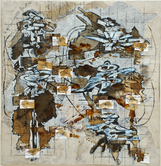
To the extent that this research is artistic, it involves the mediums of drawing, drawing towards painting, academic research, academic writing, fiction, and occasional use of video. If artistic research could be an entity with the opacity, so to speak, of such mediums, then it would not be necessary to mention its constituents. However, this is worth stating at the outset because in the author's view the Research Catalogue does have its own mediumistic basis: take the research off the platform and its form and concept alters. The topic of the research is a response to the author's genetic ancestral DNA test provided by i3S (Institute of Investigation and innovation in Health, Porto University). The author is one among a group of participants conducting individual research on the theme of 'Call for Drawing – Genetics and Identity'. This author's activity follows an exposition called 'Ancestry – before DNA test – considered through Drawing', published on the Research Catalogue. The activity concerns the charting of progress of thinking, doing and making up to and including two main pieces of visual-material work, with the expectation that the research will continue to develop.