Collaborative Live Composition with Frankie (audio clips)
(2023)
author(s): Esa Onttonen
published in: Research Catalogue
Audio clips to a paper submitted to TENOR BOSTON 2023 conference.

Poner el cuerpo – Making spaces public
(2023)
author(s): Rossanaconda
published in: VIS - Nordic Journal for Artistic Research
In this exposition, I expand the notions and practices of collective body-action intervention (dance, performance, happenings, etc.) as a method to strengthen embodied knowledge, an instigation to engage in restorative encounters, and an invitation to intervene and disrupt political biases of (public) spaces. These methodologies propose alternatives for knowledge exchange/production beyond hegemonic, Eurocentric education.
In parallel, I reflect on my own practice and the anti-patriarchal and decolonial feminist political basis of the collectives of which I am part. We work with strategies and methodologies inspired by feminisms from the Global South, such as taking care of others as a practice that puts aside the patriarchal capitalist model of life that mainly separates, individualizes, prioritizes, and promotes competition and exploitation. We promote exchange, cooperation, and interdependence. I reflect on how these encounters summon the festive memory of our territories and the resilience of our* wounds.
Emotions of the bodies and the resistances will trigger our rituals in Abya Yala**, the flows and drifts will make this poetic-affective encounter, as will the skin itself.
___
*We: Here I refer to collectivity in a broad sense in each case: We as the collectives I am part of, we as women (cis, trans, nonbinary), we as immigrants, we as bipoc, etc
**Abya Yala: Self-determined name for the territories in the global south named "America" as a result of the colonizing process.
Shadows of Intimacy, collaboration with Jia Yu Corti
(2023)
author(s): Zoe Panagiota (aka Betty) Nigianni
published in: Research Catalogue
Interactive digital art installation for dance performance in collaboration with choreographer Jia Yu Corti, London Contemporary Dance School (The Place), 2011.
Dance improvisation by Robert Anderson and Kathy Crick.

Scented Rooms
(2023)
author(s): Shauheen Daneshfar
published in: VIS - Nordic Journal for Artistic Research
The exposition Scented Rooms aims to be a form of resistance that finds itself in poetry and politics, poetic imagery, re-thinking censored archives, existential reflections on photography and cinema, and dance.
At the very core of the research is an important historic icon in Iran; The country's oldest theater which was burnt down by extremists during the 1979 Islamic Revolution, closed forever and has decayed over time. The burning of this theater, along with many others, was the starting point for imposing restrictions on art and culture.
The research departs contextually from the efforts of the Islamic government to control civil society. It is a reaction to a history of imposing a specific language discourse and discarding elements that represent a non-religious view, visual changes in the urban space and limiting access to specific types of information that refer to citizens’ collective memory.
Giving agency to this theater, the research aims to revive the collective and public memory of a society, being the voice of those that have been silenced for a long time.
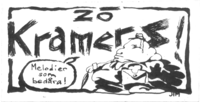
Zö Kramers 1978-1983
(2023)
author(s): Olof Halldin
published in: Research Catalogue
Zö Kramers was an orchestra in a mix of punk, reggae, ska, marching music, blues, pop, rock but not jazz.
Participating in various roles:
Calle Ottestam / bass, vocals, lyrics, music
Per Sommarström / guitar, vocals, lyrics, music
Martin Fälthammar / drums, text
Olof Halldin guitar, keyboard, music, voice, percussion, mixing
Mikael Södersten / keyboard, vocals, lyrics, music
in addition
Peter Söderblom / synth
Persa Jacobson / text
Katte Salomon / song
Joakim Pirinen has drawn and written texts
For individual bets - click on "Vilka Vem När Var Hur Vad".
History:
Zö Kramer's original composition was Calle Ottestam, Per Sommarström, Olle Halldin, Martin Fälthammar and initially Peter Söderblom. Added after about a year did Mikael Södersten. First on drums was Jolly Bod but was soon replaced by Martin. Katte Salomon also sang on the recordings from 1983. Music and lyrics were written by the band members but lyrics were also written by Joakim Pirinen and Persa Jacobson.
The band's first name was "Arne & his anabolic steroids". The name "Zö Kramers" comes from Kramer-Pollnow's hyperkinetic syndrome - (dance disease) a psychotic condition characteristic of the band's dance-inspired style. Between 1978-1983, about forty songs were written. About twenty concerts were mostly held on Lidingö. The band's biggest "hit" was Tyska marionetter (German puppets).
Live recordings have been available since the beginning and about 25 concerts were performed, but more studio mixes were made in four rounds where the first was done in 1979. Recording was done with a four-channel TEAC tape recorder and TEAC mixer table. Sound improvements were made in 2002 at the same time as digitization and in 2020 before the launch of this website.
Documenting Non-Sonic Music
(2023)
author(s): Paul Norman, Andy Ingamells, Michael Wolters
published in: Research Catalogue, Birmingham City University
How to document music with non-sonic elements? Or: How to document all the performative qualities of a piece of music that can’t be heard? Beginning with this question our group of researchers, filmmakers and dramaturgs from Birmingham (UK), Frankfurt (Germany) and Fredrikstad (Norway) met between 2019 and 2021 to develop initial ideas and questions, then test them.