Gestures and Inscriptions in Ceramics and Sound: A combined STS, Queer Marxist and Artistic Research approach to the study of Reproductive Politics
(2022)
author(s): Rebecca Close
published in: RUUKKU - Studies in Artistic Research
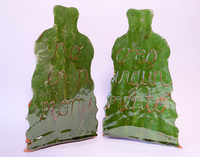
This exposition brings together Artistic Research, Science and Technology Studies and Queer Marxism to examine the gestural nature of reproductive politics. It argues for an expansive understanding of the gesture that extends well beyond the domain of the embodied gesture to include different registers and materialities of cultural and scientific inscription. Broadly, I explore reproductive politics not only as a question of reproductive health –of access and choice– but as the daily negotiation of the body’s value and legibility across communication, labour and political fields. By questioning -through artistic action- the inevitability of the economic and social conditions that devalue or invisibilise reproductive work, this article also elaborates on the gestural nature of artistic research as counter-institutional practice.
Exploring North Nordic Landscapes in a ‘Hyper-constructive’ Fashion
(2022)
author(s): Marinos Koutsomichalis
published in: RUUKKU - Studies in Artistic Research
This exposition details an experimental art/research endeavour pivoting on an improvised exploration of the broader North Nordic region. It accounts for a hybrid, maximalist, and materialist performance practice that draws on an unconditionally eclectic exploration of a particular geographic region and of certain (non)human related activities and mobilities encountered therein. The endeavour is contextualised with respect to trains of thought and empirical research methods in experimental arts, object oriented ontology, non-representational theory, techno-scientific culture, post-humanism, and improvised ethnography. It is shown to concern, inter alia, on-location audio/video recording, DIY making, (found) physical artefacts, interviews, data displays, prose, cooking, knitting, and landscape cinematography/photography. The particular methods at play are detailed and theoretical ramifications are outlined. It is accordingly claimed that a structural, procedural, and sensory hybridity of sorts may bring forth original and genuinely exploratory artistic manifestations that contribute (non quantifiable, nor discursive) ways of knowing the North Nordic region under scrutiny; ones that lie at the crux wherein poetic, enactive, epistemic and speculative tactics meet, mingle, and intertwine. This exposition also features an extensive pool of audiovisual material to aid detail the method and to support this claim.
Piano Apocalypse
(2022)
author(s): Eka Chabashvili, Nino Jvania, Tamar Zhvania
published in: Research Catalogue
"Piano music has come to an end and something quite different is coming. I sense it clearly: with the claviers made up to this time, there is nothing new to discover any more," declared Karlheinz Stockhausen in 1992. Truly, the piano, a brainchild of its era, has gradually been alienated by our epoch. Contemporary composers engage themselves less and less with the piano – particularly as a solo instrument. Though, we have to consider that a musical instrument is a musical chronicler with the structure, tuning system and performance techniques reflecting to certain extent the epochs it was created and employed in. Consequently, the main principles of music representative of every epoch lead to transformation of the instrument, its renewal, refinement, enrichment of performance techniques. Each epoch adapts the instrument to the principles of the corresponding musical thinking in order to make it capable of producing contemporary sound. Using our artistic imagination, we compare this situation to the Apocalypse, trying to find some ways of dealing with it. In this exposition we present some results of our experiments with the piano and its sound conducted within the artistic project "Has Piano Music Come to an End?". Methodology we employ is comparative and experimental. Analysis of piano music repertoire, its compositional and performance techniques and instrument's structure in various epochs led us to the reconsideration of the piano and inspired us to offer to you some new experimental options of its employment and modification, the latter resulting in a new instrument “ModEkAl”. Of course, no artistic research about music and a musical instrument could be conducted without making the research and its results public. Publicity is an inherent part of music which has to be performed and perceived in order to fully fulfill its purpose.
Find Me: Self-portraiture as a tool
(2022)
author(s): Silvia Diveky
published in: Research Catalogue
What kind of artistic research practices would enable us to reflect and respond effectively to the urgencies of our moment?
In my artistic research, I test my own limits as a documentary film-maker. Very often I feel unqualified to be the one to write about the documentary practices and so rather than write, I shoot. By creating a documentary self-portrat, I test the limits of my own capabilities to respond to the situations around me, to capture the essence of my own being as a human. I do not strive to capture "myself" but rather to explore the process itself. We tend to forget that although we consider ourselves "artists", we very often feel insecure, and this insecurity limits us from reaching beyond the safe margins of our abilities. But it is never to late to go further, never too early to find a new way of expression.
ASIA/ÄRENDE
(2022)
author(s): Vanja Hamidi Isacson
published in: Research Catalogue
ASIA/ÄRENDE: Kaarle Vihtori Turunen
Sound of Time - Tuning into the Norwegian Landscape and the Post-Industrial Soundscape
(2022)
author(s): Alexander Rishaug
published in: Research Catalogue
This exposition is a non-linear, web based, poetic, personal, diary-like, essayistic, semi-fictional, experimental and reality-based approach to immerse into the reflection-mode and mind boggling universe of the project Sound of time - Tuning into the Norwegian Landscape and the Post-Industrial Soundscape, that took place in the time frame 2018 - 2022 at Academy of Arts, UiT Arctic University of Norway.
Through his field work Rishaug's been tuning in (and out), listening, recording and investigating a wide range of sites and places, their presence, their history, stories, acoustic qualities and psychoacoustic state. This resulted in site specific installations, various collaborations, a solo exhibition, an artist book and a field recording album.
With a growing toolkit of listening strategies, methods, techniques and technology Rishaug's been able to pick up, and record a variety of audible qualities of the Norwegian landscape such as vibration, resonance and electromagnetic waves. This not only highlights the physical presence of current sounds, but points towards the contemporary state of global economy and geo-politics and how this transforms the landscape.