The Feeling of Sound: Music Curating, Performing and Connecting with and through Music
(2022)
author(s): Laura Sophie von der Goltz
Limited publication. Only visible to members of the portal : KC Research Portal
Long story short
In this research exposition, I would like to invite the reader on a journey of discovery in the field of classical music presentation. Over the last 50 years there have been many suggestions on how to allow the professional field of classical music to develop alongside its time and people.
To get a new perspective on the topic, I approach ASMR as a connected topic, investigate it under the aspect of listening and then make a transfer to my professional practice. ASMR stands for autonomous sensuous meridian response and is describing a special kind of sensory perception. I study ASMR as way of perception and as well as a YouTube / media phenomenon.
My research question is:
What can I learn from ASMR (about contemporary audience’s perception of sound) and how can I integrate this in my artistic practice?
When I talked to colleagues or teachers from a classical music context, ASMR appeared to them at first as something bizarre and insignificant. Still, it has millions of followers on the internet. A large number of followers is not necessarily an indicator of artistic quality, but it can certainly be an argument to arouse curiosity. After all, the number of followers towards a subject does say something about its appeal or the ability to grasp people.
By comparing ASMR to synaesthesia, I want to focus on perception and sensuousness but also explore common traits and differences of the two phenomena as both neurological phenomenon and the social (artistic) movement.
An analysis and five experiments involving technological and dramaturgical tools often used in ASMR, leads to the final chapter: the artistic implementation. During the two years of my master studies, I designed two performance concepts, in which I applied the insights I gained throughout this research. A documentation of the process and a more elaborate explanation of the concept are to be found in chapter 4.
In the end of this exposition, I summarize the conclusions of the research I made on a general and on a personal level.
In order to acquire more information as well as a wider view, I have reached out to literature within the fields of sociology, (social) history, psychology, neuroscience and philosophy . During my years of studies in music, music pedagogic, historical and innovative performance practice, I quenched my thirst for knowledge about the past and now I am hungry to learn about the now and the future.
Arranging and Performing
(2022)
author(s): Wilma de Bruijn
Limited publication. Only visible to members of the portal : KC Research Portal
This research is about arranging and performing; how performing my own arrangements affects my performance experience. The inner motivation for performing and sharing music with an audience has always been there when I felt a strong connection with the piece.
What if I could play and share every piece of music if I feel a special connection, no matter the limits of the original instrumentation? How do I ‘arrange’ this for myself, for cello? And how does performing my own arranged piece influence myself on stage? And how does my audience perceive this performance?
The research involved two phases where each one involved an arranging process followed by a performance. For the intervention, the method involved using a questionnaire and feedback forms to gather internal and external feedback. The internal feedback was about my own experience of performing my own arrangement, and the external feedback included the reactions of the audience and experts on my performances.
It turned out that performing my own arrangements, did have a positive influence on my performance experience for both myself as performer (internal) and for my audience (external). Because of the special connection with the pieces, the inner motivation to share the music was leading and resulted in more self-confidence on stage and authentic performances, even though I experienced more vulnerability than normal.
An additional spin off in this research was that when bringing my own arrangements to my main subject lessons, the lesson dynamic changed and these lessons were amongst the most important lessons for my development as a musician.
What I learned from this research was that making myself able to play pieces that I love makes me happy in my practise room and on stage. I believe this could be a useful key for other performers. Making your own music, or versions and arrangements of existing repertoire can help a musician to feel autonomous, happy, and convinced about their own playing and will result in a positive performance experience.
Johann Melchior Molter
(2022)
author(s): Javier Sánchez Castillo
Limited publication. Only visible to members of the portal : KC Research Portal
Among young musicians there is not much motivation to "go outside the box". We are so used to seeing from a young age the same books and the same typical pieces. All this just to get in front of a jury and play the same passages that we started to study since we were 12 years old.
But it is inevitable that a hurricane of questions sweeps through your head when you see that a composer from the 18th century you didn't know wrote a concerto for your instrument. Which instrument did the composer play? In which stylistic period can we place him? Who was the concerto written for? Do we know if there is another concerto for my instrument?
This is what my research is about, to study the life as well as the bassoon concertos of the German composer Johann Melchior Molter, born in Karlsruhe in 1696, unknown to me until a year ago. He was chapel master in Karlsruhe, he travelled around the cultural centres of Europe, which gave him a unique and varied style that is present in all his works.
Double Bass in Indian Classical Music
(2022)
author(s): SD
connected to: KC Research Portal
published in: Research Catalogue
In this presentation we will discuss the incorporation double bass in
Indian classical music. Although it’s a foreign instrument to India by
origin, but it has immense possibilities for this music. We will discuss
it’s origins in India, basics of Indian classical music, similar Indian
instruments, Indian classical violin, bassists exploring Indian classical
music, cross genre & indian fusion music involving the double bass &
it’s application as an accompanying instrument in this tradition &
arguments for it’s incorporation.
COMPOSING with PIEZO
(2022)
author(s): daniela fantechi
published in: Research Catalogue
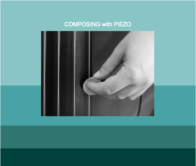
"Composing with piezo" is the title of my doctoral research which concerns the composition of instrumental music implemented with a specific use of piezoelectric microphones. During the research process, I explored a peculiar use of this technology not only to disclose and amplify the instrumental sound but also to produce otherwise unheard sounds, through a reinterpretation of some instrumental gestures, such as glissando, tapping, scraping, etc, produced by playing with the microphone directly on the instrument. Mainly because of the non-linear quality of unprocessed piezoelectric microphones, which thus present limits and different degrees of controllability and predictability - their introduction in my compositional work changed the relationships with the instrumental sound matter, bringing to question different aspects of my compositional approach. Therefore, during the whole research process, I looked for frameworks, theories, and examples, to understand and bring focus to my evolving compositional practice.
Fast- and Stop- frame, and Real- time: video's comment on matters of observation of perception considered through drawing
(2022)
author(s): Mike Croft, Safa Tharib
published in: i2ADS - Research Institute in Art, Design and Society
The exposition is a presentation of work in progress, also involving reflective commentary, by two collaborators in a research project titled 'The Observation of Perception: considered through drawing', hosted by i2ADS Research Unit of the Fine Art Faculty of Porto University. The collaborators, a digital visual artist and an analogue-focused fine artist, are respectively involved in the research through visual story-telling and video, and drawing and its audio-visual recording. In the present circumstances, each of the works is considered through its video element specifically in relation to several manifestations of time. In the digital visual artist's case, time is formatted through and as fast-frame and stop-frame, and in the fine artist's case, real-time and a psychoanalytical inflection on real, often appearing in the literature capitalised as Real. The first author, who provides the written reflection, is the fine artist, while substantial visual work, a published paper, and some critical intervention is provided by the digital visual artist as a second author. The first author takes as a directive, aspects of the second author's paper, and reflectively critiques both his and his research collaborator's time-based work in their video manifestations. Theoretical references are to the digital visual artist collaborator Safa Tharib, the philosopher Henri Bergson and the psychoanalyst Jacques Lacan. The exposition ends with a question that emerges from the commentary, as to the applicability of the indexical signifier to consideration of digital as well as analogue practice.