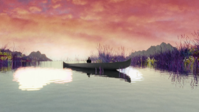
Sounds of walking: Can sound re-present the embodied experience of movement time and distance in the landscape?
(2024)
author(s): Martin P Eccles
published in: Research Catalogue
In this thesis, having introduced my research questions, in Chapter 2 I present a layered analysis of the important contexts of my practice—walking, sound, walking poetry, and place. In Chapter 3 I present and discuss three works that together explore how it is that I know the world as a sensate embodied walker. In Chapter 4 I develop what I came to call replicated walks—walks made more than once in the same place. Begun in order to re-configure time, they also led me to extend my consideration of place beyond that defined by geography, to place defined by biological phenomena or socio-cultural coherence. In Chapter 5 I describe my emerging ideas of human-scale of place and my underlying ideas of island-ness. Initially I worked on real islands, walking circumferential routes and those defined by chance procedures. From this I developed an imaginary island in the foothills of Northumberland’s Cheviot Hills; made from the human-scale of my embodied walking this led to my creation of an imaginary pandemic island of containment, created in a city, in my locale, made, and made real, by the traces of my embodied walking. Together my works constitute a body of work that represents a contribution to knowledge with specific contributions of: the use of Replicated Walks as a method of experimenting with time and place; Walking Words – the presentation of poetic text in forms (concertina-fold books, scripta continua, scrolls) that requires walking to engage with it, and that also function as metonyms for my original walking act; Walking Islands –the use of human-scale walking to imagine an island into existence, and then invoke the island as a lens through which to continue to pursue the idea. My work also contributes knowledge to the methods of how to record the sounds of the world whilst walking through it, over extended distances and time.
Creating an audiovisual performance through interdisciplinary collaboration
(2024)
author(s): Sanne Bakker
published in: KC Research Portal
Research exposition of Sanne Bakker, as part of her master at the Royal Conservatory of the Hague.
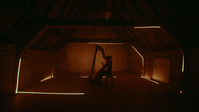
This research started with the aim of creating a better theoretical understanding and breaking down the creation process regarding the making of performances with lights. Ultimately, it became a reflection on the performative practice of a classical musician and the interdisciplinary collaboration while making an audiovisual performance. In particular, the process of the visualization of music. Through literary research into interdisciplinarity, audiovisual performances (specifically with classical music), and by doing a musical and narrative analysis through a case study of Paul Hindemith’s Sonate für Harfe, a theoretical framework is created for collaborative preparation with a visual artist and live experimentation. This research then shows the working process and the experiments that were conducted. It concludes with a reflection on the collaboration, the final product, and how playing the harp sonata in this audiovisual setting has affected the performance of the music.

Stereotype of the Devil: SATANIC PANIC
(2024)
author(s): Jakub Pavlík
published in: Research Catalogue
A visual study/moodboard/presentation of a certain conspiratorial and often delusional stereotype of the character of the devil in the context of what was known as "SATANIC PANIC" in the era of 80's and early 90's in the US.
Even though many of these associations come mainly from the western world, they have been more or less understood and recognized as "devilish" across the world and in the visual culture.
There is a certain stereotype about calling something "SATANIC". Labeling things, activities, clothing, art, products, people etc. as "devil worshipping" often isnt connected to any kind of worship what so ever.
There is this re-accuring act of calling out something as "Satanic" often snowballing the situation into an idea of an active threat, thats dangerous to the public.
The "SATANIC PANIC" era lead to over a 12,000 unsubstantiated cases of these so called "Satanic practices" and many people ended up in jail because of it.
This Satanic labeling has become a parcipatory missinformation quest.
I HAVE THE MOON: aesthetics of contemporary classical music from a composer-performer band retreat.
(2024)
author(s): Samuel Penderbayne
published in: Research Catalogue
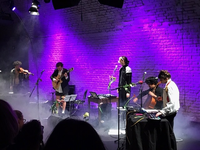
The artistic research project I HAVE THE MOON was an experimental group activity or 'band retreat' for five composer-performers resulting in a public performance in the aDevantgarde Festival, 2019, in Munich. Research was conducted around a central research question stated verbally at the outset of the project: how can aesthetic innovations of contemporary classical music be made accessible to audiences without specialist education or background via communicative techniques of other music genres? After a substantial verbal discussion and sessions of musical jamming, each member created an artistic response to the research question, in the form of a composition or comprovisation, which the group then premiered in the aDevantgarde Festival. The results of the discussion, artistic works and final performance (by means of a video documentation) were then analysed by the project leader and presented in this article. The artistic research position is defined a priori through the research question, during the artistic process in the form of note-taking and multimedial documentation, and a posteriori through a (novel) 'Workflow-Tool-Application Analysis' (WTAA). Together, a method of 'lingocentric intellectual scaffolding' on the emobided knowledge inside the creative process is proposed. Insofar as this embodied knowledge can be seen as a 'field' to be researched, the methodology is built on collaborative autoethnography, 'auto-', since the project leader took part in the artistic process, guiding it from within.
MA: digital demons
(2024)
author(s): Johannes Rydinger
published in: Stockholm University of the Arts (SKH)
Digital Demons deals with themes of religion, shamanism and spirituality.
These are some traces of media matter that surfaced during the two year masters program The Art of Impact at Stockholm University of the Arts.
Among them are videographic essays, video sketches and a recorded performance that all have worked as research tools for finding an aesthetic language and narration structure that can be used in documentary and hybrid filmmaking.
Musical Psycho Performance
(2024)
author(s): Gianmarco Moneti
published in: KC Research Portal
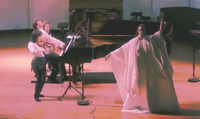
Although I love attending traditional classical music concerts, I have long felt that they missed certain aspects that would make them more relatable to the inner world of the audience. In this research exposition, I argue that this missing aspect is a social element and I guide the reader through a possible application of social themes to a classical music concert. On a formal level, I use the techniques of psychodrama – a form of group therapy – as a tool from which I borrow some fundamental concepts, along with the conception of characters, to understand how social themes can be addressed in a context in which multiple people connect to the same object. In this case, the object of common interest is the representation on stage. On a substantial level, I draw upon material I collected in my interviews with Clara Scarafia to study a social theme she has been directly involved with: suicide. The two levels are brought together in my pilot session, where I experiment through a sample of the complete performance I am designing and an audience questionnaire how psychodrama and the interview interact and influence one another. The goal is to show that the classical repertoire, with its complex emotional kaleidoscope and non-verbal language, can easily bear a social theme and enhance the collective reflection of relevant themes in our times.