Solidifying the Ephemeral: The Alchemy of the Liquid Canvas
(2026)
author(s): Giusirames
published in: Research Catalogue
Title: Solidifying the Ephemeral: The Alchemy of the Liquid Canvas
Artist-Researcher: Giuseppe Rametta Giusirames
1. Professional Biography
Giuseppe Rametta Giusirames is an Italian artist and material researcher whose practice lies at the intersection of contemporary art and chemical experimentation. Rejecting standardized industrial media, he develops proprietary material mixes, treating the creation of the "base" as an integral part of the creative act.
His most significant breakthrough is a specialized technique designed to "solidify the sea," transforming the fluid and ephemeral nature of marine environments into a permanent, solid canvas. Through his work, he explores themes of environmental memory, the alchemy of matter, and the tension between natural flux and artistic preservation. His studio is a continuous laboratory where traditional aesthetic values meet innovative material engineering.
2. Research Statement
This research focuses on the chemical and poetic transformation of natural and volatile elements. The core of the project is the stabilization of fluid environments through a unique technical process.
Material Hybridization: Sea, Smoke, and Antisepsis
My investigation extends beyond seawater to the stabilization of other volatile and antiseptic substances:
* Seawater: Capturing the essence of the ocean to create a structural canvas.
* Amuchina (Chlorine-based solutions): Integrating antiseptic elements to explore the tension between hygiene, sterilization, and nature.
* Smoke: Attempting to fix the weightlessness of air and fire into a solid surface.
By inventing these material compounds, I investigate how artistic practice can "fix" a moment of environmental flux without losing its vital energy.
3. The Poetics of Painting on the Sea
For me, painting is not a gesture performed on a surface, but a dialogue with an element. To "paint on the sea" means to accept the fluid’s rebellion before fixing it into eternity.
It is a poetic act of translation: capturing the rhythm of waves, the transparency of the water, and the ghost-like presence of smoke within the physical constraints of a canvas. This practice transforms the artwork into a relic of a moment that was, by nature, impossible to grasp.
4. Visual Documentation
Per le tre foto che mi hai inviato, usa queste descrizioni:
* Figure 1 - Organic Textures: A demonstration of how the proprietary mix creates an organic "skin," allowing pigments to settle in a cellular structure.
* Figure 2 - Marine Diffusion: The interaction between color and the solidified sea base, mimicking the natural movement of underwater currents.
* Figure 3 - The Molecular Membrane: A macro view of the stabilized material. This transparent, alveolate structure proves the successful transition from liquid/volatile states to a solid artistic medium.
The Art of Entrepreneurship – Entrepreneurship as Artistic Practice Entrepreneurship in the Artistic and Cultural Sector
(2026)
author(s): Christer Windeløv-Lidzelius, Tinna Joné
published in: Research Catalogue
This exposition documents The Art of Entrepreneurship – Entrepreneurship as Artistic Practice, a two-year artistic research project exploring how artistic work moves from idea to public encounter. The project investigates how artists and cultural practitioners in a Swedish context navigate aspirations, impact, collaboration, interdisciplinary processes, audience relations, and new forms of distribution. Through interviews, reflective inquiry, and the creation of audio-visual material, the research examines how entrepreneurial methods and models are understood, adapted, or resisted within artistic practice—and how these methods might support more sustainable artistic trajectories.
The project’s knowledge-creating approach is grounded in artistic research and co-creative methodology. Rather than treating artists as objects of study within an economic discourse, the research situates entrepreneurial thinking within the artistic field itself. Using mixed methods, including literature review, semi-structured interviews, and collaborative filming, the project brings forward stories of artistic processes, agency, urgency, and the conditions under which artistic ideas materialise and generate societal impact.
The exposition presents early findings, thematic patterns, audio-visual portraits, methodological reflections, and ongoing analyses. It also contributes to the development of pedagogy in entrepreneurship within the arts, informing existing SKH educational programmes and supporting the emergence of new content. As a whole, the exposition serves as both documentation and a platform for continued reflection, dialogue, and future publications derived from the project.
Cultural Entrepreneurship as Public Infrastructure: Enabling the Conditions for Sustainable Cultural and Artistic Practice
(2026)
author(s): Christer Windeløv-Lidzelius
published in: Research Catalogue
Cultural entrepreneurship is commonly discussed in relation to individual agency, innovation, and participation in cultural markets. While these dimensions are important, such framings tend to foreground personal initiative while underarticulating the infrastructural role that entrepreneurial practices play in sustaining cultural and artistic life. This article proposes a reframing of cultural entrepreneurship as a form of public infrastructure: a set of organisational, relational, and institutional practices that enable cultural work to exist, persist, and circulate over time.
Rather than presenting an empirical study, the article advances a conceptual argument grounded in long-term engagement with artistic education, project development, and institutional contexts. It suggests that cultural entrepreneurship functions less as a pathway to individual success than as a shared enabling system that absorbs risk, maintains continuity, and mediates between artistic, economic, and institutional logics. In many sett
Choreokratic Ecologies - An Archive of the Murmurations Project
(2026)
author(s): Carlos Eduardo de Carvalho Mello
published in: Research Catalogue
This exposition is an archival gesture emerging from the Dramaturgical Ecologies research-creation collective. Rooted in the entwined inquiries of Blacknesses and Dramaturgy, it gathers the dialogues, encounters and an artistic residency that unfolded through the SSHRC-funded Murmurations project. Between the viscous resonance of okra and the shifting flight of murmuring birds, this exposition shares choreokratic ecologies - a garden of study where movement, thought, and relation co-compose. Here, Blackness becomes a method, a lens, a refrain, challenging the neutrality of the performer-dancer body and inviting modes of collective creation that are relational, porous, and opaque. Murmurations attends to what forms in the formless - like a swarm of birds: a living archive of bodies, voices, and ecologies composing a landscape.
Costume Dramaturgies
(2026)
author(s): Christina Fossaas Lindgren, Charlotte Østergaard
published in: Stockholm University of the Arts (SKH)
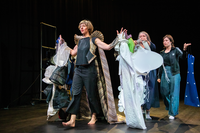
With the artistic research project Costume Dramaturgies we explore the dramaturgy that emerges when performance takes an unconventional starting point: a costume – a thing. By approaching dramaturgy as an assembly of things, we shift perspective from the human to the non-human, giving agency to costume, props, and light in performance. We argue that the dramaturgy of things remains an under-researched area in the performing arts.
The one-year project is funded by Stockholm University of the Arts and brings together 12 researchers from costume design, dramaturgy, mime acting, LARP, film direction, theatre studies, scenography, and performance art. This multi-perspective, poly-vocal approach aims to generate a nuanced understanding of dramaturgy of things, and includes workshops based on devising methods—most notably the Costume Jam Session, where participants interact with costumes through chains of action, followed by reflection on the dramaturgy that emerges. The project is a continuation of the artistic research project Costume Agency.

The Opener - sharing the performer’s process
(2026)
author(s): Einar Røttingen
published in: Faculty of Fine Art, Music and Design, University of Bergen
The Opener - sharing the performer’s process was a one-year artistic research pilot project (March 2024 - March 2025) funded by strategic funds at the Faculty of Fine Arts, Music and Design, University of Bergen. It was part of the Grieg Academy Research Group for Performance and Interpretation (GAFFI) together with external members from The Academy of Performing Arts in Bratislava. The project consisted of 8 sub-projects and educational activities, involving different instruments: piano solo, violin, duos with voice and piano, clarinet, accordion and guitar.
The term opener can in this project proposal symbolize a three-fold meaning connected to the music performance field. This project seeks to
- see the performer as an opener of musical meaning in a performance (interpretation of musical intentions in scores and improvisation)
- challenge ourselves as performers as openers that share his/her artistic work (getting insight into the creative process and methods)
- finding openers as tools to reveal and show the creative process of performers (ways of showing the artistic process)