A Diffractive Commentary
I’ll begin by considering as a whole the category of works that form Norths. The works in Norths are sound environments and sounding objects. Each intersects with some form of environmental data. I am making these to function as physical sites for the practice of critical thinking that has arisen out of my recent and ongoing research into the nature, use, perception, and understanding of information in environments. In contrast to that component of my research, which finds its output in written form, the actuality of the artworks in Norths are material manifestations of ideas, provocations, or propositions.
As material objects and sounding process, Norths invites a sort of elemental participation in the form of a perceptual response. The composition of the works lend themselves to contemplation in a variety of ways. Although the works sonify data, the data cannot be ‘read’ from the works as one reads measurements from a graph. Instead, the works use sound and data to create new environmental behaviours and dynamics that inspire laughter, curiosity, or frustration.
As discussed in the sections detailing each piece, some of the behaviours of the works exhibit a kind of uncanny mimicry in relation to an aspect of the subject matter of the piece, or to a natural environment. This is the case in Bird on a Wires, for example, in which a data sonification is presented by a bird-like sculpture who sings in birdsong-like fashion. In other cases, like Constellation, expectations as to the behaviour of data, wave-data in this case, are frustrated. This draws attention to a fundamental disconnection between perceptions of data as a stand-in for the phenomenon it measures and the phenomenon itself, a subject discussed later in this section.
The proposition collectively materialised in these works is that it is an error to assume that the experiencer and the experienced environment are separate from each another. This proposition is materialised by inviting visitors to consider that all data is gathered from a perspective. This proposition becomes more robustly phenomenological with the further consideration that all perception whatsoever arises from a perspective. The works are composed with the aim of encouraging this sort of contemplation. At times, of course, the mood is humorous or even chaotic, but nevertheless, this points to a form of critical contemplation.
The form of the pieces in Norths exhibit what philosopher Timothy Morton describes as ‘weird embodiment’, a kind of cross-modal twisted loop (Morton 2015, 2016). The works are open to the world, in that they utilise real-time data from remote locations, transplanted to the zone of exhibition. Yet the pieces are also isolated from much of the world through their enclosure in an exhibition space. The twisted loop also manifests in the works themselves, within their internal structures as twisted networks. Constellation is a scatter of small boxes spread across the floor in imitation of the sensor array it sonifies data from in real time. Bird on a Wires is a small closed-circuit network consisting of a decorative bird, loudspeaker, motor, microcontroller, and gyroscopic sensor. Brraaap and Gate are both cross-modulated feedback networks that sonify internet traffic entering the exhibition. Trve Norths networks a remote magnetic field sensor in Sweden to two small speakers, a chair, and a listener (as the data as sound manifests a psycho-acoustic phenomenon experienced by a person who sits in the chair).
The metaphysical attribute of Trve Norths just mentioned can be extended to the Norths-works as a whole: visitors are central to these pieces and complete the works. The ontology of the Norths-works is not entirely embodied in their material apparatus. Instead, perceivers are required complete the network. At present, none of the Norths-works are interactive in the sense that visitors’ behaviour alters the sound or behaviour of the piece. However, perceptual activity, intention, and wilful decision-making shape visitors’ experiences, rendering them immediate participants in these environments.
The relationality of agency in perceptual understanding that I seek to foreground in Norths resonates strongly with philosopher-physicist Karen Barad’s notion of intra-activity. Intra-activity assumes an a priori connection rather than disconnection between visitors and environments. While the activity carried out in these environments may not be interactive in the conventional sense of a visitor’s behaviour altering the work, these environments are instead intra-active. Each piece, in its own way, becomes a site for an entanglement of agency and identity between visitors and the piece that constitutes intra-activity (Barad 2007). The ecological relationship proposed takes the form of an invitation for visitors to perceptually and conceptually interrogate their embeddedness in Norths. By extension, this activity can then be extended into the everyday world outside the exhibition space.
It is important to note that, despite the fundamental recognition of embeddedness and connectivity I have emphasised so far, there is no ‘correct’ response, nor one I have sought. As in a natural environment, there are no prescribed or proscribed responses. I am instead interested in how perceivers, of which I am one, navigate the pieces. I am interested in what they do with the pieces perceptually and contemplatively. For this reason, where recourse to visual metaphor is required, I adopt another aspect of Karen Barad’s terminology, that is, ‘diffraction’ over ‘reflection’ (Barad 2014). Barad contrasts diffraction with the more commonly used term ‘reflection’ by first highlighting that reflection reveals mirror-like images that purport to represent singular, often static notions of truth. By contrast, diffractive methodologies reveal a dynamic reality of potential trajectories that attend to the differences emerging from the complexity of entanglements between a multiplicity of individuals and things. I refer to the corollaries I draw from the Norths-works to be ‘diffractive’ in that, while they are useful in the discussion that follows, they will not find identical form to that which arise from others’ entanglements with the same works.
The intra-active aspect of the Norths-works suspends any assumption of fundamental disconnection between a person and their environment, or between a subject and an object. The diffractive rather than reflective approach meanwhile invites them to perform their own reading of the circumstances within which they find themselves. However, in the absence of the pieces themselves, for the reader of this text, the question ‘what does one do with Norths?’ is significant.
The form of activity one undertakes simply by being there can also be thought of in terms of ecological relationships. Examination of this relationship by those involved within it constitutes a form of phenomenological entanglement also theorised by Barad in terms of an epistem-ontology. Epistem-ontology unifies notions of being (ontology) with theories of knowledge (epistemology). In the epistem-ontology of the laboratory practices Barad studies, the relationship between being and knowing takes the form of an entanglement (Barad 2007). For Barad, an entanglement occurs between an experimenter, an apparatus, and the object of study in a scientific experiment. An agent, involved in this system, acts. The activity could be a measurement, or even an act of mere perception. Yet, this agential act performs what Barad refers to as a ‘cut’ by which the future state of the system is both revealed and determined.
In Norths the intra-action might seem to be less dramatic. However, in several Norths-works, as in Trve Norths discussed previously, the unity as an objective ‘piece’ is relative to a psycho-acoustic or perceptual activity enacted by participating visitors. These are active agents who reflect on their experience and diffract possibilities back. Visitors perform a ‘cut’ when they take a perspective. When they do so purposefully, this activity becomes phenomenological. The works themselves are composed to encourage circumstances for this to happen, but they depend upon a stream of data from the ‘outside world’ to do so. This hybridity is ecological, a weird ecology.
Following James J. Gibson’s notion of ecological dynamics, the Norths-works afford certain opportunities to visitors (Gibson 1986). But what opportunities? While these vary with each specific piece in Norths, discussed in the piece-specific sections to follow, the affordances offered are primarily aesthetic in nature. In relation to the Norths-works, the activity of perspective taking, the agential ‘cut’ (to use Barad’s term), and as performed by visitors, becomes an aesthetic act.
The sense by which aesthetics is to be understood in relation to Norths diverges from the meaning largely adopted in Western culture from the 1700s to the present. Instead, the notion of perspectival shift as an aesthetic action takes its sense from the Greek term from which ‘aesthetics’ is derived. αισθητικη´ aisthitiki, from aesthesis, simply indicates ‘to be perceived by the senses’, to be ‘felt’ (OED 2025; Shelly 2022). New experience yields new knowledge, and so aesthetics, in this foundational sense indicating primordial perception, has a strong epistemological dimension: the experience and result of aesthetic experience are shifts in perspective leading to new knowledge.
The installation environments of Norths ecologically afford visitors shifts in perspective by inviting them to experience sound as ‘feeling’. The word ‘feeling’ in this exposition is used in a textural rather than emotional sense. By texture, I refer to that which can be described by touch and tactile metaphors. Tactile descriptors are particularly apt for descriptions of dynamics based on sonic density and surface, and for how sound-material processes interact (Boehringer 2019). In departing from traditional Western formal approaches to sound composition, it is useful to adopt a new vocabulary for their description in the hope that new forms of experience follow from this.
Designing for physicality in sound results in a sound that is felt and thus understood in terms of texture. Although the Norths-works often rely on data sonification in the background process of how they are created, the data tends to control the behaviour of the sounds, as textures, more than their individual spectral morphologies. Thus, despite the ubiquitous use of data in these works, the data-as-sound is not meant to be ‘understood’ in the sense of being ‘read’ but rather is made intelligible as ‘felt’ information.
Sound-as-texture finds its natural presentation in spatial arrangement, and in the Norths-works spatialised sound and unconventional loudspeaker placement and materials are inseparable from other aspects of the sound design. Space, sound, and material emerge together in the Norths-works. This approach contributes to the aesthetic situating described previously: primacy is given to listening to sound as experience, sensation, something felt, rather than something linguistic or symbolic. The combination of textural sound and spatial presentation emphasises sound’s physicality as a phenomenon. Listeners are invited to navigate the space and sound in a fundamentally empirical manner. Following this, having begun with a primordial place of listening, more complex reflections may naturally follow.
In the Norths-works, the avoidance of many technical and aesthetic assumptions of the type discussed previously aids in opening a new space for contemplation. In Norths, space is designed to resist sedimentation of this approach atop other more traditional assumptions. Instead, the use of unconventional loudspeaker materials and placement critiques these assumptions and invites contextual awareness of Norths as a new space, one of potential phenomenological insight. This is one of the many ways that ethical and aesthetic dimensions intersect in Norths. Along similar lines, composer Pauline Oliveros sought the freedom to practise perceptual fluidity through textural, attentive, ‘deep listening’, a fundamental openness to the world. Oliveros characterised deep, active listening as a ‘birthright’ that allows movement between contexts and an experience of reality from multiple perspectives (Oliveros 1999, 2011). In deep listening, the listener retains a fundamental agency that renders listening active rather than passive, even when silent.
The individual capacity for action, present even while exercising non-action, challenges contemporary institutional dependence on data, as a stand-in for phenomena and a proposition of ‘truth’. The silent non-actionist retains their individual responsibility of how and where to act, based on what they take to be true from the environment they are immersed in. When engaged in active listening, the action performed is not non-action, even though this activity may be evident only for the listener themselves. Thus, in a societal context faced with a description of reality based on data, the silent but active listener performs an act of quietly radical empiricism, personally reclaiming agency from authoritarian or market-driven forces.
Norths uses textural, spatial sound to invite listeners to participate as agents in the perspective they take on what they hear. In Norths, data is sonified not to shed light on the data, nor on remote phenomena by analogy, but to create new experiences through a listener’s free negotiation of the works themselves. As in Oliveros’s Deep Listening work, the aesthetic and ethical dimensions intersect. This relationship is highlighted by both anthropologist Tim Ingold in The Perception of the Environment and philosopher Maurice Merleau-Ponty in The Structure of Behaviour, in terms by which the fundamental ethical dilemma of ‘what to do’ can be directly related to the aesthetic question of ‘what is sensed’ (Ingold 2011; Merleau-Ponty 1983). In Norths what is sensed is primary, and affords opportunity for agential action, intersecting the ethical dimension, which asks, ‘what is to be done?’
From ‘Overview’ to ‘Insight’
I am seeking what is usually called an ‘overview’: a vantage point from which I will draw corollaries from insights emergent in the development of Norths. Yet is ‘overview’ the correct term for this process? The ecological perspectives discussed in the previous section suggest that we should not seek Norths by ‘zooming out’ as though from a ‘polar perspective’. Instead, Norths is to be accounted for as a participant, who experiences the works from within. As the works themselves are not present in this largely linguistic exposition, what is of concern in exposing practice as research is my own perspective as participant-creator of these works. Therefore, the remainder of this section, forming the main body of this exposition, is not occupied with a description of the works. Instead of an ‘overview’ Norths should be understood in terms of ‘insight’, therefore, what follows is a broader discussion of conceptual corollaries arising out of my own participatory entanglement with these works and data sonification.
Three critical challenges emerge throughout this exposition, as they have throughout the process of making the Norths-works. These are listed here as a means of framing the more detailed discussion to follow:
The first challenge concerns how the Norths-works materially situate circumstances for individuals to take a critical stance on how their environments are constituted. Criticality in these relationships arises from dissonance between perceptual frames of reference that individuals bring to their experience of my work. Such dissonance often arises out of expectations as to what data means or does.
The second challenge interrogates how standards of measurement are applied to understanding, and how understanding is communicated. In seeking a basis for intelligibility in relation to an environment, it is necessary to investigate the relationships between measurement, data, objectivity, belief, and truth. The pieces in Norths address and even lampoon these issues in the diverse ways discussed in the sections to follow.
A third challenge concerns how Norths as a whole situates the scepticism performed by challenge two with the critical context implied by challenge one. The result is an aesthetic field that is energised by an ethic of enactive phenomenology.
The first of these challenges is ontological. It concerns the being of environments that are inclusive of embodied participants within them, as well as the necessity of adopting a critical context from which this becomes clear. Norths makes first steps towards providing a space from which perspectival shifts towards the necessary sort of contextual consciousness may arise.
The second challenge is epistemological. It concerns how knowledge of one’s environment and the beings and objects in it is to be attained and communicated. The two challenges are revealed to be different according to perspective by the third. These challenges emerge for individuals through action and perception and exemplify the everyday ethical and aesthetic challenges are inevitably encountered by individuals in any environment be it a city park, a forest, or an art installation.
To summarise, the pieces in Norths aim to situate circumstances for visitor participants to perform phenomenological shifts in perspective enacted though listening experiences. In the text to follow, I explain how this work has arisen within my practice as a whole. Drawing upon this, I apply a reflective-diffractive approach that unpacks material propositions and conceptual corollaries operating across Norths. Subsequent sections then detail each specific piece, locating the themes discussed here within the material manifestation of each work. Together the insights expose artistic practice as research.
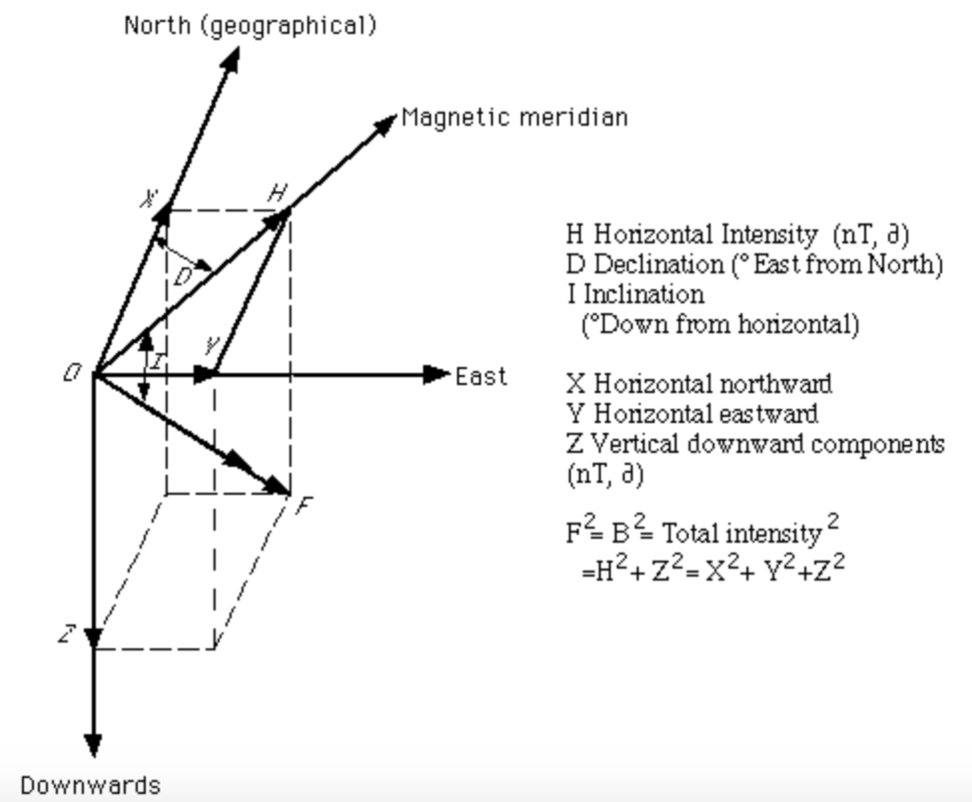
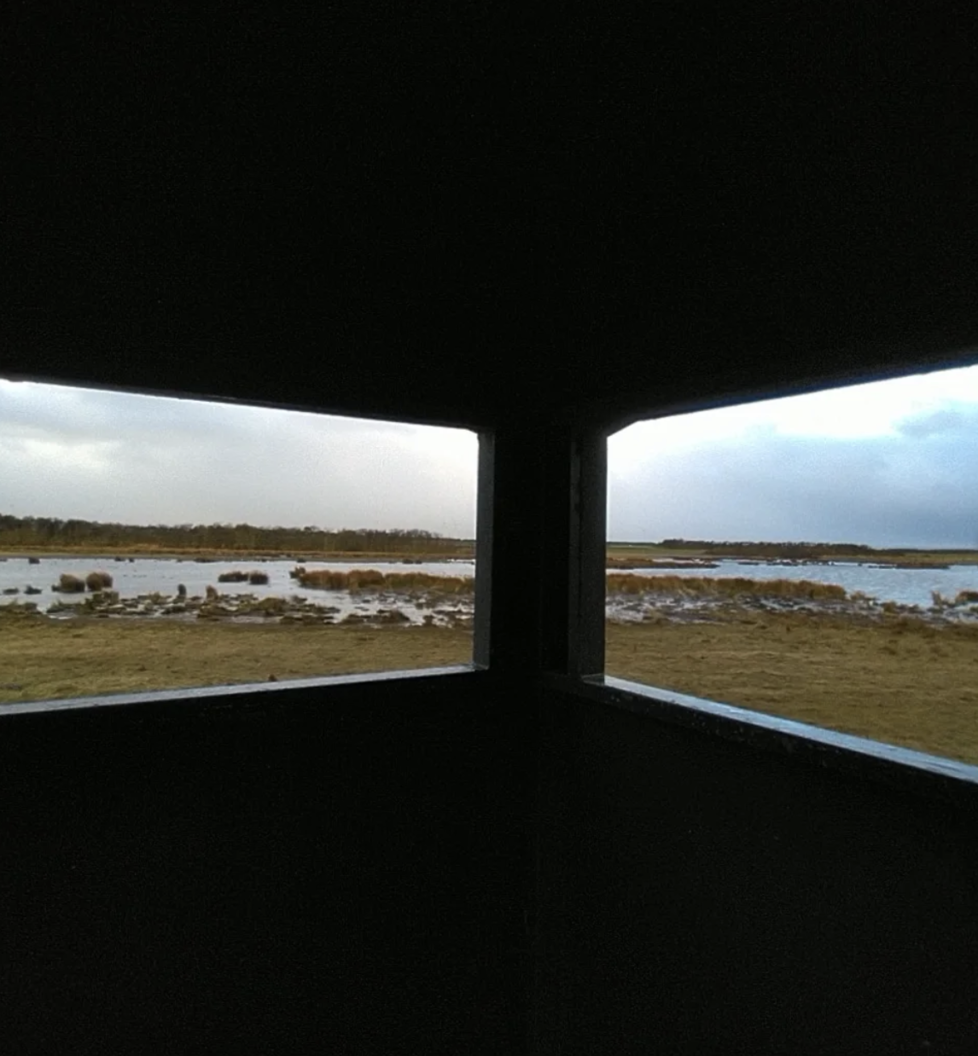
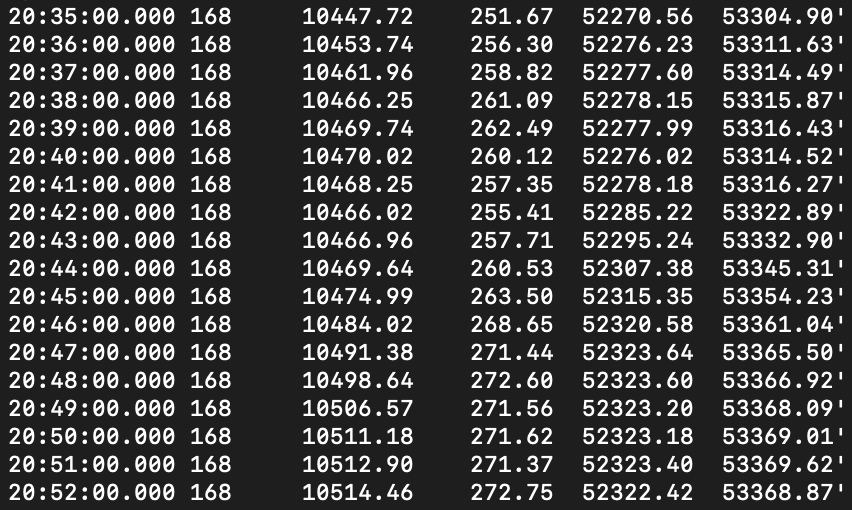
The image above, from the IRF website, a key source of data for some of the Norths-works, illustrates a scientific means of gaining a perspective on a phenomenon (magnetic declination) (IRF 2023b). The photograph below illustrates a visual means of taking a perspective on the landscape.