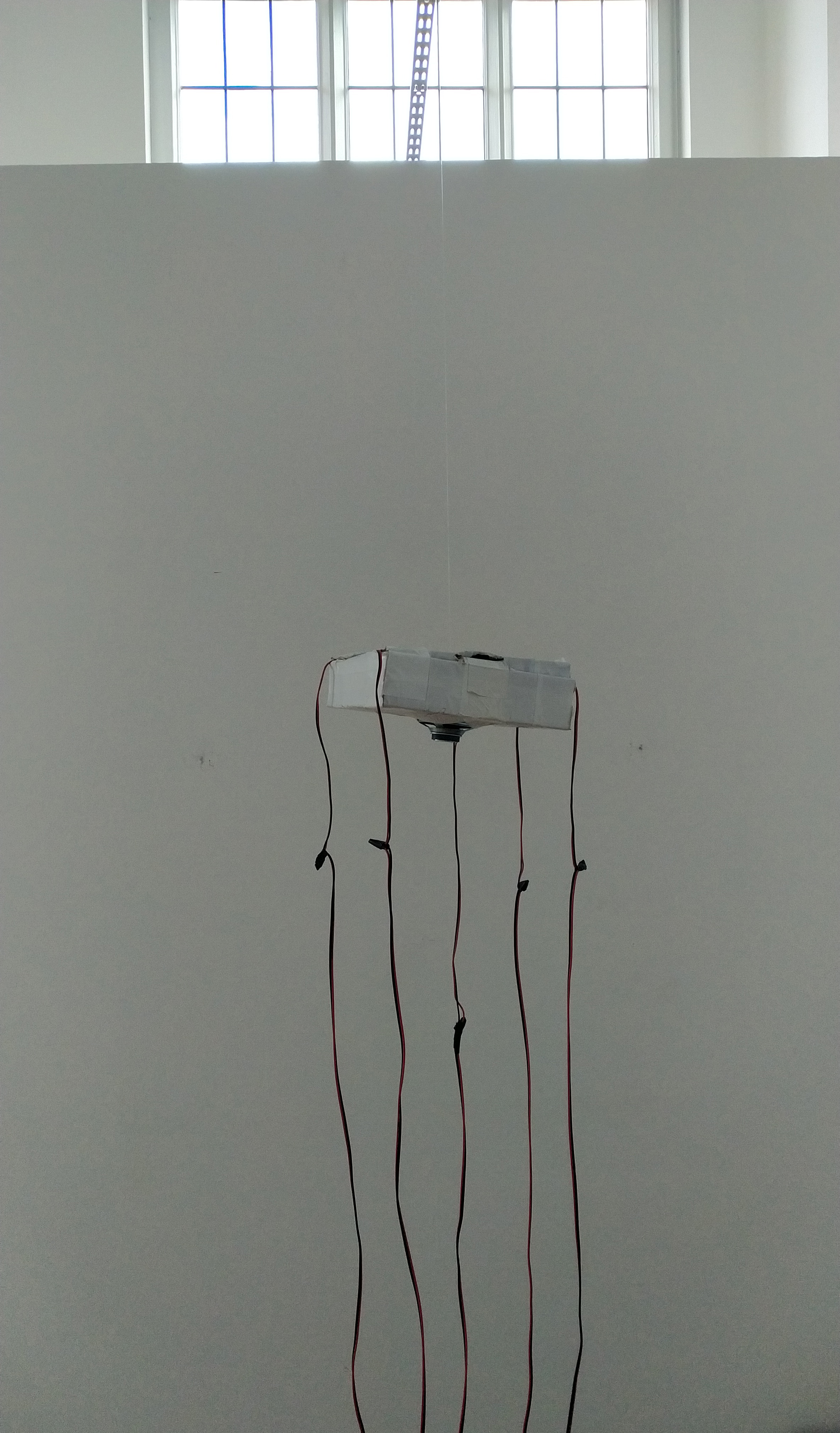
Local Seis
(cardboard, accelerometers, computer, small loudspeakers, fishing line)
Local Seis allows us to hear local disturbances in spatial position in real time as they occur. The outward form of the piece mimics, in miniature, boxes that encase sensors at the Eskdalemuir Observatory (BGS 2025). At the observatory, these boxes shield the sensors from local signals that would interfere with the remote movement the sensors are intended to measure. However, in Local Seis the box, suspended in the air by microfilament, contains both sensors and sound production components. While sensors and measurement apparatus are typically designed in a way that minimises or eliminates environmental or observer influence in what is being measured, in Local Seis they are intimately entangled. The visitor is also invited to become entangled with the immediate environment through the mediation of the work.
The piece is suspended about two and a half metres above the floor with fishing line. It is free to swing and turn about its axis. Inside the suspended box is not a seismograph but a device containing a three-axis accelerometer set. The device is free to rock back and forth within the box but resides approximately at the centre. The sensors return values for acceleration along orthogonal X, Y, and Z axes. The device cannot distinguish between linear and rotational motion as a gyroscope might. Instead, it provides five channels of raw data in the form of three orthogonal accelerometer measurements (X, Y, and Z), along with values between negative and positive ninety degrees for vertical pitch and horizontal roll. These changing values are sonified. The sound is produced from a set of five small loudspeakers built into the housing of the white box sensor setup itself. Thus, the vibration of the speakers is picked up as a largely continuous source of ‘background noise’ to the sensor set itself, creating a situation of constant feedback that would be intolerable for a functioning seismometer.
Local Seis utilises vibration feedback that would normally be eliminated from seismic observatory systems. Raw sensor data is sonified in a one-to-one manner, rescaling the data to lie within the audible range and using it to ‘play’ a very simple software synthesizer. The synthesizer allows for the blending of sine, saw, and square waves, which can be tuned to the resonances of the exhibition space. The feedback system does not create a consistently amplifying feedback, as results from the Larsen effect (such as occurs when a live mic in a room is focused toward a sound output source [Rane 2005]). Instead, data not direct sound signal is what is sonified, and the sonification occurs through synthesis, not merely by amplifying a microphone. Thereby, the steady stream of vibratory feedback generally attains equilibrium and results in a stable flow of ongoing measurement data, unless the whole system is substantially and violently moved. The resulting sonification hums along rather consistently, providing a continuous background sound that behaves as a perceptual frame of reference. Raw data can be heard as modulation in pitch, creating shimmering waves within this steady drone-like continua. Local Seis creates a kind of audible mantra as it performs its nonhuman embeddedness in its environment.