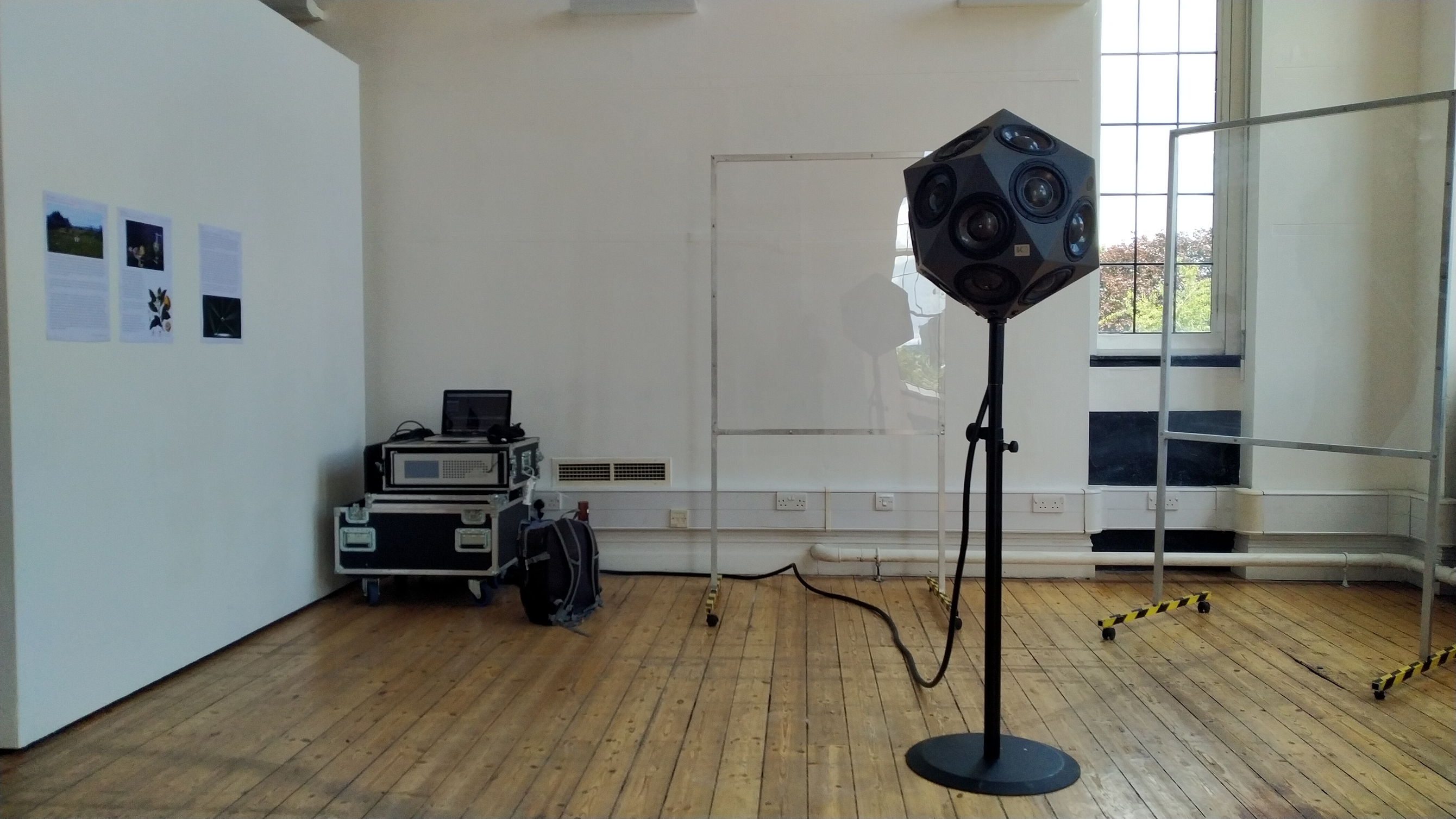
The IKO Speaker Array
The IKO speaker array was developed by Sonible and the Institut für Elektronische Musik und Akustik (IEM) in Graz, Austria. As one of the most compact higher-order Ambisonics arrays in the world, the IKO icosahedral speaker array consists of 20 loudspeakers that work together to form directional, shapable beams of sound (Sonible 2023). The sound beams are then reflected from surfaces within the listening space to create a spatialised sound environment capable of high-resolution sound localisation and movement (Sharma et al. 2014).
IKO generally renders frequency response and spatial attributes in a uniform manner for listeners in different spatial positions. It bears mention that with the use of IKO, the sound does not stand apart from listeners but shares and creates an interconnected listening space (Wendt et al. 2017; Zotter et al. 2017).
BRRAAAP
(installed spatial audio derived from data transmission, IKO Ambisonics loudspeaker array, reflective panels)
Brraaap is often exhibited with Gate and can be heard in a short video (below) documenting an excerpt from both pieces, which are themselves processes.
Brraaap uses the IKO icosahedral Ambisonics loudspeaker array (pictured below) to spatially sonify the size and frequency of data packages received from the Eskdalemuir seismic sensors in near real time (IRIS 2023; Nowacki et al. 2023). Data from the Eskdalemuir Observatory is also used in several other pieces in this exhibition. A more detailed discussion of this sensor array can be found in the essay on Constellation. Constellation sonifies seismic data values from Eskdalemuir, whereas Brraaap sonifies the structure of the data received and the behaviour of the data stream from its location on the receiving end of the internet.
An interesting attribute of Brraaap is that while it sonifies data described as having several dimensions, and contains measurement values that describe spatial displacement, the transmitted data it deals with has no clear spatial dimension. The term ‘dimension’ in reference to data refers to how many different measurements are included in a data package. If, for example, I create a data format that packs together measurements for length, width, height, and weight, this is described as a ‘four-dimensional’ data package. This is similar to geometrical dimensionality in the sense that were these attributes to be graphed, a four-dimensional axis would be required. However, in numeric and electrical form, its physical state and existence in space are difficult to classify. What is the shape of this data? One cannot easily break open a broadband fibre optic cable and peer into it to discover whether it is seismic data or a picture of a cow being transferred. Thus, an interesting spatial and ontological ambiguity, if not a fracture, exists in the relation of data to the phenomenon described.
Intentionally contrasting this, Brraaap sonifies this data spatially (the binaural recording on this page gives an idea of what this sounds like). This gives intangible data a spatial presence. In fact, in working through this piece, I determined to leave it at this admittedly rough level of precision. An informed listener can hear that something is occurring in terms of packages of information being released into the sounding space, but the piece makes no attempt to say anything more specific about this. The point is to physically experience something that is otherwise fundamentally intangible.
In choosing not to develop the sonification in Brraap further, this piece also illustrates a particular position on sonification. In this, my view differs from some within the auditory display community. Artistically, the experience of something otherwise inaccessible is in itself of inherent value. Leaving its interpretation open increases its value, as it leads to a multiplicity of understandings and the possibility for new insights by bringing these into dialogue. This option exists in marked contrast to fields in which it is insisted that the only valid or valuable use of sonification is one in which we are ‘taught about the data’ or in which the values of the data are ‘conveyed’ (Hermann 2008, 2025). Instead, in Brraaap, data remains immanent to the situation. It is not phenomenologically essential to know where or how, and this is not made explicit anywhere in the piece or the documentation.
The works in Norths form the beginning of a spectrum of fundamental approaches to data sonification. Trve Norths seeks to materialise an epistemological proposition about what the empirical understanding of complex data might feel like. Constellation sonifies data regarding seismic waves travelling through the earth only to collapse into its own failure to physically re-create the phenomenon of these ways, revealing a key aspect of its own ontology as a data object. Both Brraaap and Gate rely on data but relate to and participate in the world as further phenomena in that world. Somewhat ironically, Brraaap materialises the dimensionless and meaningless nature of its information packages using a very present physical object, the IKO Ambisonics speaker array. This apparatus provides the only physical anchor for a sound work that is otherwise completely immaterial, and is so individually striking it requires a further word.