Constellation
(data-derived audio, amplifiers, transducers, cardboard, wire, internet, programming)
So if you lie on the grass. So this could be where if the earth moves or not. So here we go. I feel the earth move under my feet. I feel the tumbling down the tumbling down. I feel if some ostriches are a like into a satchel. Some like them.
I went to the window and wanted to draw the earth.’
Philip Glass/Christopher Knowles/Robert Wilson, Einstein on the Beach (1976)
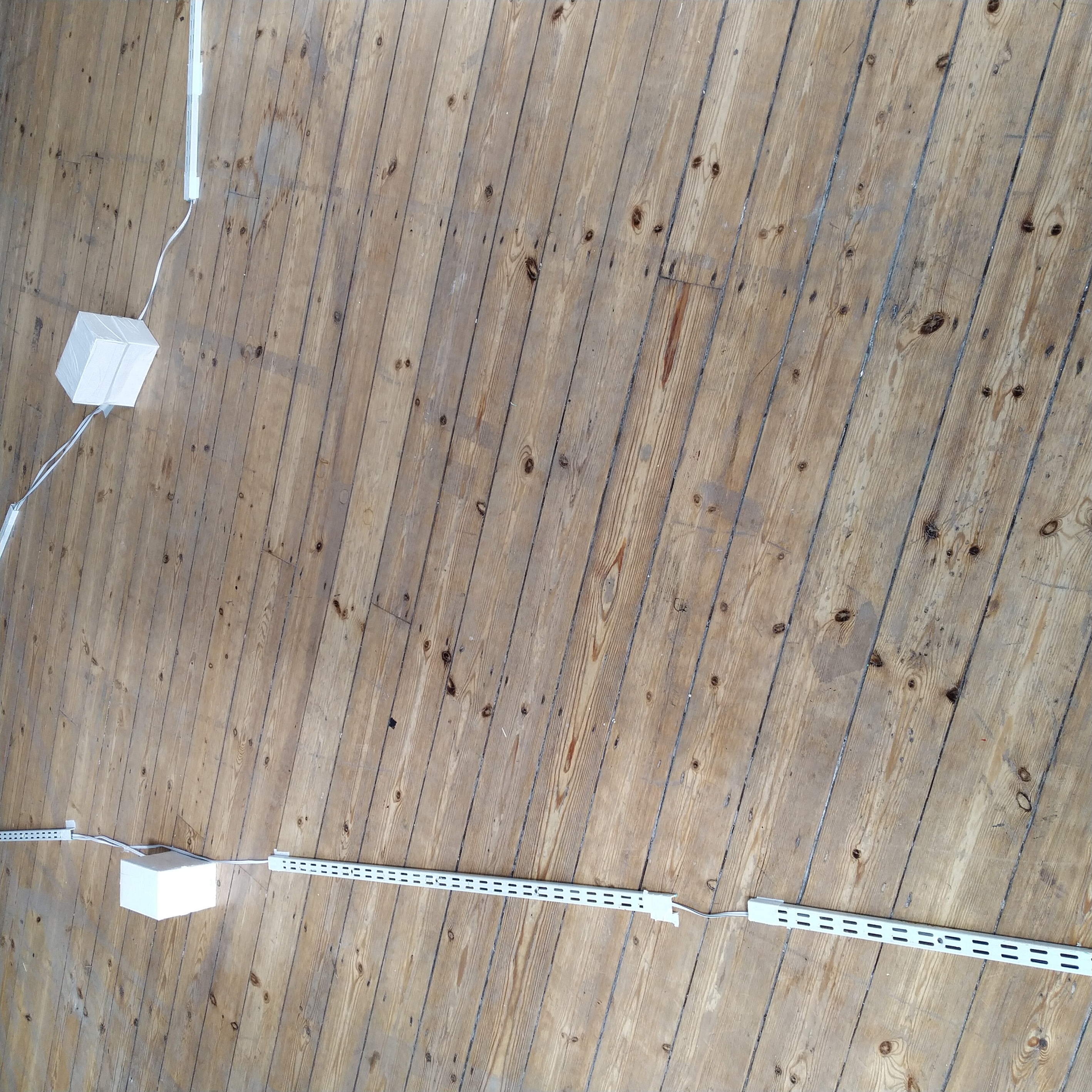
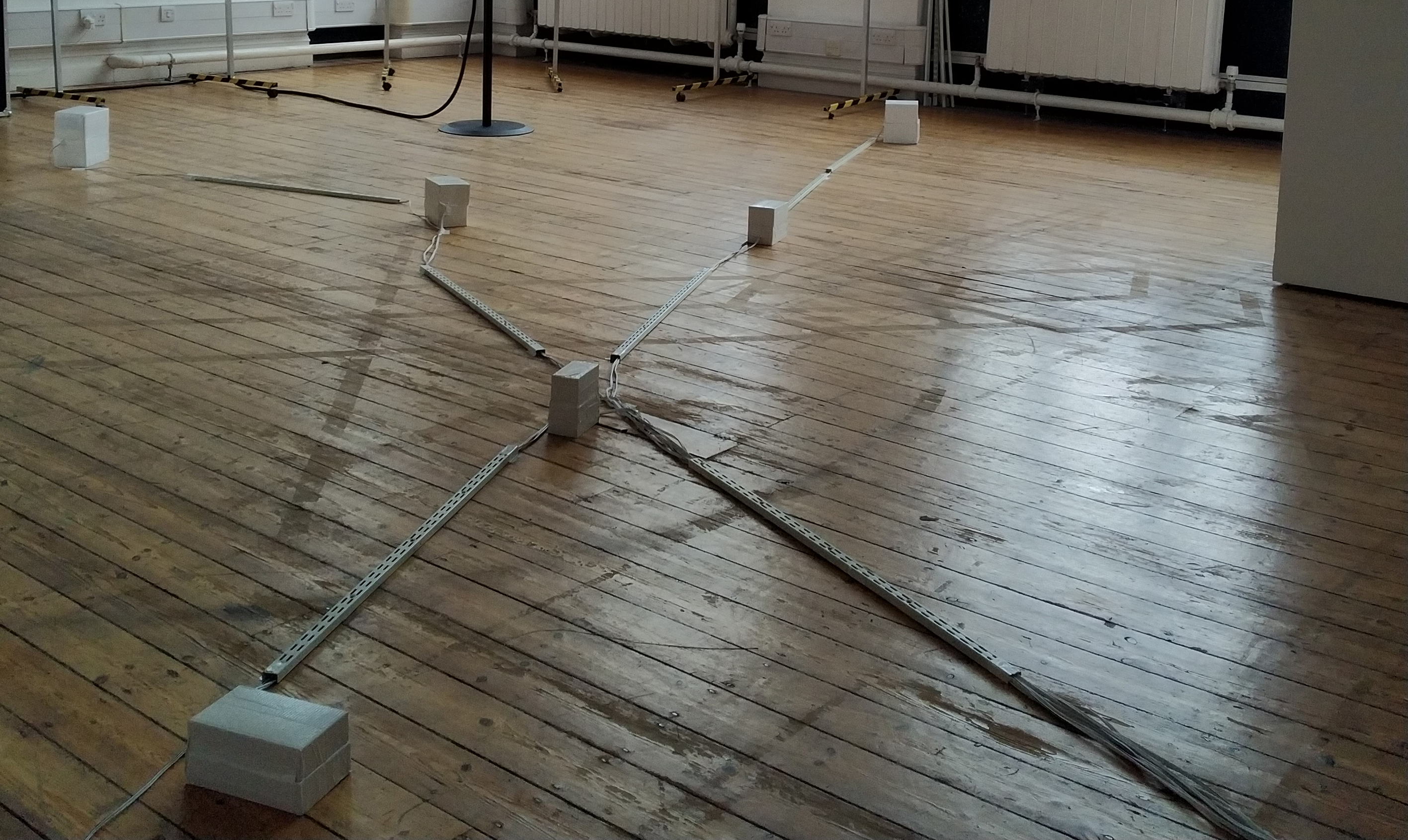
In Constellation, a digital connection is established between an array of seismographs near Eskdalemuir, Scotland, and a computer at an exhibition space. Data from seismic measurements is sonified with a set of simple software synthesizers of my own design written in Pure Data (Pd). The datafied sound signals are then played through acoustic transducers housed in small white boxes that stretch across the floor of the exhibition space.
The small white boxes that the transducers reside in mimic the boxes that some of the seismometers at Eskdalemuir are housed in. This is visible on the website of the ESK station book (BGS 2025) and pictured on the page discussing Gate in the present exposition.
On site at Eskdalemuir, boxes like those visible from the link above serve to help isolate the magnetometers and seismometers from undesirable environmental noise. However, in my installation the boxes have the opposite function, providing resonant bodies between transducers and the floor. While Eskdalemuir's seismographs measure ground vibration, my transducers use data derived from them to produce ground vibration, albeit on a smaller scale.
Although this piece has quite a range of sounding states, the sound example gives a sense of some common vocabulary. This is a binaural recording, so headphones are recommended.
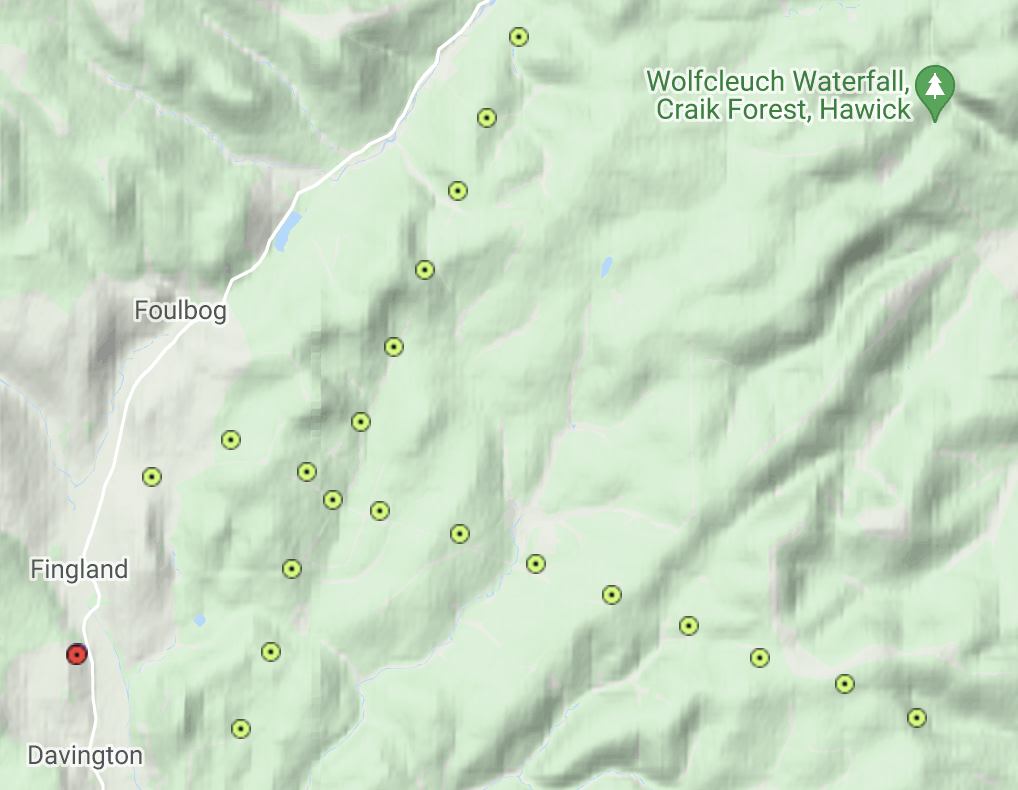
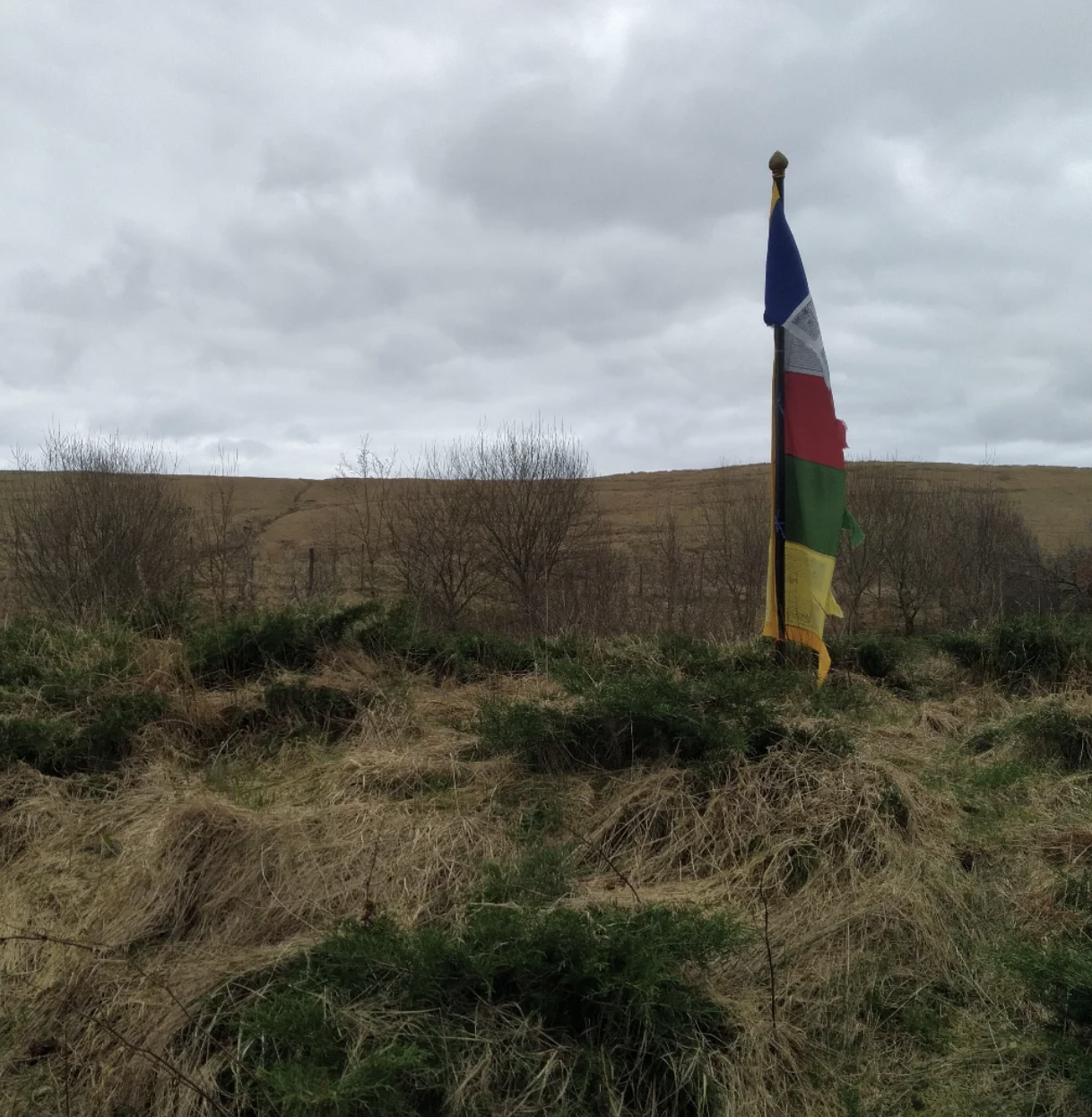
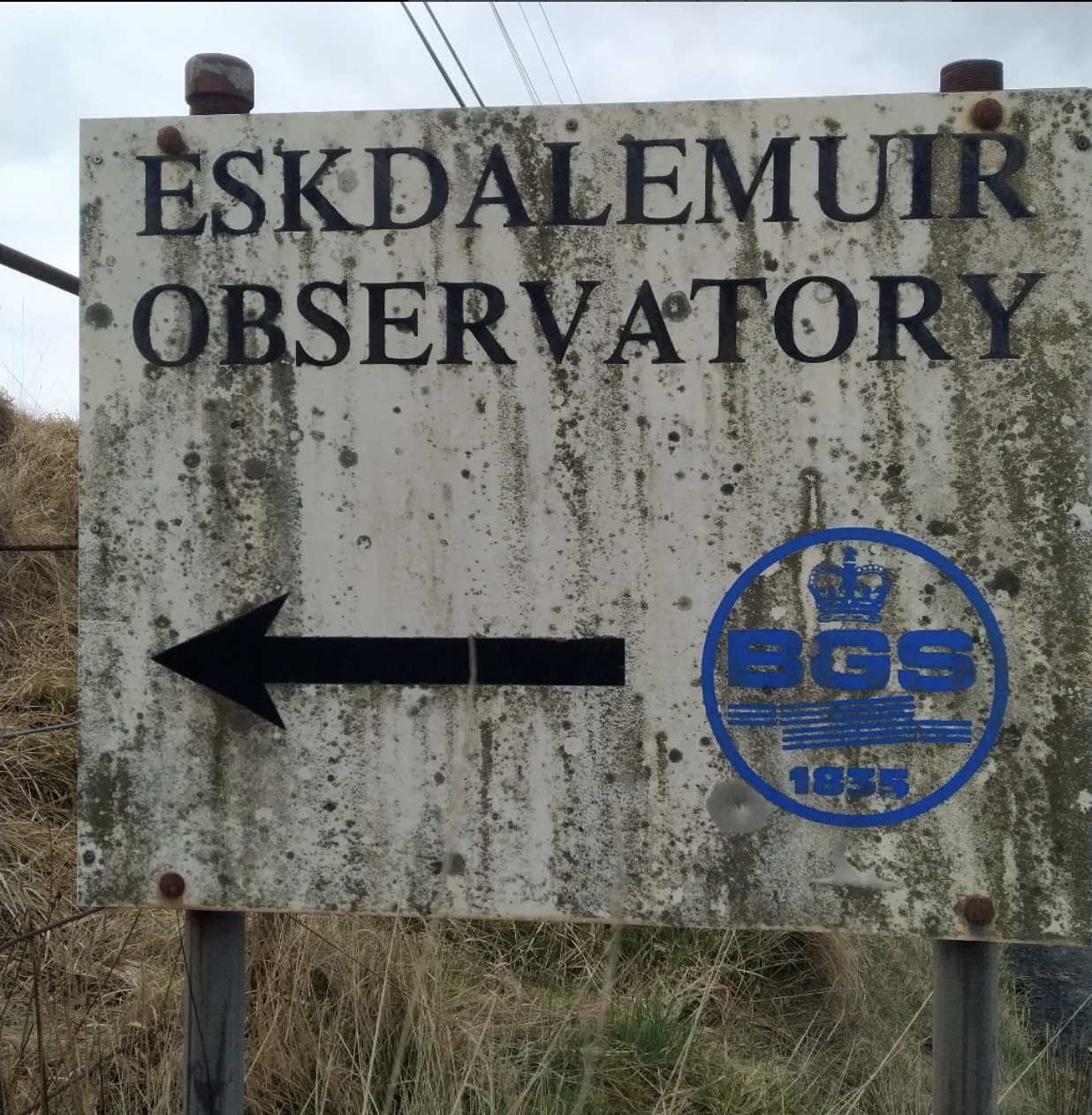
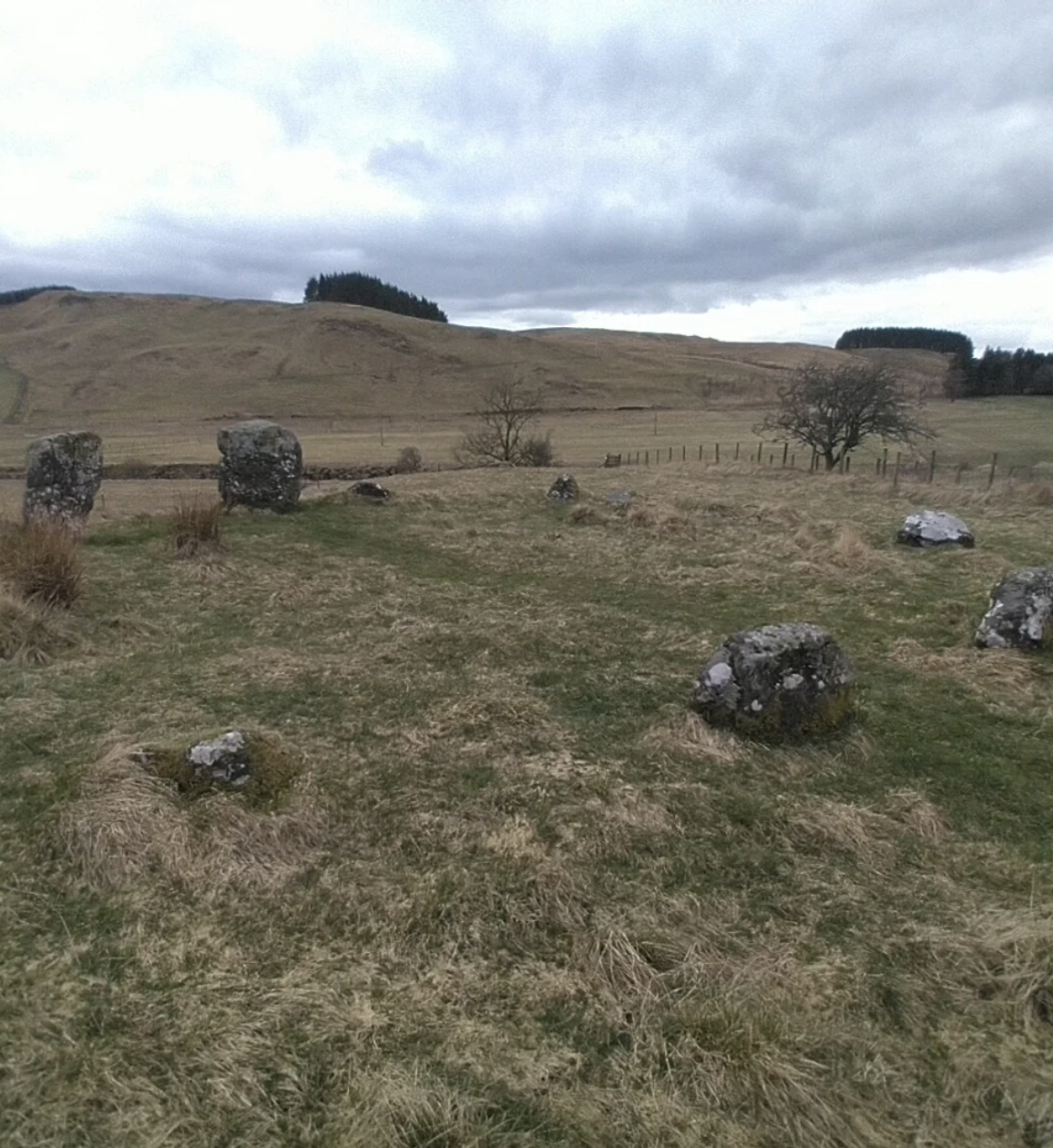
The seismometers that form the Eskdalemuir array stretch across the rolling landscape in a shape depicted on the map above. This is echoed in the form of my installation. The cross arrangement of seismometers allows the station to determine the direction that seismic waves are moving and to ‘steer’ and focus the array (CTBTO 2025). The Eskdalemuir Observatory houses a broadband seismometer set and a geomagnetic observatory (IRIS 2023; Nowacki et al. 2023). Their neighbour is the Kagyu Samyé Ling Monastery (Kagyu Samye Ling 2017), where other forms of vibration are observed. Around Eskdalemuir stretch the remarkable hills of the Scottish Borders with many Paleolithic, Neolithic, and Roman sites, but in general there are not many people around.
I like to imagine the possibility of installing my piece on a very large scale, on top of the buried seismographs at Eskdalemuir, to study what feedback behaviours might be produced in this way. The resulting instrument could foreground the notion of entanglement between instrument and recording apparatus while literally sounding the landscape.
Time spent in the sounding space created by Constellation provokes a great deal of reflection on one’s expectations for what data about a phenomenon provides. There tends to be a tacit assumption that data can function as a stand-in for phenomena, particularly in artistic works. While a recording of the bird song of species who might soon be extinct certainly preserves something valuable, it does not preserve the bird, and I would argue that it does not preserve the song either. Song is dependent on context, the world in which it is heard. It depends on the place and time of that being’s existence, embeddedness, and participation that make up a particular environment at a specific time. Data is never a stand-in for phenomena, but it can offer information about a phenomenon, and be used in constructing new phenomena, like the works in Norths.
While common sense suggests that seismic waves would connect to contiguous points across the landscape, this is not generally what is heard in Constellation. In the installation, the experience of the seismic ‘waves’ is largely one of discontinuity rather than continuity. What is heard from my transducers are not a series of sound-producing nodes from which wave-like behaviour can be often interpolated, but rather isolated instruments in a landscape in which some individual sensors appear to be broadcasting a lot more than others.
Occasionally, the installation does respond in a manner suggestive of a single sounding body. When this happens, the installed transduction boxes can be heard to function as a spatial unit. A listener can connect the sounding nodes into wave behaviour heard all around them. In these moments a listener can feel, by ear, the vibrating piece of the Earth’s crust, which connects the corresponding sensors across the surface of the region sensed. Something similar is achieved spatially in relation to the surface of the sea in my piece Irminger Channels (Boehringer 2021). However, in most cases, it is a disconnection rather than a connection that is emphasised in Constellation. The vibrating transducers only rarely form a Constellation, and when they do, it is because a perceiver is there as a significant and participatory node around whom is interpolated a phenomenal wave.
This observation underscores a notion from the opening discussion of this exposition. Data sonification re-embodied as sound phenomenon is not only useful as a form of representation. By contrast, it is especially useful as environmental, spatial sound. In this form it affords exploration and discovery. As heard, data is rendered visceral even where the listener may not be aware that what they are experiencing is information. The listener makes observations regarding the empirical connectivity or disconnectivity of sound behaviour in space. These observations are often immediately relevant for understanding the phenomena under study or the dynamics of the data collection-transmission system. However, and moreover, they are relevant for the listener as listener, as a connected being in an ecological relationship to the landscape in which they dwell. When listeners feel, as in the famous song by Carole King, ‘the earth move under [their] feet’ (King 1971), it is they who draw the lines necessary to connect the data into a form. Only then can it be communicated to others as a Constellation.