
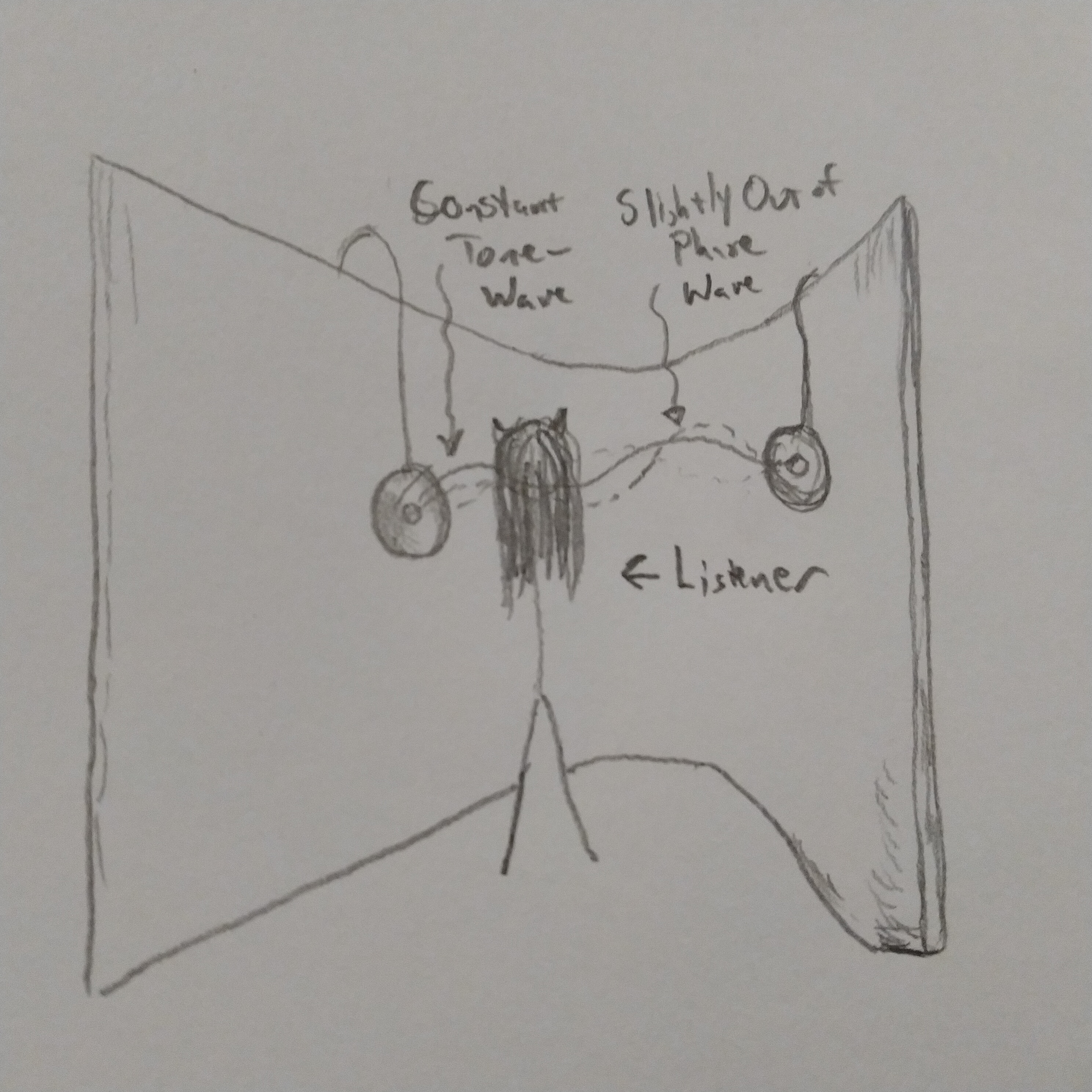
In my piece I automate the calculation of magnetic declination using values received from the IRF in real time, by regularly requesting data updates with a simple Python program (Python 2025). I then send these to Pure Data (Pd 2025) for simple sonification with mixtures of sine, square, or sawtooth waves depending on the spatial context of the installation. One speaker emits a continuous tone representative of true north, while the second speaker plays a tone differing from the first by an amount proportionate to the current value of the declination angle. Magnetic declination is scaled to a microtonal deviation from the held tone. This is perceptualised as a moving pressure wave whose behaviour is apprehended and interpreted by the listener.
This last aspect is key. While the piece is ostensibly a data sonification work, the end result is an indeterminate experience, which varies perceptibly for different listeners. The listener becomes part of a sensing system that is connected to the phenomenon, along with their subjective activity of will and interpretation. The data may represent an objective measurement of the phenomenon of a moving magnetic north, but the visitor themself is what renders this sensible, through their actions. The visitor may choose to listen or not. In so choosing, perception itself becomes an action that entangles an observer or listener with their object of perception through a fundamental relationality, as argued by psychologist Alva Noë in Action in Perception. Noe narrates perception as an enacted encounter in a manner characterised by Trve Norths, and across the Norths-works. The key difference is that in Trve Norths, the role of one’s own perceptual system becomes much more perceivable than in many everyday situations.
Where Noë describes the way things ‘look’, I will substitute here [‘sounds’]: ‘First, according to this enactive account of perception, [sounds] are not mental entities. [Sounds] are objective, environmental properties. They are relational to be sure. But they are not relations between objects and the interior, sensational effects in us. Rather, they are relations among objects, the location of the perceivers’ body, and illumination [resonance/reflection]. Perception may be a mode of encountering how things are by encountering how they [sound]. But this encounter with how they [sound] is itself an encounter with the world. What is encountered (or ‘given’) in perception is not sensational qualities or sense data, but rather the world’ (adapted from Noë 2005).
As far as is known, the behaviour of the magnetic field is not directly accessible to human beings through sensory perception. Some birds and fish can sense magnetic field fluctuations, and mobile devices and communication technologies are very sensitive to them. By working through perceptions beyond my own, which are uncontrollable and have variable, indeterminate results, I am not merely sonifying data. In the context of artistic practice, I am conducting a different sort of research, one which listeners can join me in when they participate in the piece. This activity is, in the sense that Noë establishes above, fundamentally relational and both objective and subjective at the same time. By sitting for a while in Trve Norths, listeners experience the phenomenon of the moving condition of magnetic north empirically. Moreover, the piece offers a circumstance for reflecting on how they apprehend information physically, as embodied participants in an environment. As is the case with a rainbow, the ‘objective’ phenomena of the buzzing wave in Trve Norths is experienced and interpreted differently by each individual perceiver based on their own visual system, their position, and the embodied connection to their environmental situation. Thus, as a relational experience in Noë’s sense, Trve Norths is both ‘subjective’ in that the experience is entirely dependent on the position and physiology of an individual subject and yet is objectively agreed upon between observers to exist. Objective and subjective at the same time: a weird ontology indeed!
Trve Norths
(speakers, amplifiers, software synthesizer, live geomagnetic data, internet connection)
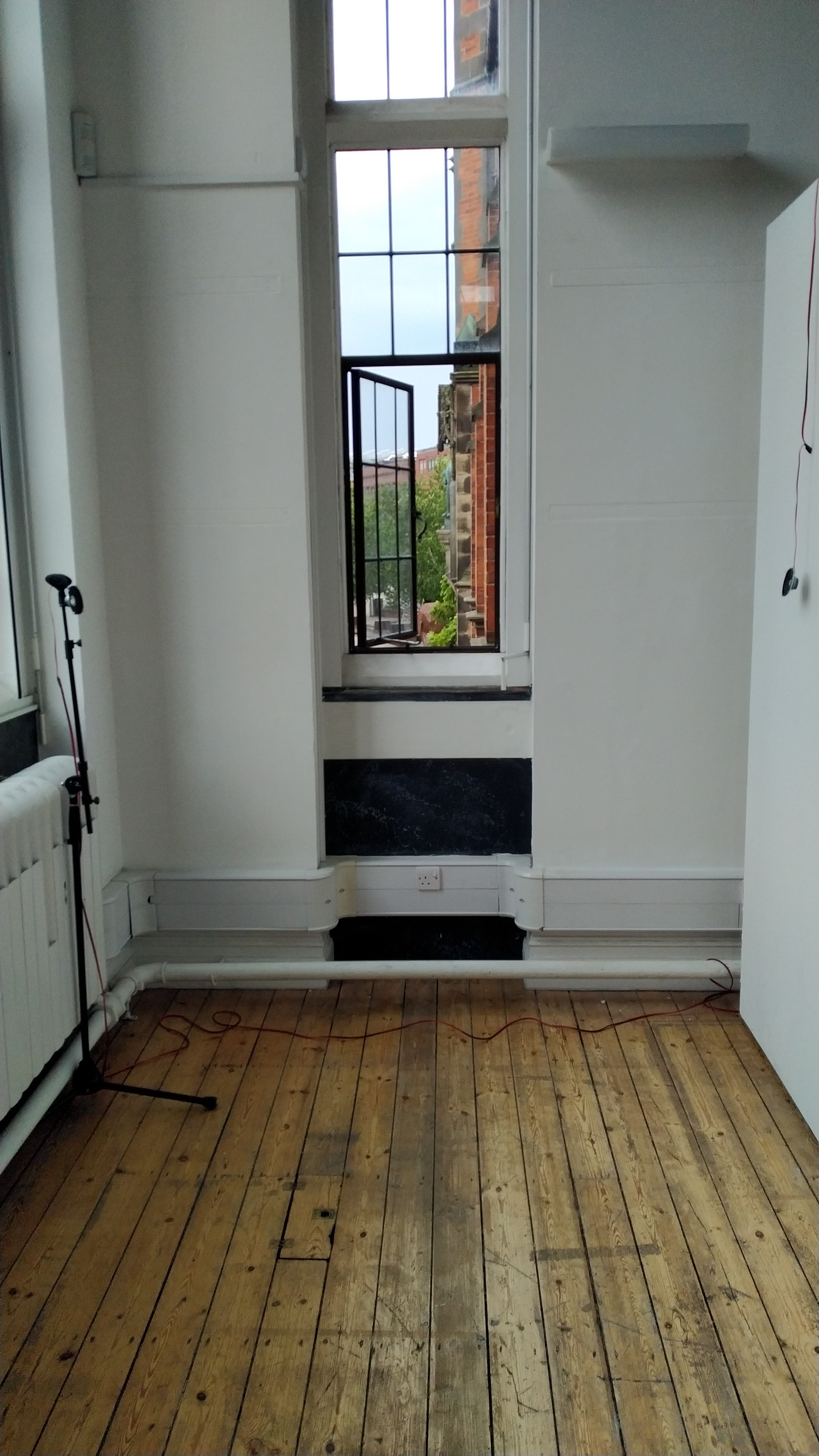
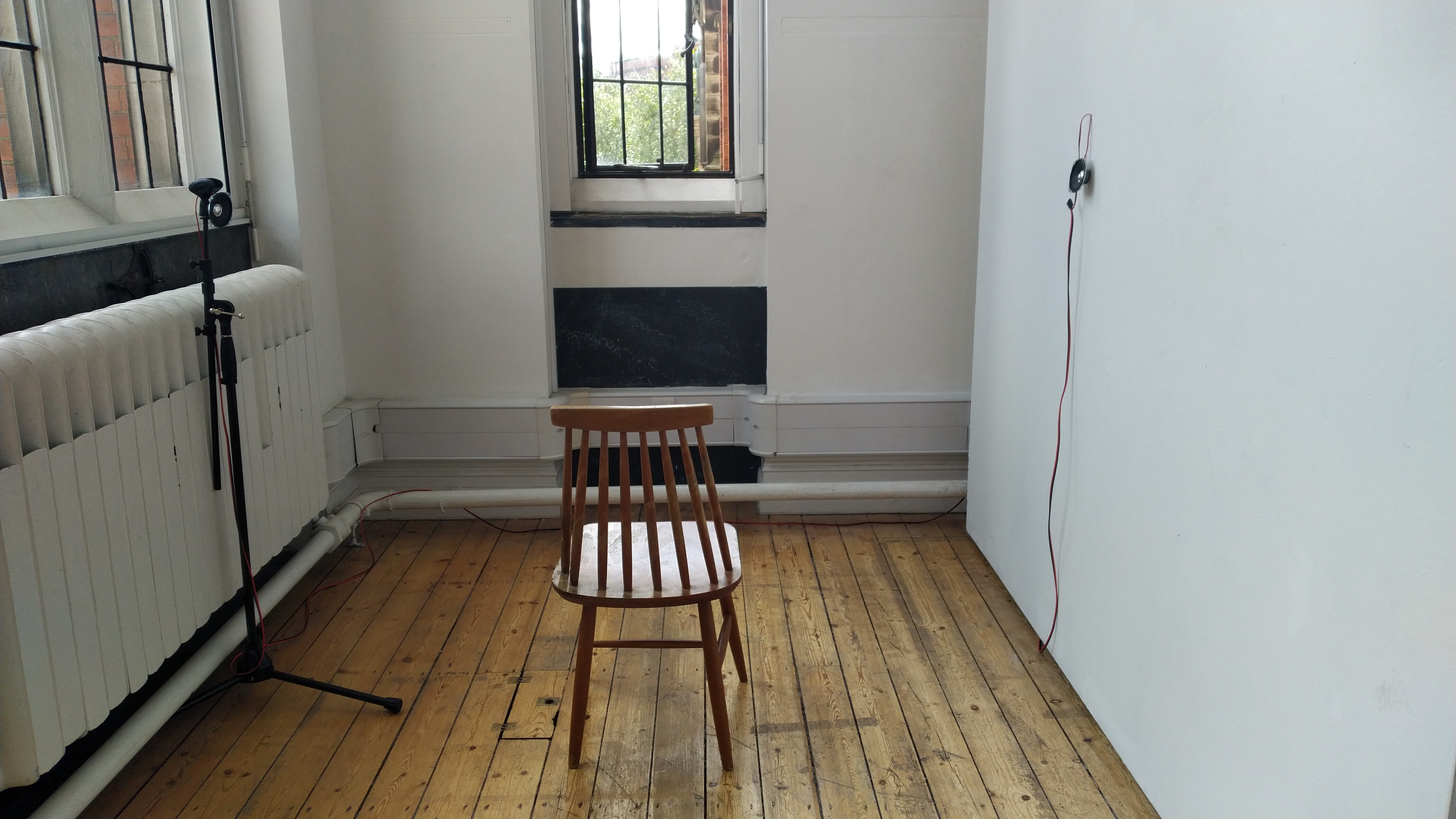
Trve Norths is a sound installation designed to be experienced by single listeners, one at a time. The apparatus of the piece consists of a chair, set between two small loudspeakers at (approximate) ear level on either side. Where possible, the piece is situated before a window, which, again if possible, may be left open.
Trve Norths is a materially simple piece but produces a complex phenomenon while pointing to other complex phenomena. Outside of the context of the installation, psycho-acoustic properties will not be present to the same degree. Nevertheless, the sound example below demonstrates how beating frequencies can be used to sonify measurements:
From even a short distance away, all that is heard from the piece is a continuous buzzing tone. Slight phasing in the tone may be apparent. However, when sat in the chair the experience is very different. If a listener sits for a short time, allowing themselves to become acclimated to the buzzing sound that now surrounds their head, they will generally experience a sensation of spatial movement. The experience somewhat differs from one listener to the next. Usually, it consists in experience of a periodic wave of sound that moves under, over, around, or through the listener.
An information sheet is provided in the installation. This is installed in a manner such that visitors are likely to listen first before they read. The information reveals that the moving wave one experiences in the piece is a sonification that renders perceptible the current location of magnetic north with respect to true north.
True north is one pole of the axis upon which the Earth spins. The Earth’s magnetic field is also oriented towards poles, as is the case with a bar magnet. The ‘north pole’ of the Earth’s magnetic field is what a compass points to, and is called magnetic north. ‘Map north’ is north as represented on a map. Aligning these helps to plot trajectories from one’s location using a map (Government of Canada 2025; IRF 2023b). However, magnetic north and true north diverge by small amounts all the time, and very occasionally by large amounts. In Trve Norths, both the intensity and the frequency of the wave heard (and/or felt) are dependent on the current state of deviation of magnetic from true north. The piece about not only listening to the phenomena of magnetic declination but listening through it. The sonification of the angular difference between the two norths simply produces two tones, but it is the listener’s mind-body perceptual apparatus that produces the psycho-acoustic wave phenomena that listeners experience. One hears one’s own hearing rendered audible through the sonification of this normally inaudible magnetic phenomenon.
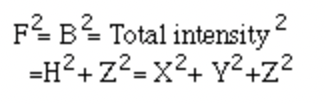
In Trve Norths, the geomagnetic data comes from an observatory in northern Sweden at Kiruna (geographic coordinates 67.84° N, 20.41° E). This observatory provides near real time data on magnetic field behaviour as part of the work of the Swedish Institute of Space Physics (Institutet för rymdfysik) (IRF 2023a). Trve Norths sonifies the current state of deviance between true and magnetic norths by calculating the declination, the horizontal angle between true and magnetic north. This can be calculated by applying this formula (IRF 2023b, Government of Canada 2023):
In this formula, H is the horizontal intensity of magnetic north, X and Y are the horizontal eastward and northward forces respectively, Z is the vertical downward component, and the sum equals the square of the total intensity. D, the declination, is the angle between X and H when graphed on a three-dimensional axis where X and Y are vectors at right angles to each other. For more information about how this calculation works and a visualisation, see IRF (2023b).