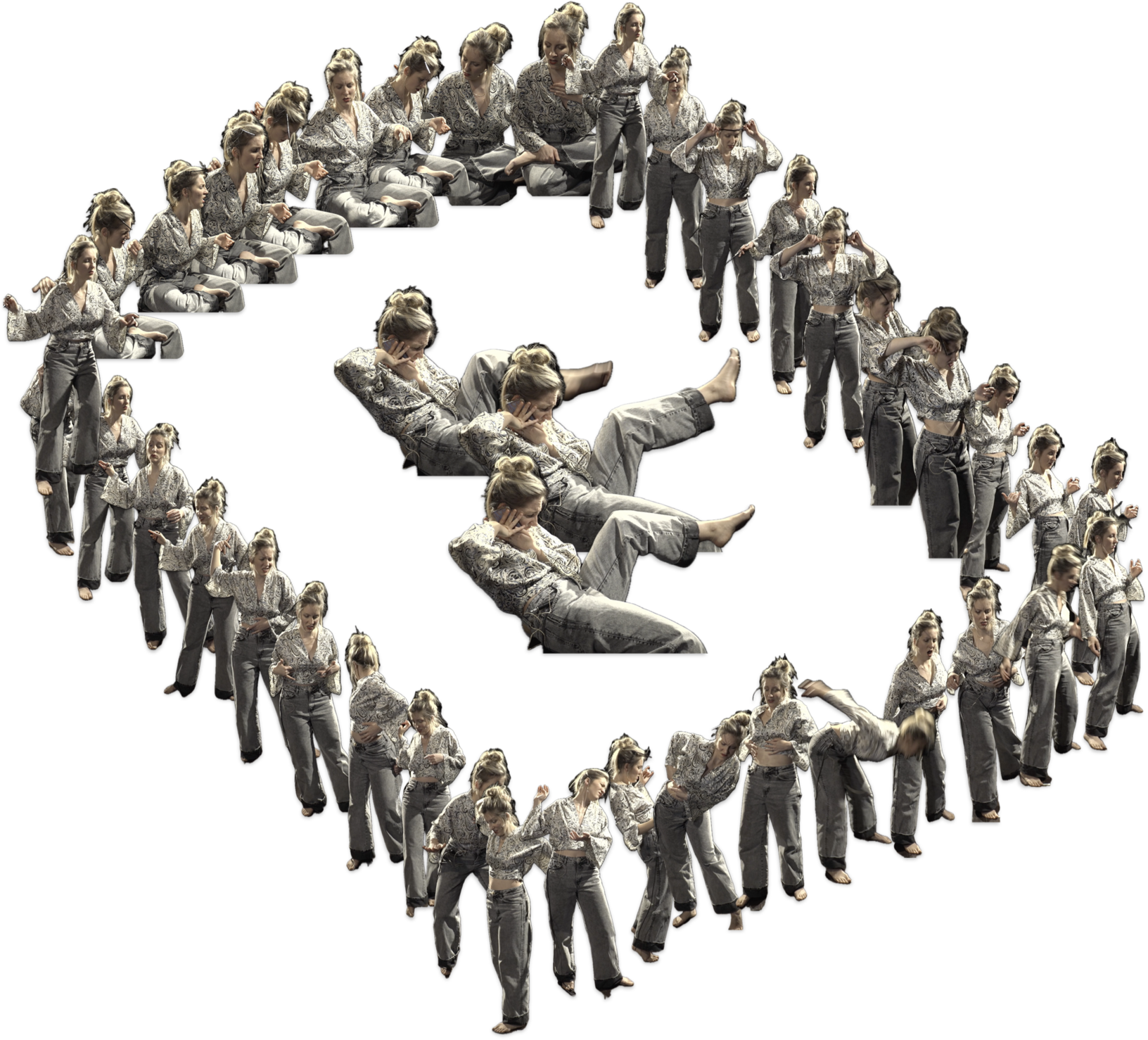
ExKaJuMa is a live streamed series of videos in which I perform live alongside pre-recorded audio compositions and improvisations collected from nine artist friends and composers: Mark Vernon, Paul Zaba, Simon Weins, Kevin Leomo, Jer Reid, Jordan Henderson, Simon Whitehead, Noah Drew and Nick Fells. I streamed these nine videos in one Facebook live session to an audience of my Facebook friends from a black-box performance space at Concordia University.
Presented here are three selected videos from the total of ten: my improvisations with audio from Kevin Leomo, Simon Whitehead and Simon Weins.
–
Motivated by the previous performances I did with Feronia and Tim, I wanted to recreate here some of the conditions that have been creatively generative in the past. I reduced these conditions to two essentials: 1. sounding alongside other sounds while 2. being witnessed by an audience.
This piece took place in the third year of my PhD, while I was on a visiting doctoral trip at Concordia University in Montreal. Having recently landed in a new city, without knowing many people, I saw this live performance as a strategic way to tap into the technical resources that were suddenly available to me (cameras, lights, live-streaming equipment), so that I could generate more material that illustrates my performativity to potential local collaborators. What I miscalculated in this event was that those two elements: sound and audience, were not enough to support the kind of expression I was employing.
I find it hard to listen back to my voice in the recordings from this event as I hear in them a bodily tension and an unresolved struggle, a desire to be open and a difficulty to reach that openness. This is also what I find materially interesting: working with tension, through a tense body that shapes expression, tapping into what is there, even if what is there is frustration, anger or failure - sounding through those difficult emotions, integrating them into the creative act. Working with this kind of tension, one that transcends the physical and is merged with the emotional, relational, affective, is a high energy expenditure. It can be done but, as I've come to learn after this piece, requires resilience, recovery routines and perhaps more support from others than I was willing to admit at the time. As it was, after the one-hour performance, I crashed and needed a few days to recover from the big effort it required.
What I really needed for this piece to unfold without incurring such high emotional costs remains somewhat unresolved. The two immediate pointers are towards: 1. collaborators that share the load of the performative risk; 2. a kind of performative maturity or skill that I still needed to develop - a resilience in being with and sharing difficult emotions without having to pay for them with self-judgement and 3. other processes of making that ask for less exposure or risk while still fully using my expression.
In Saketopolou's framing of limit consent, which I mention in container two in relation to participatory performances, she defines a type of safety shared between members of a collaborative encounter:
"The safety in question, however, is not that things will not go wrong but that if they do, which they could, both parties will stick around to process and hold the injury together." (Saketopolou, 2023, p.68)
Having asked for no support from my collaborators beyond the audio they sent, I limited the scope of our creative encounter, making it almost transactional. I did this to challenge myself to be somewhat self-sufficient (I still had help with the tech and setup from my husband and a Concordia University technician). To see what would happen if I held the creative space of risk on my own, in a combination of ambition and denial of my own needs and limits.
I wanted to test if after all the work I previously did sharing my expression with others, I was finally ready to just be a performer or an improviser under normal conditions. Someone that can turn up, play and share their expression, pack up and go. Someone that could communicate with others through sound, hyper-focusing on sonic materiality as the absolute relational mechanism without further complications. Could the creative work I did up to this point, could it have healed me from my needy complexities?!
I craved being this person, because the contexts and scenes that can hold this kind of expression already exist - it is possible to rock up in a new city and bring this expression forward, building something with someone else on the improvisation scene without much friction. The city of Montreal was emanating a lot of this type of sonic creativity, and I wanted to at least understand what my role could be in it.
I craved this simplicity, this belonging, this understanding and appreciation of skill, expressivity and virtuosity. I was tired, alone and tangled up in a complex creative expression that I couldn't fully understand. An expression that felt fragile, that, at the worst times carried judgement and denial about what it was, always needing something else to be able to be itself.
The alternatives were costly: perhaps I needed a support worker, a performance therapist, an outside eye, a creative consultant, some pastoral support or a team of people that could make and hold the space for this kind of risk. I dared not dream of this kind of support.
Upon reflection, ExKaJuMa was a hustle, a desire to fit a form or function that I hoped would make processes of making more streamlined. In truth, that form or function is not what my expression was or could be at that time.
By doing it I exhausted myself and learnt some limits and lessons that informed my creative process further. At the same time, I also generated some material that, over time, helped me understand in greater detail some nuances of the erratic. The bodily movements, the tangents, the intensities are all there, hinting at an erratic performativity that, at the time, I wasn't fully ready to value for what it was.
I also understood that I needed to learn to feel and respect my own boundaries and develop some better support systems for myself: to learn how to self-soothe and help myself recover more quickly after a big energy burst. A lot of the Fitzmaurice work I did later on helped with this. But this self-work does not fully resolve the question of support that should be asked more widely of processes of making. If vulnerable and honest expression is to be supported, some questions of care need to be carefully considered.
In the quote below Rajni Shah reflects on one of the lessons her departed collaborator Mark Trezona taught her. After ExKaJuMa I had this quote with me as a companion while I navigated life in Canada, meeting various artists and collaborators as part of my visiting researcher position. I embraced its sensibility, sharing the quote with people I worked with, inviting them to resonate with its ideas. This taught me that prioritising an honesty about affective states over a fear of scarcity of resources doesn't just relax me and others but helps us tap into a deeper more honest mode of expression.
“He taught me that there is a version of selfishness that is generous, that is about inviting each person to take responsibility not just to show up, but to show up with honesty about where they are at and what they need – and that knowing when you can’t show up is a core part of this work. He helped me understand the flip side to this too, that there is a version of generosity that is selfish, where we spread ourselves thin, keep showing up without having the energy or resources to follow through – and this version of generosity is pervasive, and can be dangerous.” (Shah, 2022, emphasis my own)