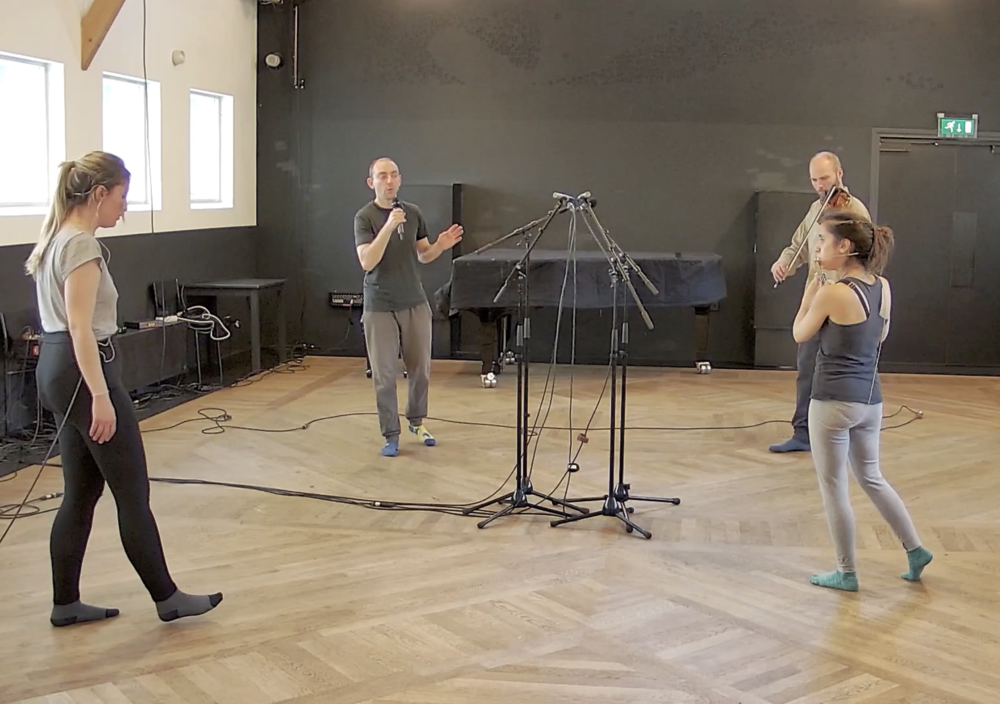
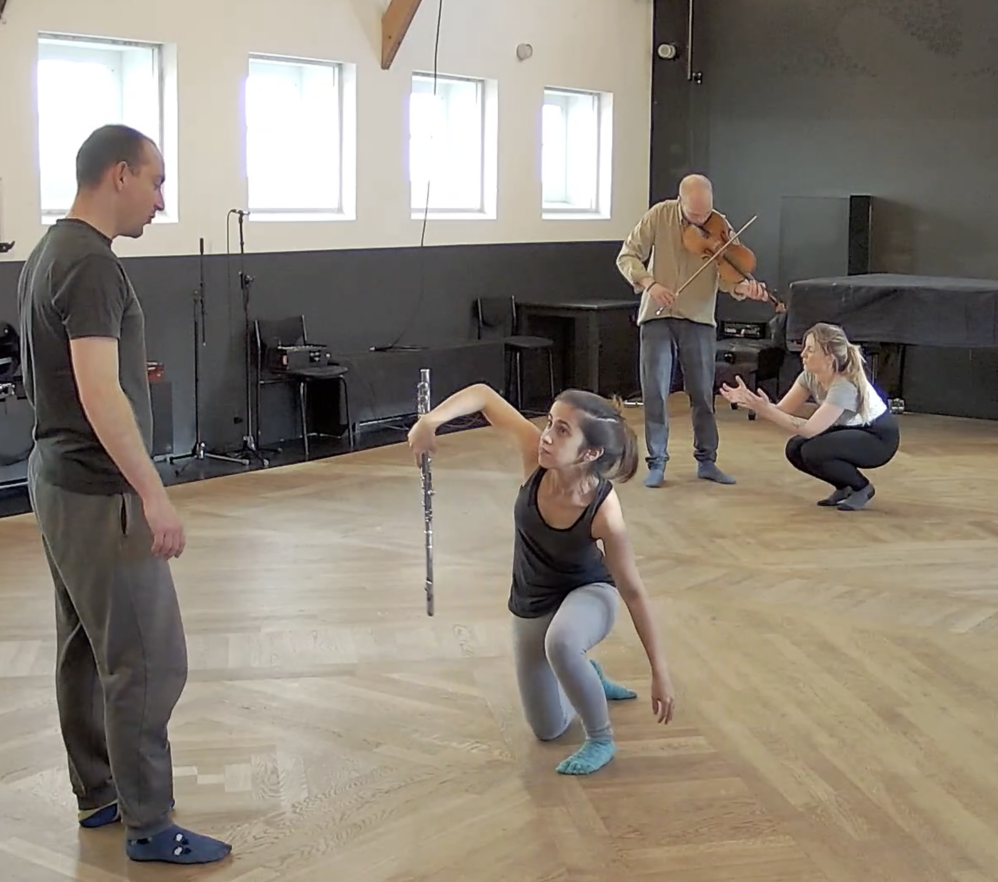
The Splendor micro-residency in Amsterdam was the first opportunity I had post Covid pandemic to work with a group of performers. Tatiana Rosa (flute), Hessel Moeselaar (viola), Luke Deane (voice) and I met for two full days in a setup that I designed and was made logistically possible with the help of my good friend, composer Luke Deane at Splendor studios.
At this point my research, questions to do with group work were imprecise, even confused. I didn't totally know what I was looking for in working with a group as this direction of the research got side-tracked early on by the restrictions on face-to-face contact during the pandemic. As it was, I had a strange feeling of starting a new PhD in the middle of the existing one. Still, it was important for me to pivot back towards group work, to apply the knowledge I've accumulated in contact with other collaborators and understand how to navigate/direct/facilitate/lead a collective creative context, one in which my own expression was free to manifest.
By this point in the research I've been exposed to a range of performance and voice-based techniques that facilitated group expression, from teachers like Margaret Pikes, Kate Hilder or Persis-Jadé Maravala, (more on this in section Embodied research into existing techniques and practices). When participating in the workshops led by these women, I often became surprised at my own openness, sensibility and ability to be with others and express myself. These approaches were deeply embodied, calling forward trust, risk, sensitivity, and relational connections, and, most importantly, brought me unexpected ease and pleasure in contexts that were previously terrifying for me to open up in. In this Splendor residency I wanted to continue building on them to facilitate a group expression that aligned with my artistic practice.
Before the residency I put together a structure for these exercises and tested it a few times with groups of musician friends in Glasgow. I borrowed these exercises from the practitioners that trained me, learning through trial and error how to lead others through them and how to adapt them to include musical instruments.
The video below gives a short overview of the kind of exercises we worked with on the residency.
At Splendor, the question of what to do after the exercises remained ongoing. In all the other creative works I did before this workshop, content, form and function emerged through co-creative collaborations with other artists over longer periods of time. Here I was faced with a small group of people and a desire to steer the group towards an artistic outcome of sorts.
I split the days in two, spending the first part of each day in group exercises and the second part of each day in a recording context. For the recording context I brought together a few elements:
1. A surround microphone array recording setup with four microphones in the middle of the room and individual separate portable instrument microphones attached to each instrument,
2. A set of solo recordings of my voice I had compiled in Glasgow, intended to be played in the space as starting points or structures for group improvisations,
3. Some basic structure scores that guided the roles we took in group improvisation - e.g. chose the musical content you're improvising to either oppose or be similar to what the person next to you is playing.
In the first part of each day, the microphones were not present. As soon as the microphones entered the space, the dynamic we built between us through the physical exercises became fractured, mediated through the big technological giants - the microphone stands in the middle of the room. These technologies brought with them certain affective flavours, emanations or subtle habits we all had in relation to them that changed the dynamic in the room.
A similar thing happened with the pre-recorded vocals which were an alien acousmatic appearance in the space between us, interesting and effective to an extent but too incidental and disembodied to seamlessly hook onto the physical work we did before.
The structure scores provided new dynamics that proved to be irrelevant as they ignored the impulses, sensibilities and para-verbal communication that were exploded and amplified by the physical practice we shared in the first half of the day.
Upon reflection, the resulting effect of the embodied exercises opened new possibilities of sensual relationality between us, moving towards what I now conceptualise as expression within the incoherent sphere of feeling, expression executed with sensory conviction. By offering certain setups or instructions in the second half of the workshops, I inadvertently closed the scope of this expression, limiting its emergent potential. Instead of following impulses and intuitions dictated by the improvisational togetherness we built together earlier on, our attentions became subservient to a group of novel elements (audio, microphones, instructions) that offered the wrong kinds of limitations.
This tension between structure and flexibility of frameworks is and has been a real challenge for this kind of work. The impulse to bring more purpose to our explorations in the second half of the days is a valuable one, but the question of what that purpose is and how it can manifest remains an open question for further research.
On this residency I felt the weight of the composer role, this image of a strong leader with clear visions and tasks for the musicians they work with to execute. I felt a fear of being too ambiguous and imprecise, asking too much input from the musicians. Working with these implicit assumptions which operated at a non-verbal level in my intuition complicated things. My double role as facilitator and participant added complexity, leading me to both process emergent dynamics as a performer and to attempt to make sense of what I was feeling to make creative decisions for the group. All of this made it difficult to have clarity in the moment about the value of the immaterial subtlety of what was opened in between us through the exercises and how to harvest that creatively.
This project left open questions around facilitation, co-creation in group settings, what my role could be within that and what kind of skills I need to develop to be able to hold that role. These questions were investigated further during my Visiting Doctoral Research position at Concordia University and the Embodied Improvisation Research Workshop.