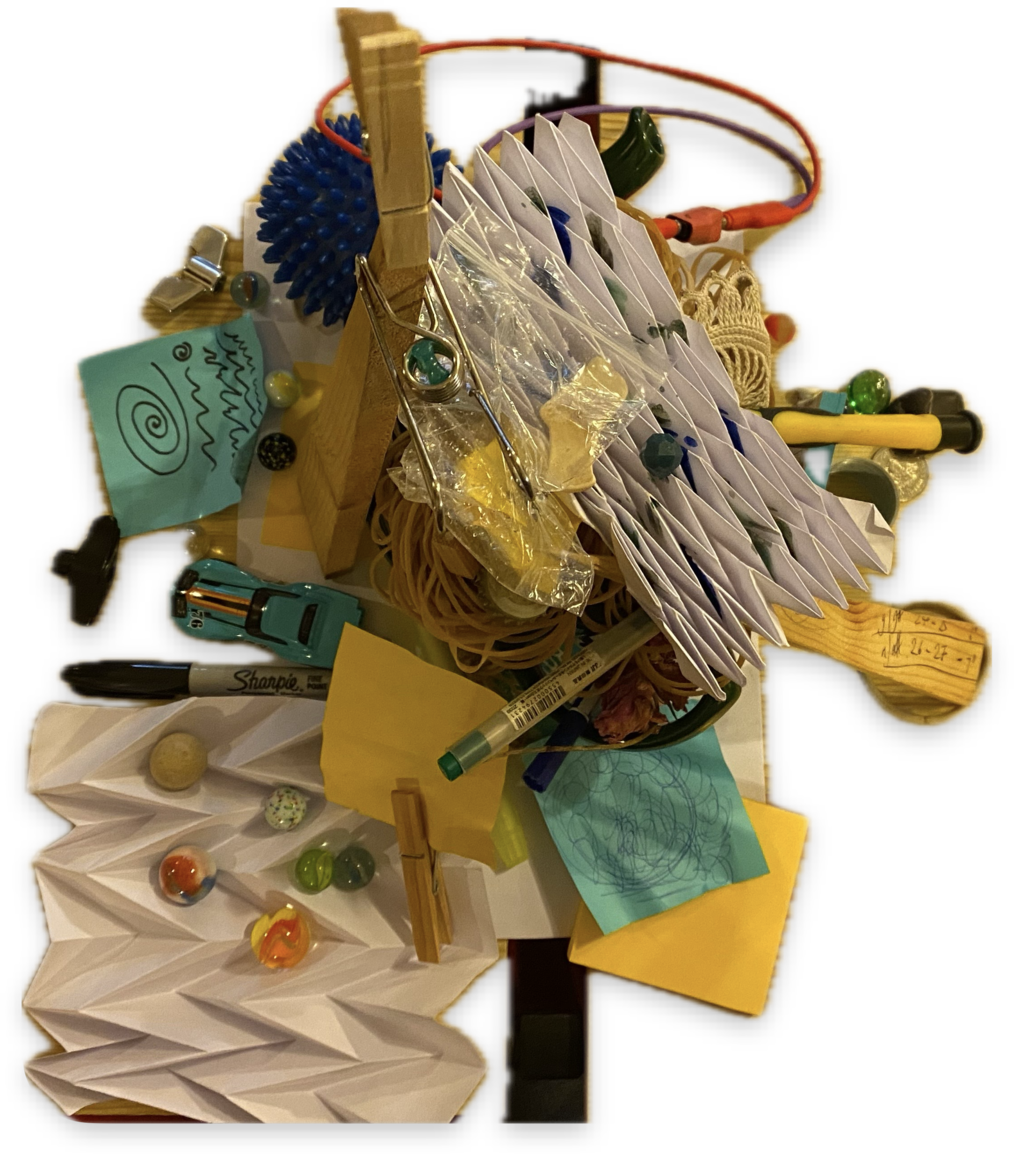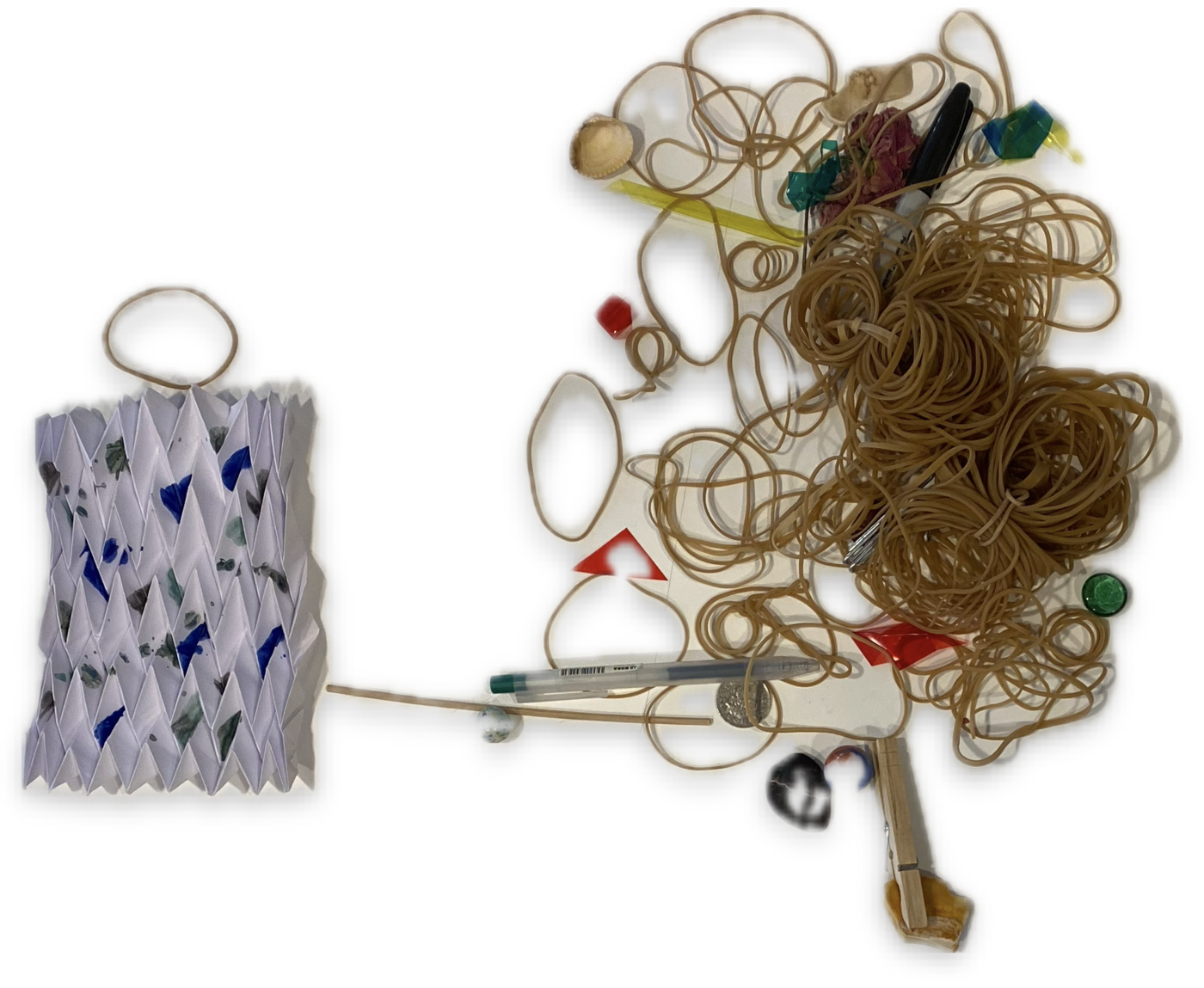
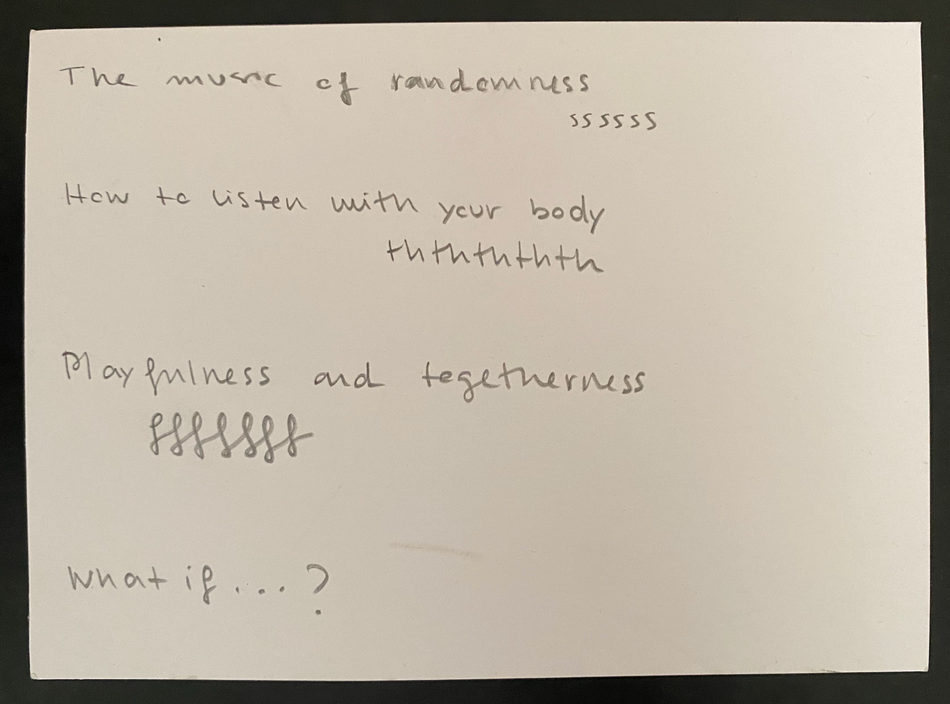
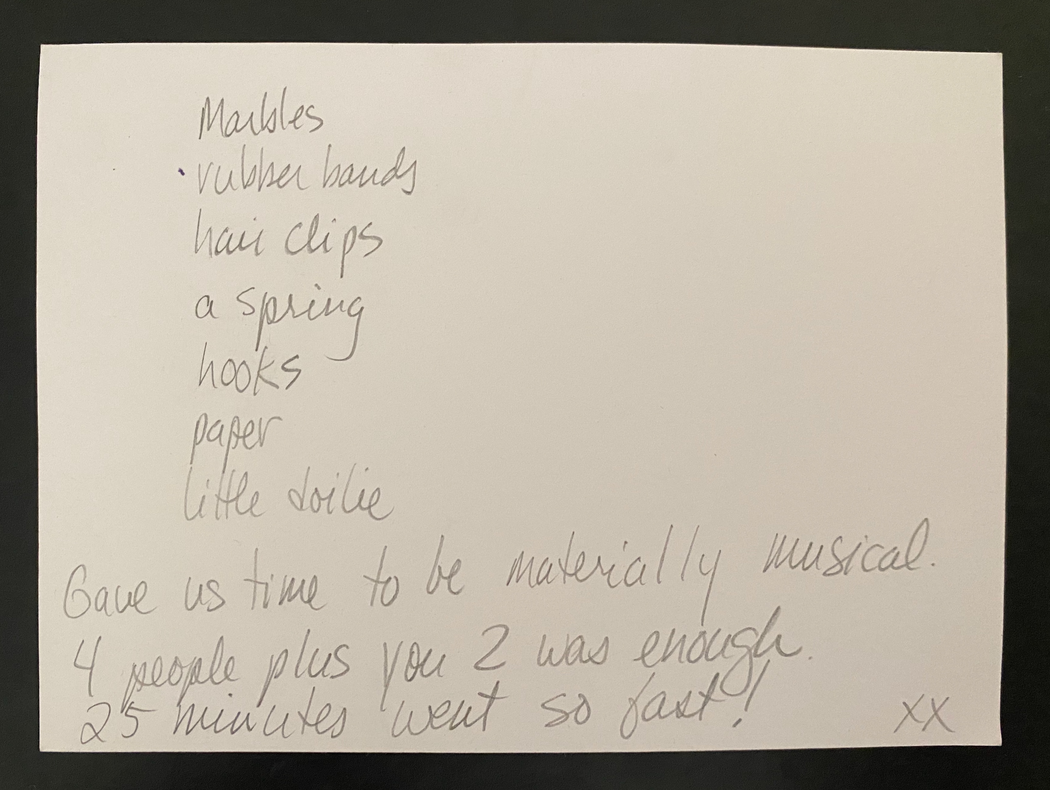
Taking further the work Christine and I did on our previous piece, Ecstasies of Rooms, in which we use voice to attune to emanations from our living rooms, in this piece we attune to the ecstasies (in Bohme's (2016) conception of the term) of physical objects we encounter together on a table, inviting four other participants to co-create the encounter with us. Unlike Ecstasies of Rooms in which we guide participants step by step in how to attune to space through voice, in this piece we build on the kind of non-verbal participation that I explored in Tea Break.
The specifics of voice
The piece opens with an improvised song that Christine and I sing while circling the participants. In that moment, our voices are reaching away from our own selves, leaving our body, aiming to touch each other's body - the safe space of friendship, kinship, mutual connection and risk. Once touched, we reflect each other back into ourselves, carrying within us both a sense of how we feel and a sense of how the other is feeling. Working collaboratively over time allowed us to carry the felt sense of both self and the other without conflict.
The emergent song functions as a probe into our felt togetherness and escapes out into the performance space we share with the four participants, transducing this feeling out into the open air. This vocal escape can be seen in itself as an ecstasy - as emanations from our own bodies that are affecting and changing the surrounding. Introducing ecstasies into the room by virtue of our voices primes the space, the modes of engagement and of listening, to be attuned to other potential emanations. We employ this kind of listening when we sit down and start touching the objects on the table. Our bodies as performers make this leap, forge this connection between voice and touch, between the atmosphere of song and the atmosphere determined by the encounter with objects and people in close proximity around a table.
Even though voice becomes absent from the encounter as soon as we sit down, the type of attention we use to engage with the objects taps into the musicality objects have beyond the sounds they make.
Objects/Things
It would be tempting to situate this kind of engagement alongside works like John Zorn's Theatre of Musical Optics (1975-) which he described as "music without sound" asking “If you can make art with sound, can’t you make music with objects?” (Zorn, 2013), but unlike Zorn's piece which is concerned with the intrinsic optical musicality that objects have presented as sculptures or static situations, here we encounter objects whose affective qualities do something to the relationships between people, and between people and things.
And it is specifically the affective qualities that differentiate what the objects do in this piece with other works such as Jodie Rottle's Your Sound Future (2018) in which the multi-sensory quality that objects have make their sonic powers more apparent. While in Ecstasies of Things, the objects' sonic potentials and their multi-sensory qualities do make them more appealing, their affective powers transcend their aesthetic sensuality, determining an encounter with the more-than that gets created with this type of physical engagement - a bodily immersion in the atmospheres they create.
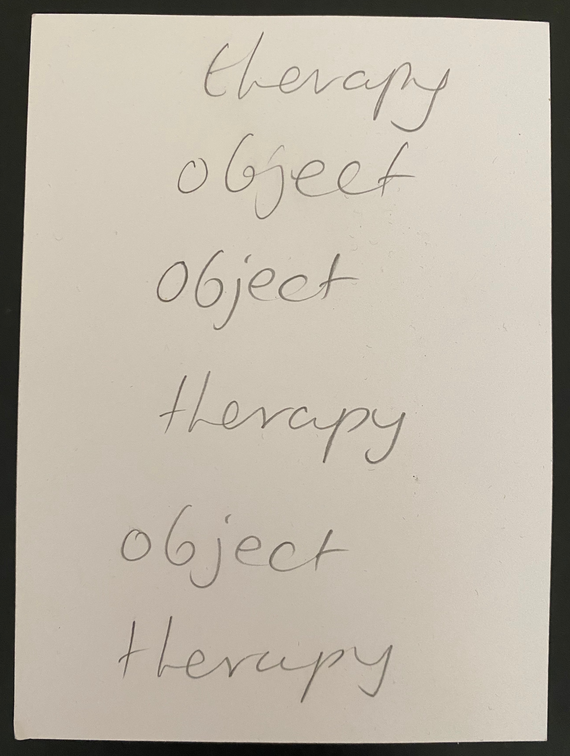
The objects used in this piece were selected for what they brought to the body: joy, safety, pleasure, stimulation, relaxation. (They take further the work I started out on the Balancing Art Residency). In this way the align with Lygia Clark's use of relational objects in her artistic practice, which she defines as objects as having 'no value on their own' (Lygia Clark, Memory of the body, 1984) but which are used as part of a therapeutic practice of aesthetic healing called 'Structuring of the self' (1979-88).
The relational potential of these objects can also be seen from the ADHD self-soothing action of stimming considered as an act of ‘parsing ... the confusion of the sensory field into coherence’ (Walker 2021, p106, cited in Watson, 2024) or 'a fluid physical process making sense of in-flux environments' (Watson, 2024).
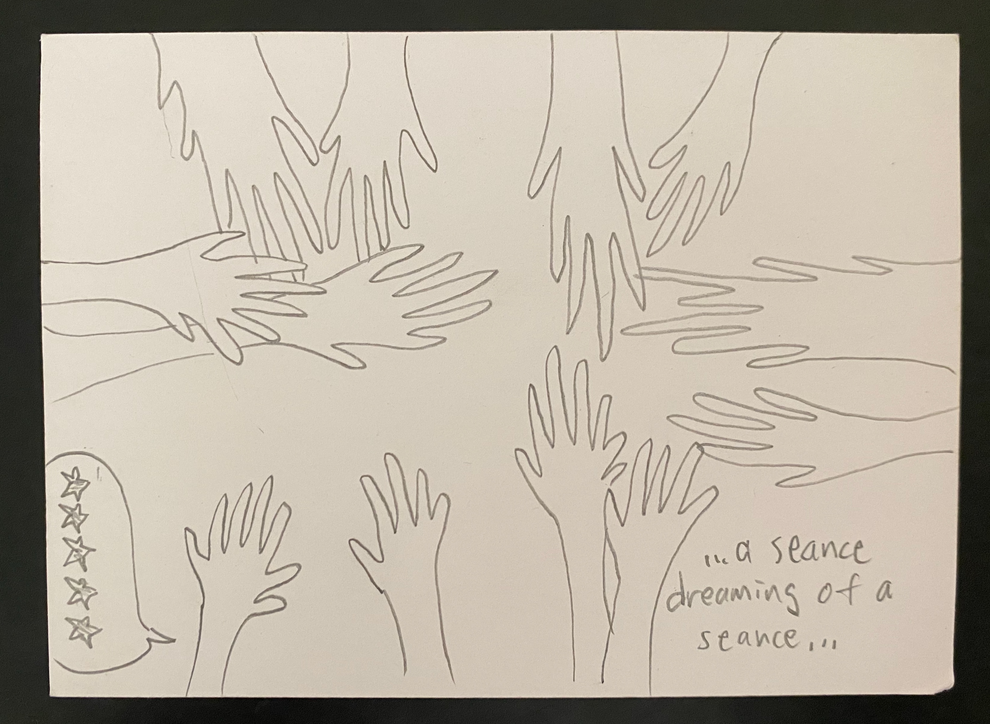
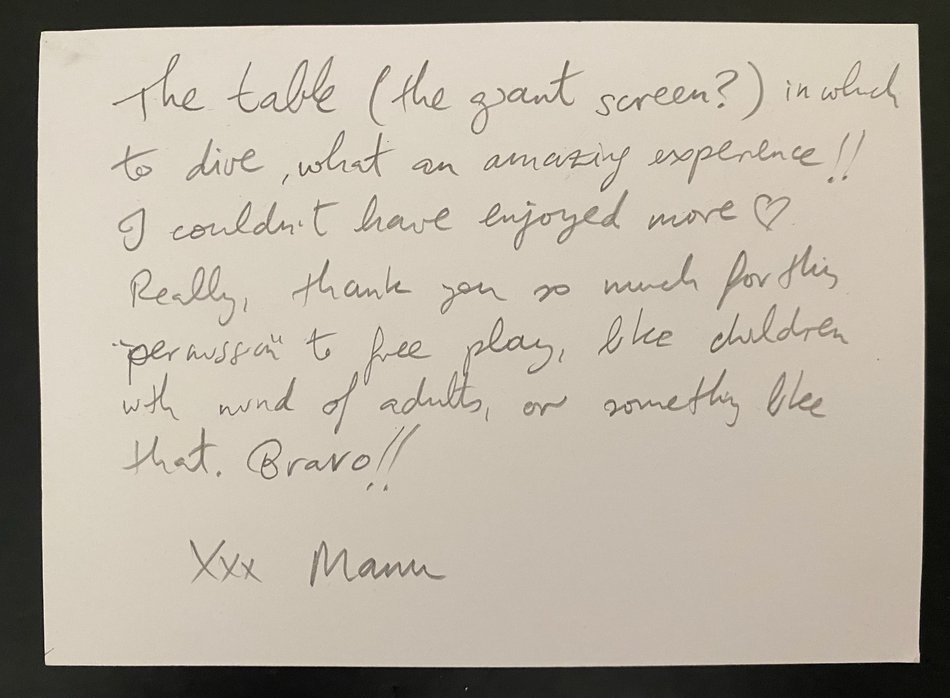
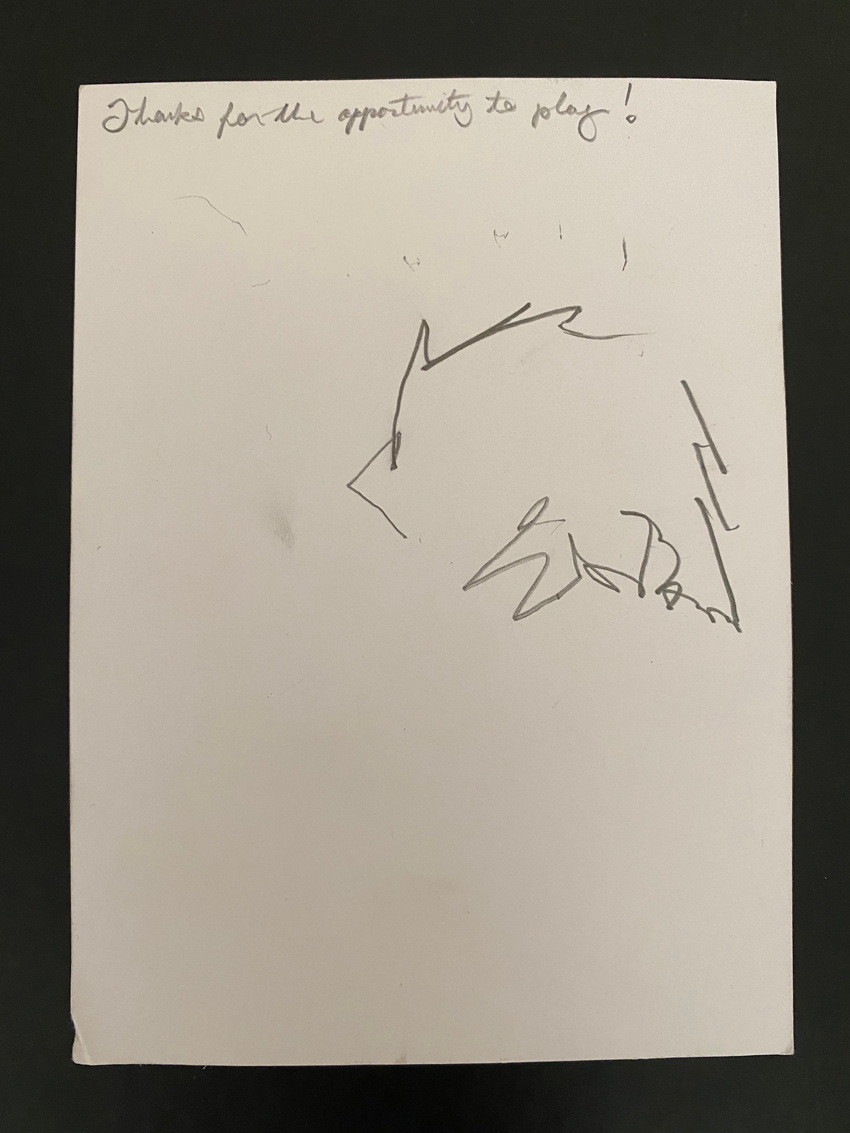
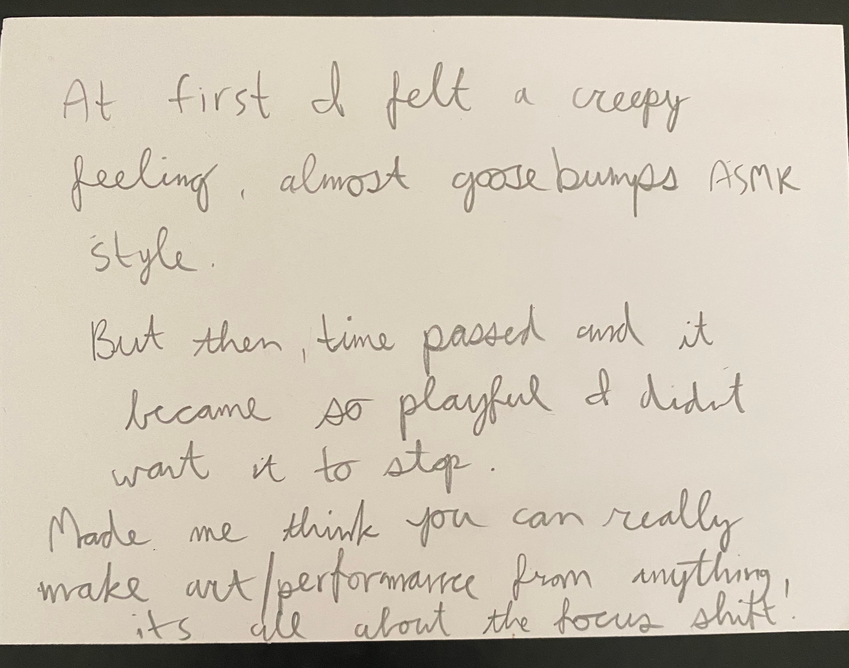
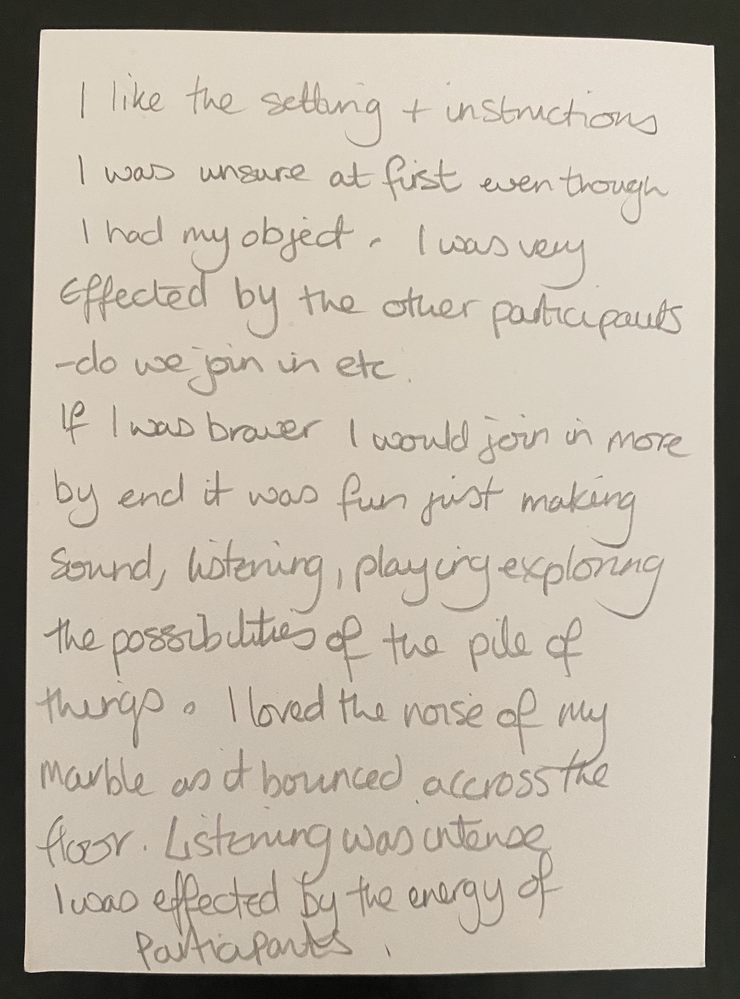
The ambiguity of the encounter, its tentative-ness and variable narrative are all employed to support a genuine emergence of a relational sensuality (rather than sociality) which prioritises pre-conscious choices, bringing all participants into a chaotic but pleasurable encounter.
"Do you see, Arren, how an act is not, as young men think, like a rock that one picks up and throws, and it hits or misses, and that's the end of it. When that rock is lifted, the earth is lighter; the hand that bears it heavier. When it is thrown, the circuits of the stars respond, and where it strikes or falls the universe is changed. On every act the balance of the whole depends."
Ursula K. Le Guin - The Farthest Shore (1972)
About the documentation
There are two videos included on this page. The first one above is an artistic trailer/teaser of the work that reflects the tactile and proximal care Christine and I give to our interaction with objects.
The second video, further down, offers a bird eye view perspective of the performance, edited for conciseness. The text interspersed with this video is a poetic reflection of the encountered, layered on post-factum that aims to nudge the viewership angle to particular poetic directions.
Both of these videos are an attempt to make up for the lack of participation when engaging with the documentation of a live participatory piece - an attempt that would never fulfil its role fully. This limitation of the documentation is a well-known conundrum for artistic research.