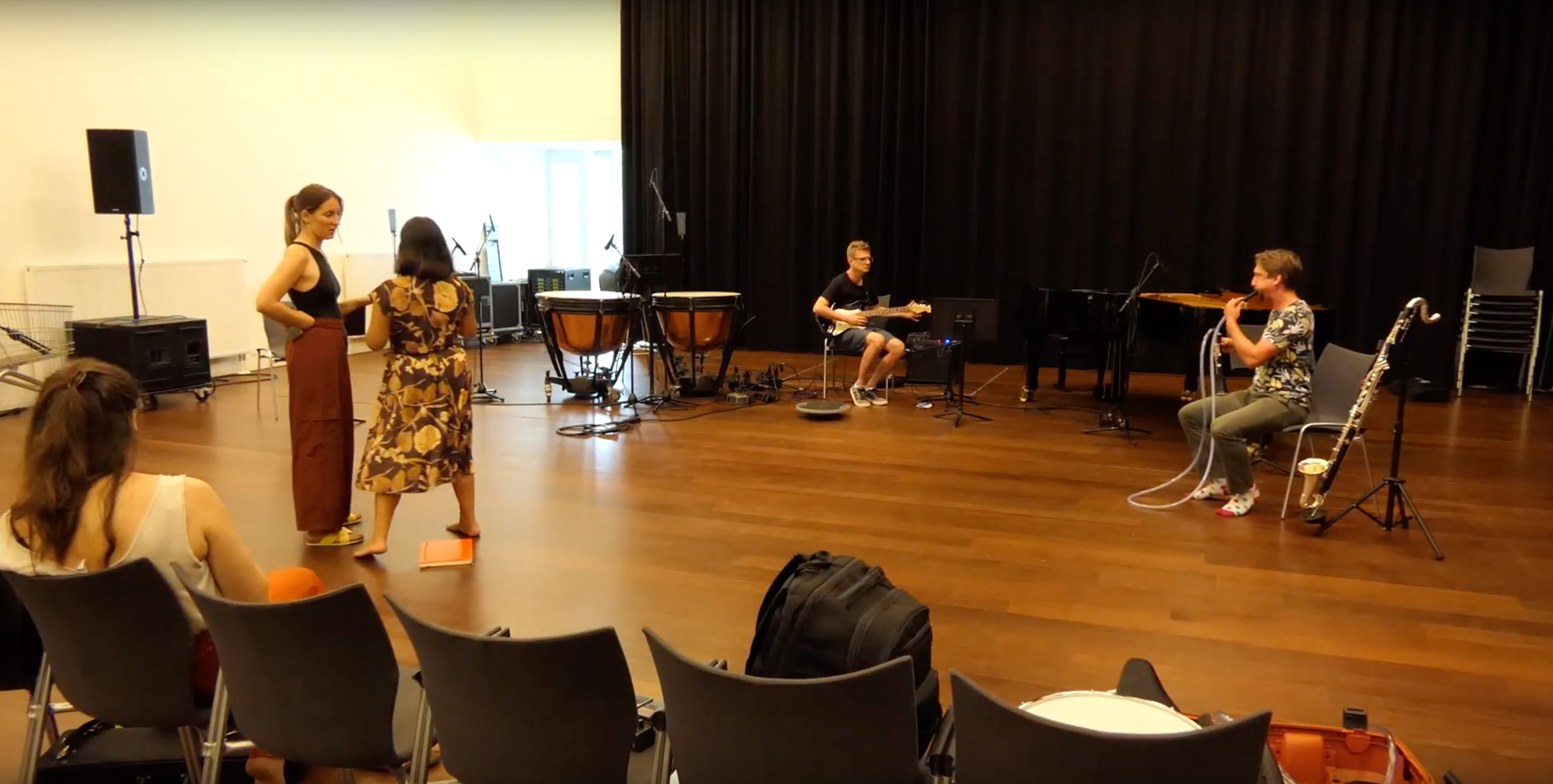
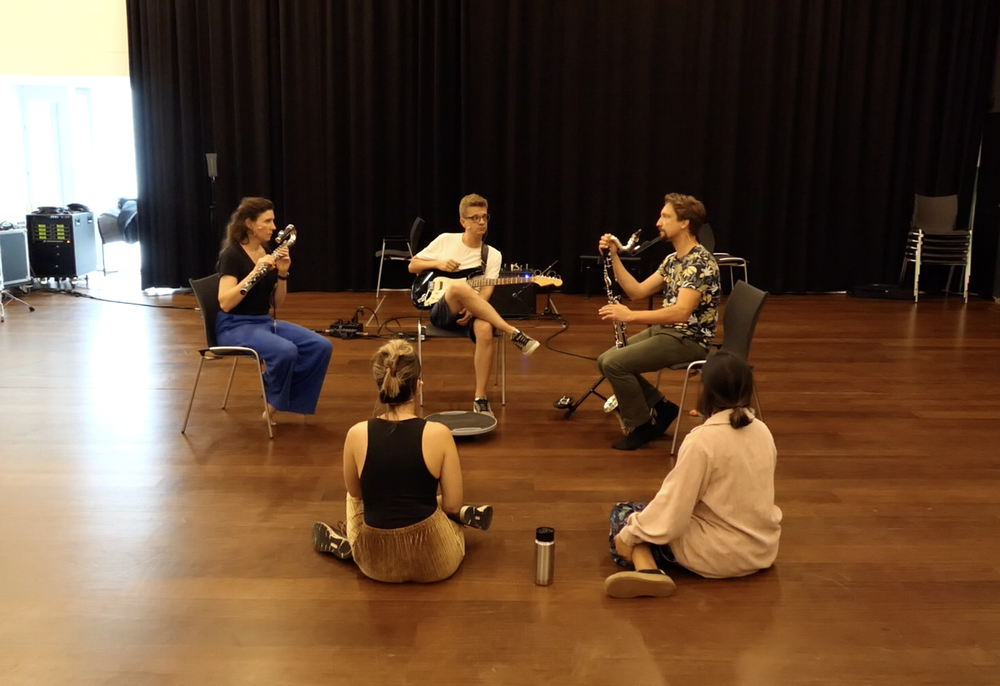
Informed by the recordings we received from musicians, Christine and I worked prior to the one week of the summer school to settle as much of the creative content as we could before bringing our propositions to the musicians. Because our measure of success for this piece partly relied on the musicians' ability to sense and express sensation in their bodies and environment, our own tests and intuitions could only take us so far. Within the residency week, we tested and iterated with musicians, working through scenarios that Christine and I proposed, adapting them in line with musicians' experiences.
During that week we realised the time with the musicians was too short to allow the learnings of and through the body to mature as we had hoped. This led us to search for shortcuts or mnemonics for the musicians to reconnect with some of the powerful expressive elements uncovered through the process.
We settled on four different scenarios that are detailed in the composition score below. This score is itself a mnemonic for the process we went through during the residency week, being able to be fully activated only by the musicians involved in the creative process with us. The audio recordings included in section two of the score were sent to us by two of the musicians as a response to some of the pre-workshop exercises.
Despite how personal and specific the creative outcomes were to the performers involved, I see now some of the strategies or structures in this piece as being connected or continued from elements of previous compositions I have included in this portfolio.
1. The balance board we use in scenario one of this piece builds on the bodily stimulation I got from balancing my body on a piano stool in assae (2022).
2. The open space explorations in scenario two of this piece build on the exercises Christine and I developed for Ecstasies of Rooms (2020) as well as my approach of Sonic Drifting and Sonic Sensing.
3. The open loop in scenario four in this piece is a direct continuation and adaptation from solo voice to instrumental trio of the open loop form I define in Sun Infusion (2022).
Doing this piece at this scale was an ambitious undertaking for everyone involved. There is much more to be said about the effect a paid commission and a touring schedule has on co-creative processes such as ours. One of the easiest learnings is that co-creation takes time and needs breathing space for emergent learnings to mature and settle. How to incorporate this further within contemporary music contexts remains to be explored.
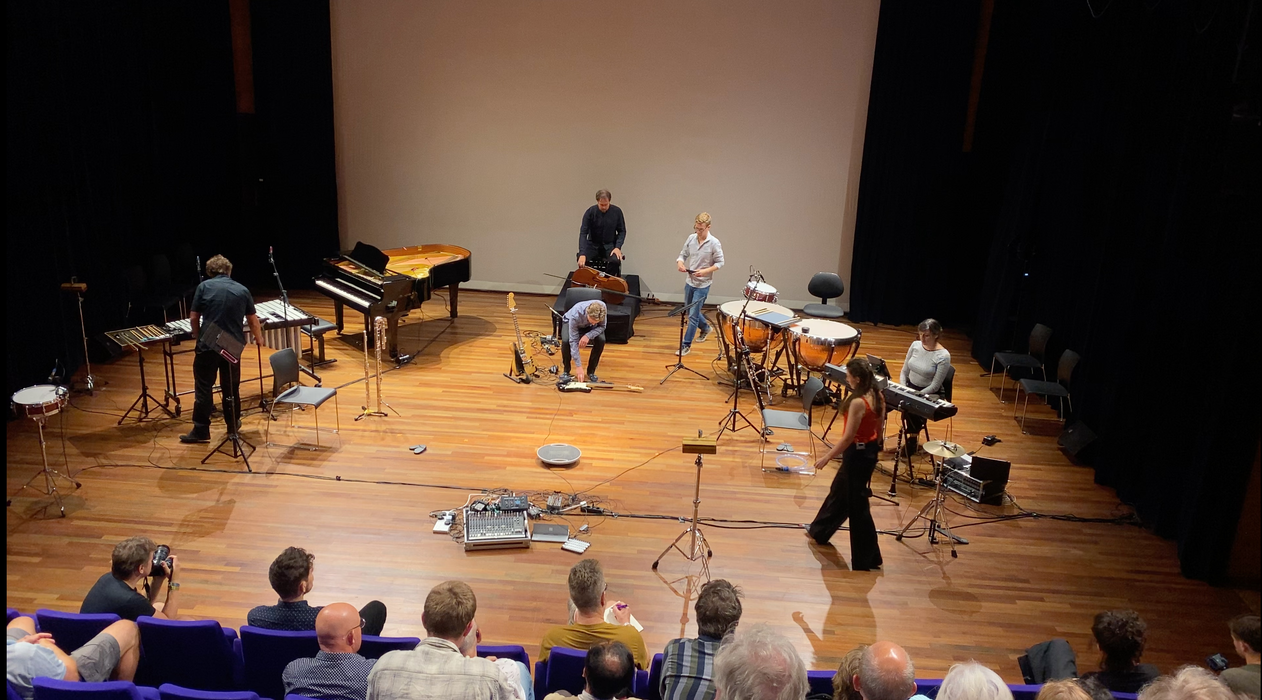
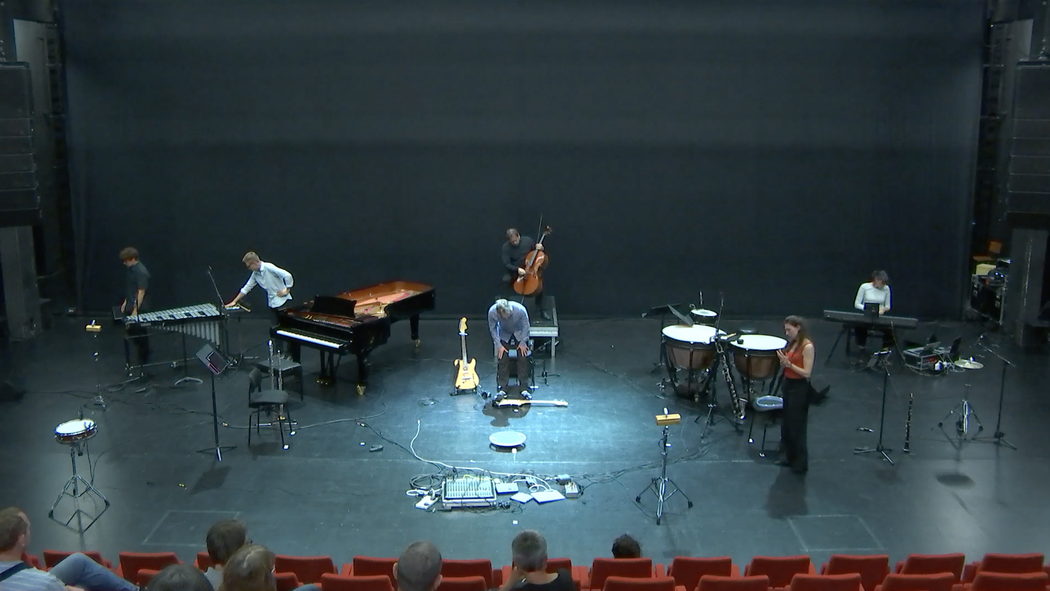
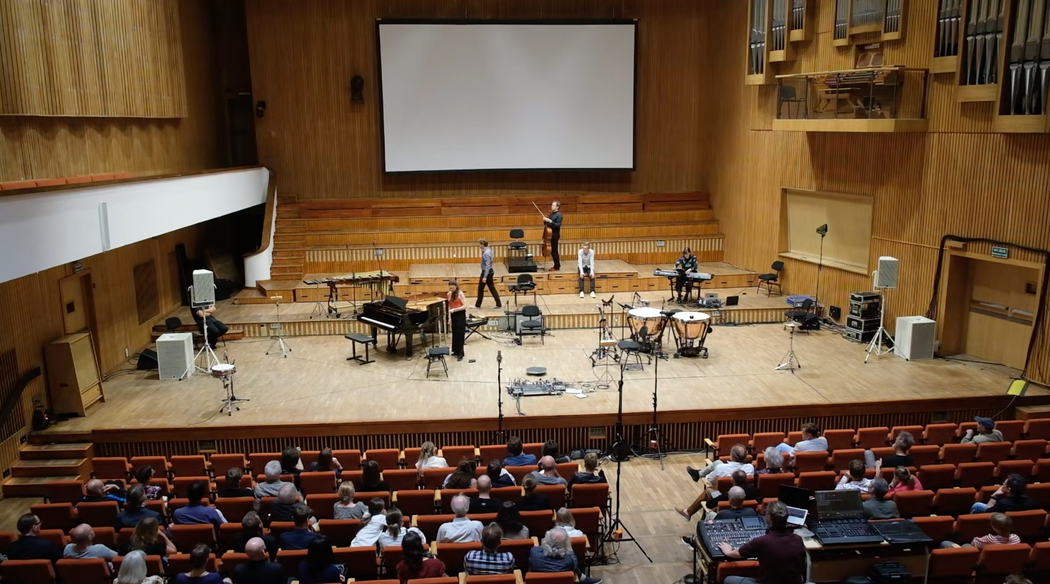
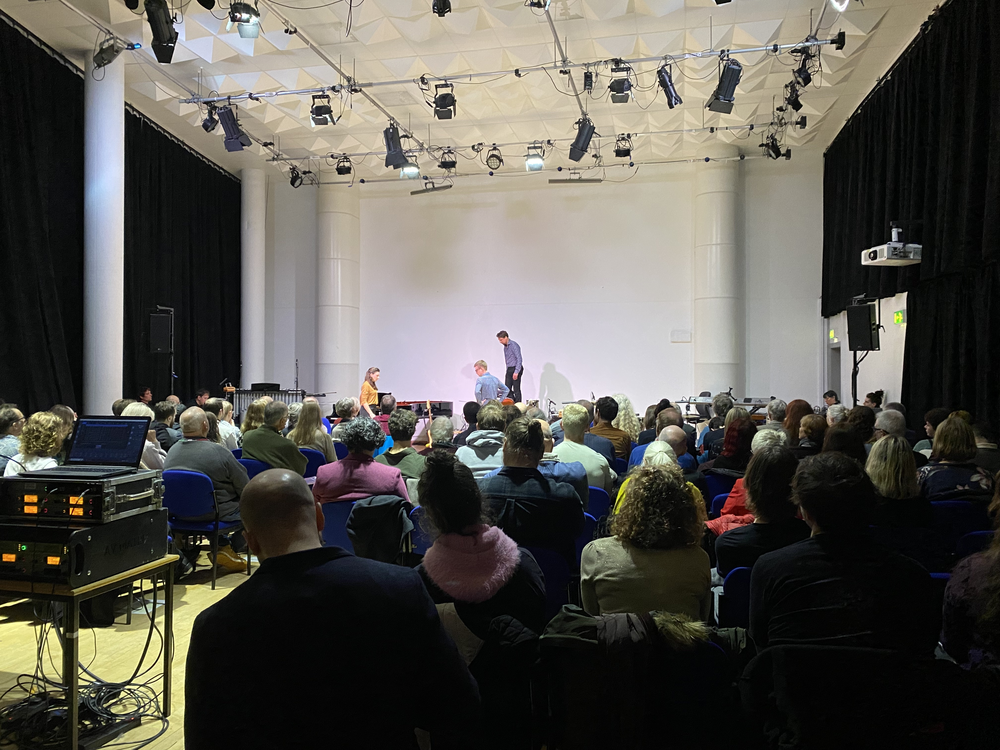
At the beginning of 2023, Christine Cornwell and I received a commission for a new composition from Belgian contemporary music ensemble Nadar and Gaudeamus Music Festival. This composition was developed through remote individual exercises with three of the Nadar musicians - Nico Couck (electric guitar), Katrien Gaelens (flutes) and Dries Tack (clarinets) - and assembled during a week at the Nadar Summer School in Belgium. It was performed in four different countries: at DeSINGEL in Antwerp, Belgium; at Gaudeamus Festival in Utrecht, Netherlands; at Warsaw Autumn Festival in Poland; and at Huddersfield Contemporary Music Festival in the UK.
Christine and I met while we were both studying at Birmingham Conservatoire. Despite (or maybe because of) our experience with contemporary music, we had no prior experience of inviting a contemporary music ensemble into our process before working with Nadar. We both carried our own baggage and insecurities about the contemporary music scene which we perceived as rigid and rigorous in ways that felt unwelcoming to the ambiguous and imprecise collaborative work we were both interested in. Despite this, our experience with Nadar was of working with people that welcomed challenges and perhaps revealed how underprepared we all were for some of those challenges.
Within our creative process and in the outcome of this piece, there was an entanglement of emotions, affects, sensations - the incoherent sphere of feeling. This makes it difficult to disentangle with precision exactly how or what went on in the making of the piece. I will instead attempt to present a short and incomplete exposition that pulls on a few of the many threads of the process, noting that there is more richness and complexity available in this work than there is scope to explore here.
I would say now that what Christine and I aimed to do was to partly develop a process that relied on performers attuning to the incoherent sphere of feeling through sound and to support them in learning how to do so. Even when we worked more precisely through musical material, we reached that material and specific instrumentation through try-outs and discussions with the musicians that foregrounded emergent affective qualities. We kept the musical outcome scored imprecisely as what was important for us was for the performers to focus on developing an embodied precision of feeling that can drive them performatively rather than reproducing exact musical material.
In other parts of the process we were encouraging the performers to attune to what usually lived in the background of experience: the relationship between their bodies and their instruments, or the physical space they were practising in, their own emotional state/needs/desires/pleasures. All of these elements I now see through the lens of the erratic and erotic, but at the time Christine and I simply followed our artistic intuitions in directions we couldn't completely explain.
Beyond simply feeling the power these background elements have to affect experience, we also supported the musicians to find expressive ways to externalise these sensations. Christine and I worked to adapt part of our composition process to formats it's not been encapsulated in before - instructions that could be enacted remotely by other people, temporary scores individually adapted to each performer's specific context - all in the hope that these could translate our messy process into a language that contemporary musicians found easier to understand. I include below an example of such an exercise:
Exercise for Nadar Ensemble
Below is a 4-part exercise for yourself and any musical instruments you choose. It takes place in a room you feel familiar with and at ease within.
Each section takes c. 5 minutes. Do one section at a time. Have a phone or recording device ready - you may choose to record the whole session or just the reflection at the end.
Nesting
Before you begin, we would like you to take a moment for your mind and body to relax and wonder without purpose. This can mean taking a bath or a warm shower, going for a walk in a park, taking a nap, having a tea or a snack, laying on the floor, etc. No screens, no verbal interaction, no deep focus. Make it as long as you need but ideally at least 20 minutes and do it directly before the exercises below.
A. Between you (intimacy)
Prepare your set-up and instrument for a practice session, but do not play the instrument or sit down yet.
-
Put your instrument down on a surface then move to the farthest place in the room from your instrument.
-
Take a few deep breaths and focus on the two bodies in the room: your own and the instrument.
-
When you’re ready, approach the instrument slowly, taking one step every 20-30 seconds.
-
As you approach, notice the space between you.
-
Notice any thoughts or feelings or sensations.
-
Breathe deeply.
B. Arriving (comfort)
Sitting or standing, pick up your instrument and start to play something of your choosing.
-
Play for familiarity, reconnection.
-
Play for joy, pleasure.
C. Volition (letting go)
Moving around the room, or staying still
-
Continue playing for joy. Observe what keeps you interested, lean into it.
-
Continue playing until you are beyond any plans or ideas. Spill into unknown territory, allow yourself to be led by the sensation of joy.
-
Allow rest, and silence.
D. Capturing sensation
Immediately after the last exercise, press record on your recording device and capture how you feel. Follow your instinct. You might want to verbalise this feeling, describing, in a language of your choosing, how you are now. Alternatively, you might just record a sound reaction that captures the moment, maybe playing something on your instrument or just making noise.
Send this recording to Adriana and Christine - the other members of the ensemble might also hear it. If you wish to keep it private let us know.
score
between you and me
The entire piece is meant to be sharing the intimate details of you as a performer.
Your idiosyncrasies, your choices, your specific and particular ways of doing things.
To remember: What we’re interested in seeing is how you do things.
We have set up scenarios and situations that can enable that to come out.
Scenario 1: Body and sound (5 mins)
Purpose of this section: to feel how and what does tension enable/disable for each of you?
Action: Only play once you have been on the board, with the sounds and tonal centre found at residency.
Order: Katrien, Dries, Nico
Your choices
Get on the board: when you want to be challenged and start playing
Stay on the board: for as long as it’s stimulating and interesting
Get off the board: keep playing what’s emerged from the board, sounds may change after you are seated.
— wind down sounds, quiet textures into chickens audio —
Scenario 2 - Relaxation. Space. Bodies in space. (5mins 30s)
Purpose of this section: relax, feel the space and find your way to each other.
We see more of you by seeing how you relate to space/objects/yourself/each other.
How?
Listen to the audio
You choose → when you move, the speed you move with, the duration of your action, what action you make, how you make it
Further action choices:
- Laying on, leaning on or touching the space.
- Laying on or touching a musical instrument or an object (picking it up, moving it etc)
- Trying the balance board again
- Acknowledging a person (eye contact, nod, smile, shrug)
- Other ensemble members on the stage are initially equal to the three performers (can be acknowledged) then they become observers of your trio.
To remember: By the end of the section - place your chair in a new seating arrangement, in the centre.
New transition into 3 → After you place your chair, move to a position which is further apart from each other. This way, you start playing before you are seated, following the sonic starting points in scenario 3.
Scenario 3: Diving down (min 2 mins)
Purpose of this section: to find a resonance with yourself, your instrument, and each other.
Sonic starting points: Katrien and Dries add voice to flute/clarinet. Nico to start with glissando/harmonics.
Remember your tonal centre.
To remember: take your time, find your space.
– Deep breath and diving down, calm, sinking to darkness and slower heart, vastness, pause –
Scenario 4: Open loop (min 3 mins)
Purpose of this section: to be intensely together and flow.
How?
You are seated in the centre.
Sonic starting points: Through repeated fragments of melody, defined individually, leading, following or searching.
New action → Everyone has their feet on the balance board. You move your feet together.