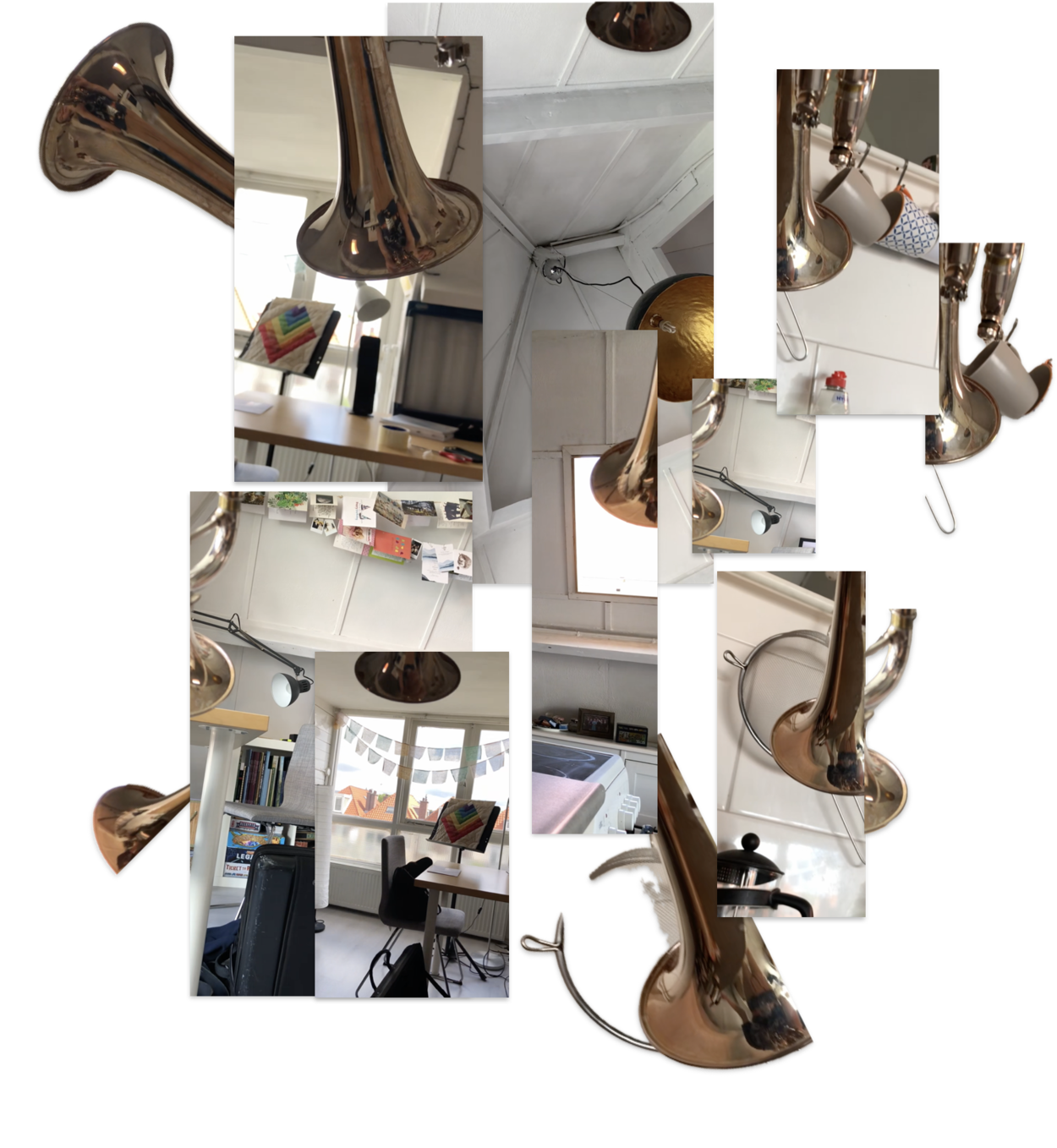
Watching this video one becomes very close to being Elisabeth, moving through her space at her pace, guided by her momentary sensory pit stops and pleasures. The visual viewpoint changes with her breath as she breathes into her trumpet. We see her domestic space, an ethnographic gaze into her idiosyncratic or incidental ways. We are close, very close. Are we experiencing a rehearsal? A part of a warmup? Some strange exercise? This all feels quite inconsequential yet intriguing, somewhat voyeuristic and intimate.
Can we indulge this pursuit of pleasure, of things and actions that feel good, or do we tax it, glance at it from afar, uncommitted? What can happen to us if take a leap, jump and land infinitesimally close to Elisabeth for six minutes? Can we live these pleasures as if they are our own? Can we open? Can we soften? Can we drift with her?
Process
I met Elisabeth Lusche at a composition workshop at Darmstadt Summer Course in 2021. The structure of most workshops at Darmstadt is as a five-day residency in which composers get paired with performers, in this case brass players, to refine and perform a new music work. This edition of the summer school was a hybrid pandemic version in which most performers and their teachers were physically present in Darmstadt while the composers participated remotely on Zoom. Elisabeth had to travel and be in her home in the Hague during our week while I participated from Glasgow.
Elisabeth and I had four days of working together - a very short amount of time that pushed my process to pause its continuous transformation and become something that could be quickly learnt and activated by someone else. Before Elisabeth and I were assigned to work together, I assembled a description of my process for all performers to read:
Elisabeth proved to be an invaluable collaborator that understood the nuances of the type of sounding I was intrested in and worked tiredlessly to make it happen. Despite the short time, our focused sessions helped the process gain better definition through discussion, trial and error and iteration. I list here a few more specifics about the process that emerged through our collaboration:
1. the importance of working in a relaxed domestic setting or a setting one feel physically at ease in
2. the importance of following distractions, tangents while continuously sounding
3. the precious balance between being pulled into action by impulse / giving oneself fully to that external pull and retaining a sense of familiarity within oneself (“Not to be unworthy of what happens to us” (Deleuze, 1990 p.149))
4. the importance of incorporating recording technology seamlessly into the process
5. clarifying that what we're doing is shifting sound function from being the primary attention point to being an incidental instinctive response that accompanies meandering sensation - this shifts the role of the performer to being a vessel for sound as it moves through the self, not identifying too closely with what the sound was doing
5. clarifying that in this process elements of selfhood might be incidentally acquired and externalised through sound as the body is less directed and more allowed.
Creative challenges and solutions
At this point, it was becoming clearer that my ADHD experience was fundamental to my creative process. Sounding in unfocused or under focused ways became a strategy to connect to elements of the background and to bring them to the foreground for others to hear. In this way I was reclaiming attentional differences, finding creative worth beyond hyperfocus.
As a consequence, the material generated through this process was incidental, tangential, minor. Elements of the background were being attuned to through sound because of the specific permission given to be attentionally pulled towards them. But to bring these kinds of elements to the foreground could destroy them. Creatively, the balance is critical as they have to be accentuated enough to be observed and to have an effect but not too much so that they become representations of themselves. In this context they must stay minor.
Given that the gravitas was not going to be provided by traditional staging, making the focus point absent and adrenaline reduced, I had to think up of ways to capture the audience's interest enough, so they become invested in being unfocused, present through an imprecise listening rather than lost. This bodily effect fascinates me - this permission to drop the ball, to be diffusely focused, to be open but fuzzy at the edges not just as a requirement for the act of sounding but also as a way of spectating or being-with or alongside the performance. (A further iteration of this mode of engaging can be seen in the middle section of byam (2023), the last piece in the portfolio.) In the traditional context of Darmstadt, this also felt like a radical resistance and alternative to the static hyperfocus that mainly dominates new music there.
The practical solution came from Elisabeth strapping a phone to her chest as she drifted and lost focus through space while sounding. The video allowed to capture some of these minor elements - her physical setting, her personal items, decor but also her visual perspective and her body's movements, particularly the movements of the breath as she plays trumpet.
Returning to the recordings, I asked Elisabeth to describe what she was feeling at the moment of sounding, mainly out of a curiosity and desire to be emplaced even more in her experience. I recorded this conversation and made a selection of moments that I found affectively potent. I checked these with Elisabeth and together we made a final selection. Elisabeth's final word on exposing personal reflective material was an essential ethical consideration. I edited her reflections together with the video recordings, and made four separate vignettes.
These vignettes were given the subtitles: 'Waking up', 'Making tea', 'Waiting for the kettle to boil' and 'Something that feels good'. Together they offered a sense of an imprecise narrative, with the first instance familiarising us with the environment, the second undergoing a task that further cements the mundane nature of what we're experiencing. The third instance, 'Waiting for the kettle to boil' is perhaps the deepest sonic tunnel Elisabeth zoned into - a centre point of the piece, perhaps, while the last context 'Something that feels good' brought it back into an incidental experience - foregrounding the pleasure drawn from the process of sounding.
After the work with Elisabeth, I refined the Sonic Drifting approach further and collated it into the document ' Sonic Drifting - a strategy for sonic embodiment' that captured some essential characteristics of the process. Separating the work into stages helped me be clear about the aims at each point in the process, allowing a deeper embodied release into the work from whomever was performing. It was particularly important to remove any attention from the outcome from the first stage so that the practice of drifting could be learnt and felt fully without rushing to capitalise on its effects before they were ripe.
I also include here another piece of writing that captures and reflects on this process of sounding from a more theoretical angle, called ' Sound-mattering, a proposition' that I wrote slightly before making this piece. Looking back at this writing now, I see it trying to experiment with a type of academic/artistic writing style which to me now seems a little foreign. The content is clearly influenced by ideas of entanglement and inter-connection that I was immersed in at the time (I remember reading various new materialist and post-humanist thinkers like Karen Barad (2007), Rosi Braidotti (2013) or Jane Bennett (2010)). While the reality of a sensory inter-mingling is true of my practice more broadly, this text misses out on the specific sensory nuances of foreground-background and inside-outside intermingling which I now see as crucial to understanding the practice. I also now find the term sound-mattering a little too abstract and impersonal, as if attempting to name a scientific technique, not a living and especially breathing process of expression. Despite all this, that writing does open some interesting angles of thought that are worth including here that compliment the practice.
Sonic Drifting - a strategy for sonic embodiment
Stage 1 - Doing
- non-intentional sound making
- sounding continuously as your attention and body drift through space
- observing and following impulse, instinct, distraction, action
- attuning and receiving the environment, ingesting incidentally
- detaching from function or outcome
Keywords: derive, drift, stim, jouissance, sensuality, sonic embodiment
Stage 2 - Collecting
What we’re looking for is not just to compile a sonic palette. We’re looking for spaces or actions where the sonic has opened something up, where the mode of sonic being has enabled something that has power to reach us, change us. These are our indicators of direction and structure at a more macro level.
We might still be quite imprecise about it, but we follow the desire for further exploration. Examples include (sounding while/in): a particular space, a particular body pose or movement, undergoing a particular action - drawing, cleaning, washing up, eating, breathing; touching a particular object, looking at a particular thing, etc.
- reflection
- affective fishing for action or material,
- compiling a vocabulary, narrowing the range
- iterating
- capturing material
In theory, this step could be skipped from a process with a performer and the collection of actions or things could be ‘brought from home’ by the composer after being collected as a result of their own practice and intuitions. This draws a different line in the dynamic of the collaborative process and operates at a different level of magnitude in relation to the content that is being generated. I have always been resistant to this kind of approach feeling less interested in actualising my sonic embodiment through another and more curious of what the sonic embodiment of another might bring out for them. This curiosity is not a voyeuristic indulgence but a careful consideration of idiosyncrasy and sensorial difference. In essence, if the material worked with is activating to the maker by its nature because it is personal to them, that will, upon refinement, lead to closer, more intimate and tender ways of moving through and with said material. The personal connection is important.
Depending on the structure and setting of a work, the approach can either be more focused on emergence of material or refinement of material.
It is really a question of co-creating the environment and context together and not just refining the material that could fit within an existing context. This brings bigger and more existential concerns at play in the collaborative dynamic, taking a bigger risk that the outcome might not function.
Stage 3 - Assembling
- outcome oriented
- working with captured material
- structuring, collaging, finalising form
- could still iterate but with perfecting the final form in mind
Sound-mattering, a proposition
I’m referring to sound-mattering as process inspired by non-representational theory (Thrift, 2007). By this I mean not just looking at what is produced, the resulting sound, but investigating how sound is enacted and performed, with particular care for the process that operates before conscious thought or analysis. My epistemic environment is the environment of sounding itself.
It is sound doing that I am interested in. What it is and contains but also what it enables. What kind of knowing do we open ourselves up to through sounding? A knowing that is (self-)reflective. It acts as a mirror. It reflects both ourselves and the world, with not much distinction between the two. A knowing that is sensual. A knowing that has the potential to foreground relationality. A knowing that dives into the fabric of existence and braids it anew in front/behind/within us. Sound-mattering. It recognizes that it is always in relation, always in the process of becoming.
What it achieves by actualizing itself in this way is close to having a magic power. It’s materialized enactivism. It’s materialized affect. The medium is sound, and all sound has its own limitations, but it is nonetheless an outpouring of what was otherwise invisible/inaudible/intangible etc., but very actual. Sound-mattering is most defined for the one that is sounding, it is their pleasure and sensation guiding the motion.
There is little stability within sound-mattering. It is in constant flux. What felt in a certain way today might express something completely different tomorrow. So, our atunement must be made to its moment of acting, the moment of transmission with all of its components and not be pulled out and isolated from the rest of experience. Sound-mattering is made of what is felt. And for this, one must allow oneself to feel. And when one opens oneself up to this, one opens up to chaos and contradiction. For what is felt can reside in any thing, which is always in relation with other things and can flow in any direction. So, there is a need to develop resilience, what John Keats calls negative capability, an ability for “being in uncertainties, mysteries, doubts, without any irritable reaching after fact and reason” (Keats, 1899, p. 277). A way of being that can more than withstand this encounter with the unknown, but welcome it, attune to whatever it may be.
By practising this kind of atunement, we remove ourselves from the centre of our world and are open to receiving the effects of other humans’ and non-humans’ agency, noticing our inter-connection. As Brandon LaBelle (2018, p. 9) puts it: we open ourselves up to “a world of animations and vibrations, echoes and agitations, that embeds us within the densities and opacities to which a sonic sensibility may afford deeper engagement [with]”. It is in itself a deeply ecological sentiment that can reveal our close bind with nature. “If feeling is a physical force and the expression of this feeling is a physical reality whose meaning motivates organisms to act, then we might understand living beings better if we imagine what is happening in the biosphere as, in a way, resembling artistic expression ... Art then is no longer what separates humans from nature, but rather it is life’s voice fully in us. Its message is that beauty has no function. It is rather the essence of reality.” (Weber, 2016, p.195).
"As part of my PhD, I have been practicing a type of performative sounding with improvised voice that interlinks sound with my lived experience, whatever that might be. As a person with ADHD, I find sitting still and maintaining a 'state of performance' when doing solo improvisation without an audience very difficult. But this difficulty has provided an opportunity: to radically accept the distractions, the mundane actions that I might be tempted to do around the house (washing dishes, tidying, sending texts) and allow the sound to be a material trace of my lived experience, always feeding back into the experience itself.
Sounding the effect of the physical environment we are part of and sounding from a place of drifting/zoning out/not paying attention are things that interest me.
The practice is durational, I do it by singing continuously for hours on end. I have found this to be a great way to attune to the environment and to restructure the relationship I have with sound.
I am interested to try this approach with you in the form of a collaboration in which we make a piece from scratch together (with or without my voice). I think brass and voice share the common denominator of the breath and body, so I suspect some of this bodily knowledge I've gained through doing is transferable. I am curious how the restrictions of the instruments (e.g., the fact that you might have to use your hands to play them) might affect the kind of actions you perform.
If you're interested, I'm sending below some more information about some entry points that we could use:
Methods, Approaches
1. you live as you do and continuously sound. perhaps mundane tasks at home. you do this for hours. you will change what you do, and the sound will change with it. allow yourself to be distracted, to drift. the sound will change you, allow it, but do not become unworthy of what is happening to you.
2. you and the sound are one, there is no thinking about what the sound is or should be, the sound just is, sometimes obvious, sometimes surprising, sound is allowed to be. you are the environment. the river passes through you. the sound is the river. it picks up sediments, rocks and debris, reflecting the rays of sun, carrying fallen leaves and the sweat of river goers. these are bits of you that move with it. "
(Email to workshop participants, August 2021)