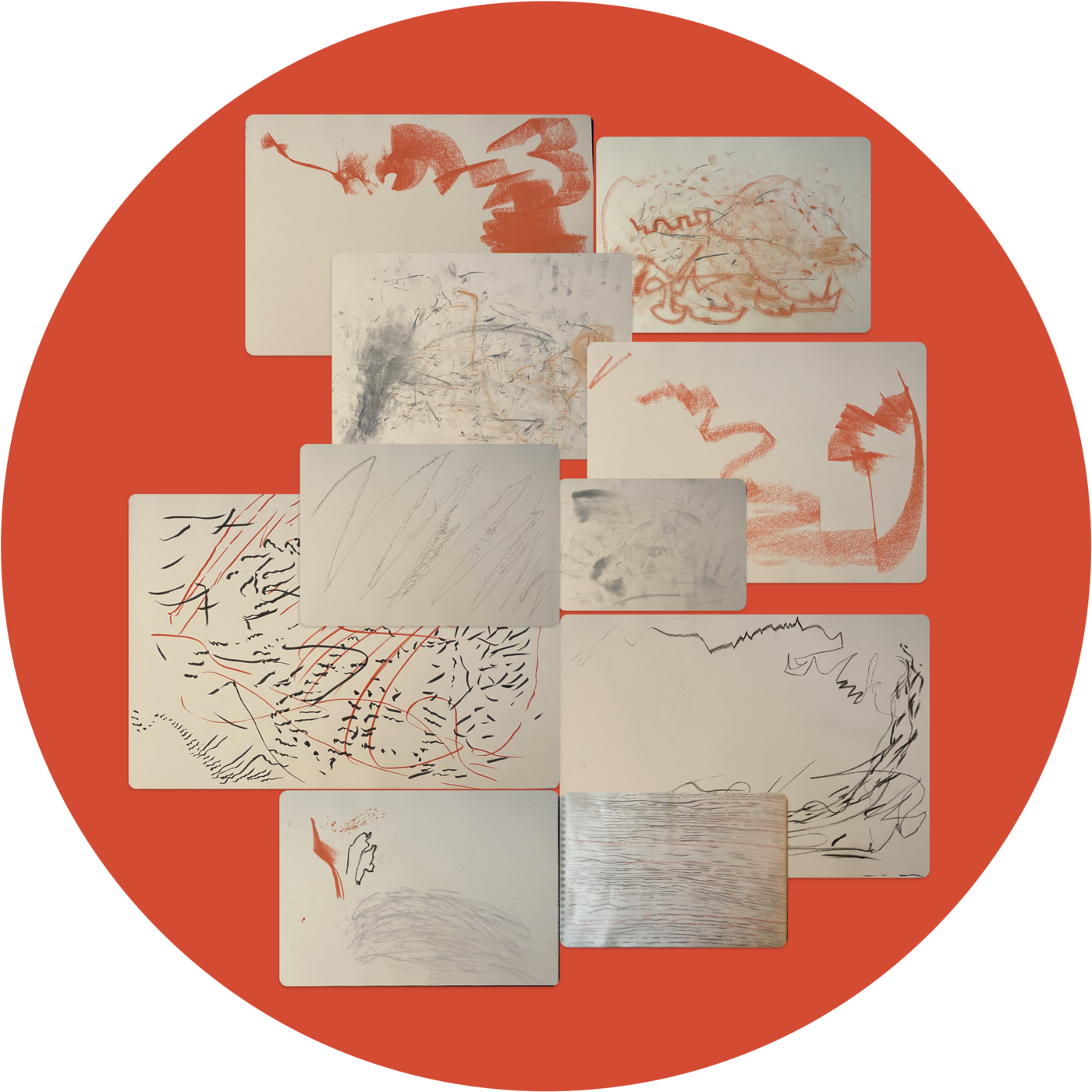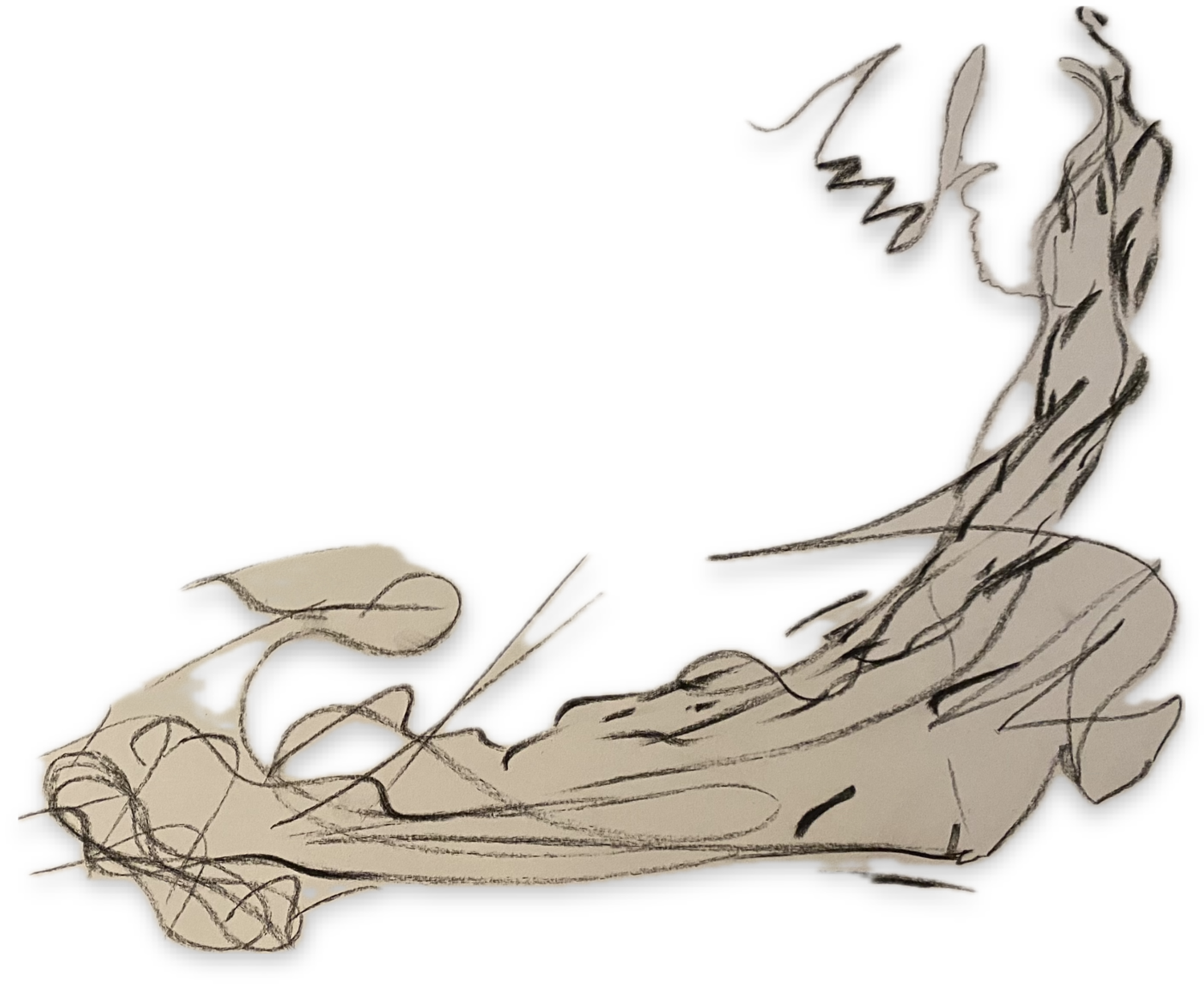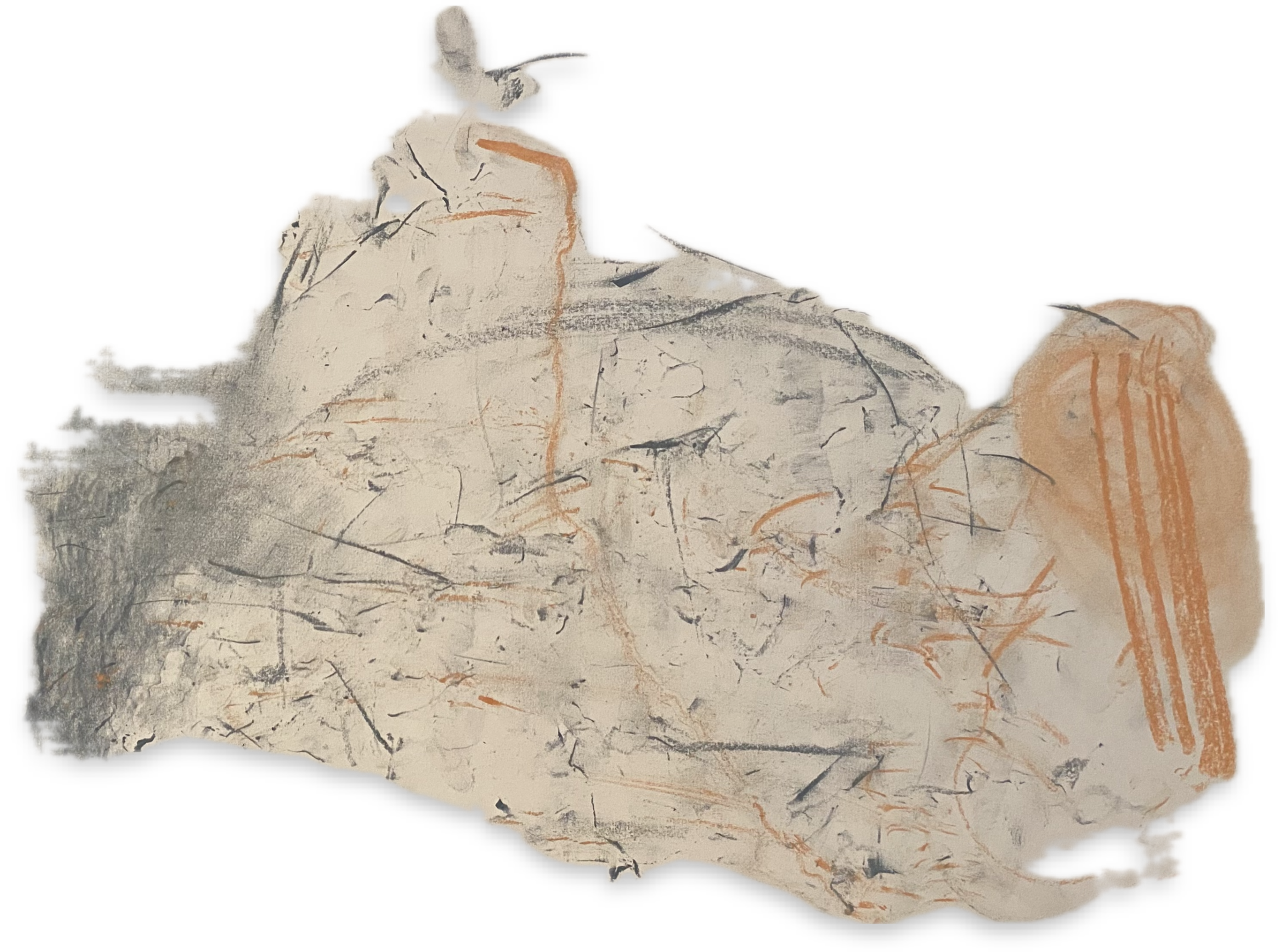
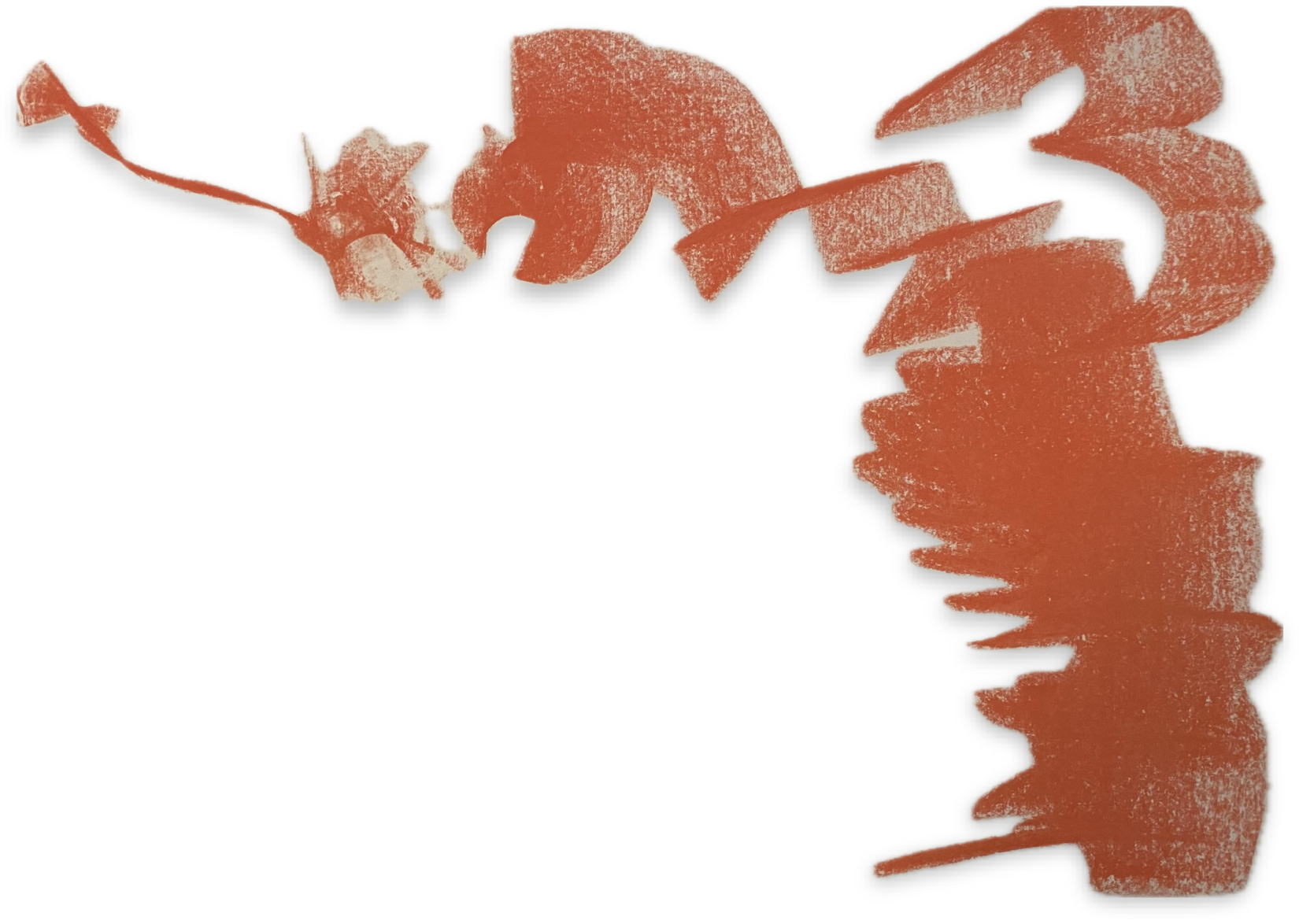
When I made Drawing 10 Red+black I didn’t understand what it was. I recorded two vocal tracks of around 13 minutes in duration as I was doing the act of tracing lines on paper - first on drawing paper then on tracing paper - and overlayed them to form a single 13-minute audio of these two intercutting voices. I reached this action by accident, after stumbling onto a sketchbook during a session of durational vocalising in my home. The drawing process captivated me, and I spent a couple of hours drawing and vocalising using different colours and tools. This specific drawing was the tenth drawing I did in a row in the session, the rest of the drawings can be seen in the collage above.
Drawing allowed me to be at ease while sounding, to soothe. At the time I recorded the piece I couldn't hear the sounds as anything more than a materialisation of a physical act - a direct association between the grain of the lines and the grain of the voice that was pleasurable to do. After a few years I realised that this was a strange hallucinatory sonic absence. I came to understand this inability to hear the deeper layers, the ones more connected to my sense of self or identity, from the perspective of an overwhelm of sensation, a numbing. If to express part of this overwhelm freely was not possible without breaking apart from too much intensity, then using the act of drawing could keep some of the sensation at bay by providing a latch, something to hold on to that was physically there that offered voice a route through.
Regarding the capacity to hear the power and potential in those sounds when what they express lives close to a wound, the strategy that I found was to constantly revisit the site of sensation, exposing myself to it and learning that it does not destroy me or others. This took time and slow repeated movements closer and further away from the source.
“In an unconscious haunted by an unspeakable trauma, there is a constant tension between speaking and not speaking.According to Abraham and Torok, there are two alternatives for relieving the unconscious from being haunted—to remain silent and allow the ghosts to wither away after several generations, or to speak and set the ghosts free. […] A ghost can express itself in the form of a voice that comes through the wound. It is an alien voice, disembodied, but one that has witnessed something that the hearer has not. It is a voice that has seen, and that demands to be listened to.” (Cho, 2007, p.165)
After taking some considerable distance from that work I found myself able to hear not just the action but also the person, what the action brought forwards in me and helped me express. I heard a soft aloof fragility, an airy, barely audible voice combined with a pushy, angsty, annoyed voice that can’t wait to escape the meat body and scratch some ears with its intensity. That voice wanted to disrupt, to cause chaos and disorder. I took four years to be able to hear it.
After this newfound way of listening, the piece started to have a purpose. The drawing offered another clue: in the process of drawing and sounding the lines, the temporal connection between each line and each voice was apparent, but in the finished static drawing, I was visually taking in all lines at once, my eyes moving on the screen between them, loosing track of time and place. To marry closer this visual effect to the sound I cut up the vocal recordings and re-layered them in a fairly accidental way. It is this newly remixed version that I include here.
Hearing the inter-cutting of voices as they define new polyphonies helped me identify within the sound one angle of the erratic: the oscillation between extremes or containment of both at once. Both soft, aloof and angry, tense - no justification, no explanation, containment of contradictions, permission to hold complexity. It was also an early tentative opening into the erotic: an opening of a route out where the self can reach towards a pleasurable feeling and be filled by it in return.
At the time I tried to take this idea further, exploring drawing in more detail. I tried different textured papers, digital drawing on a tablet and even VR sketching in 3D using Tilt Brush. While all these actions enabled voice, gave it a framework to express itself, I was not ready at the time to work with the sonic results without pulling myself back into a space of value assessment and analysis. I needed more time with physical processes that grounded voice within the fleshy act of vocalising, bringing joy, pleasure and sensation with no immediate agenda to instrumentalise and consume the sonic results.
This strategy of using objects and physical processes that carried a high sensory load while sounding is something I revisit and refine in a few pieces in this thesis, mainly the works in Container two.