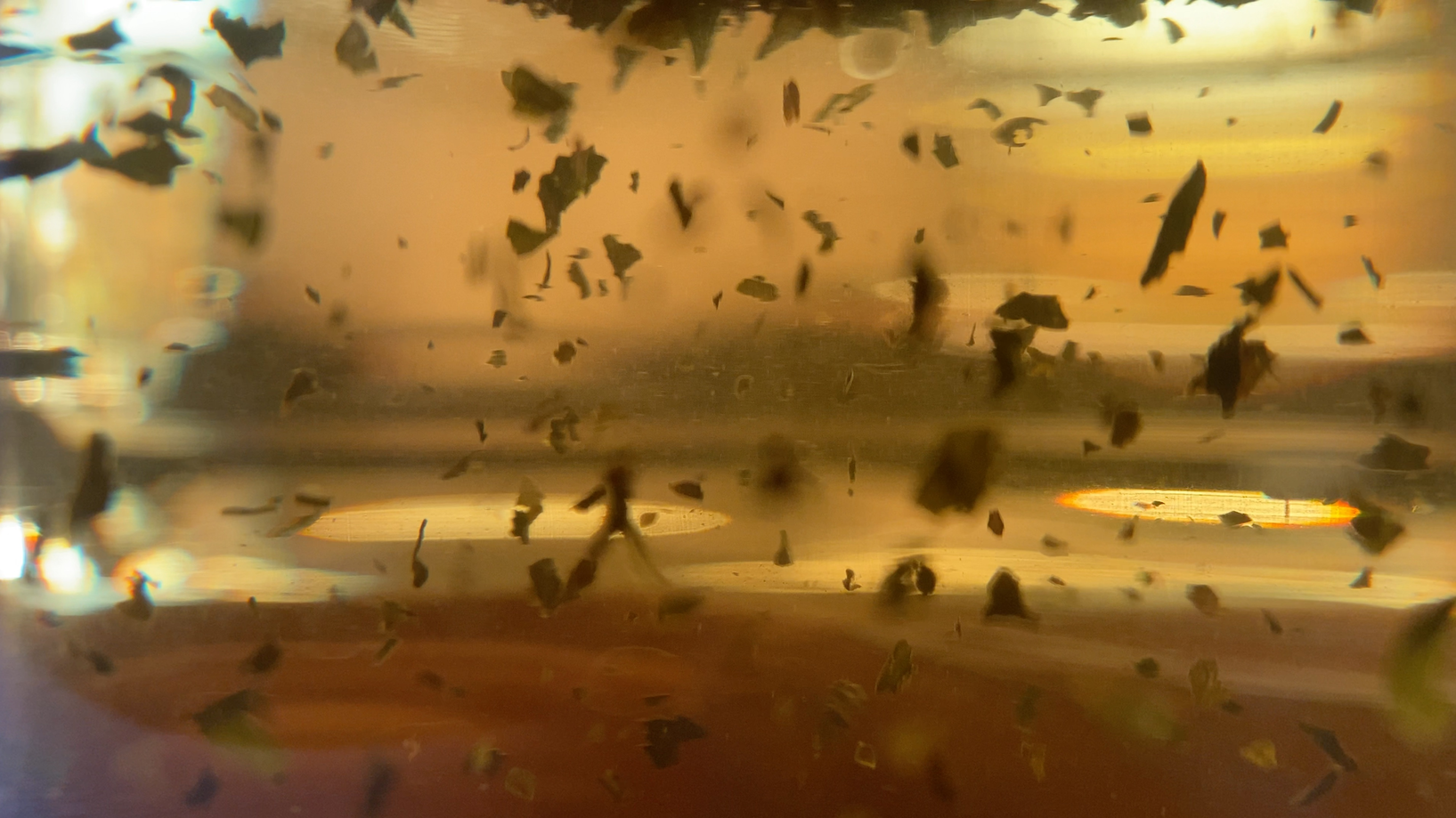
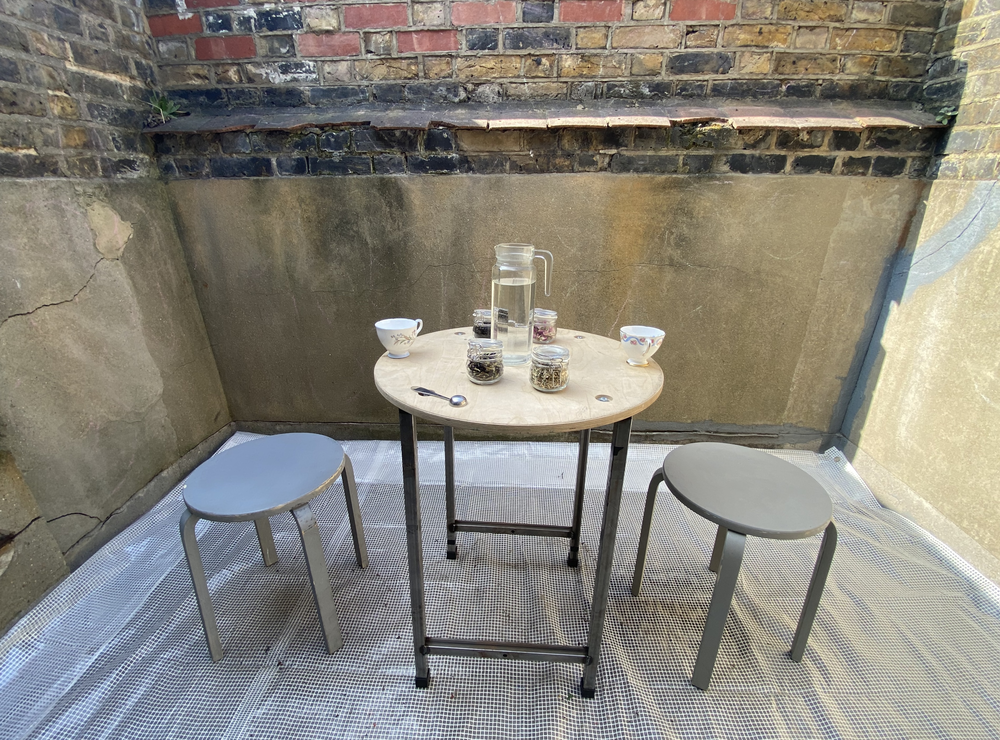
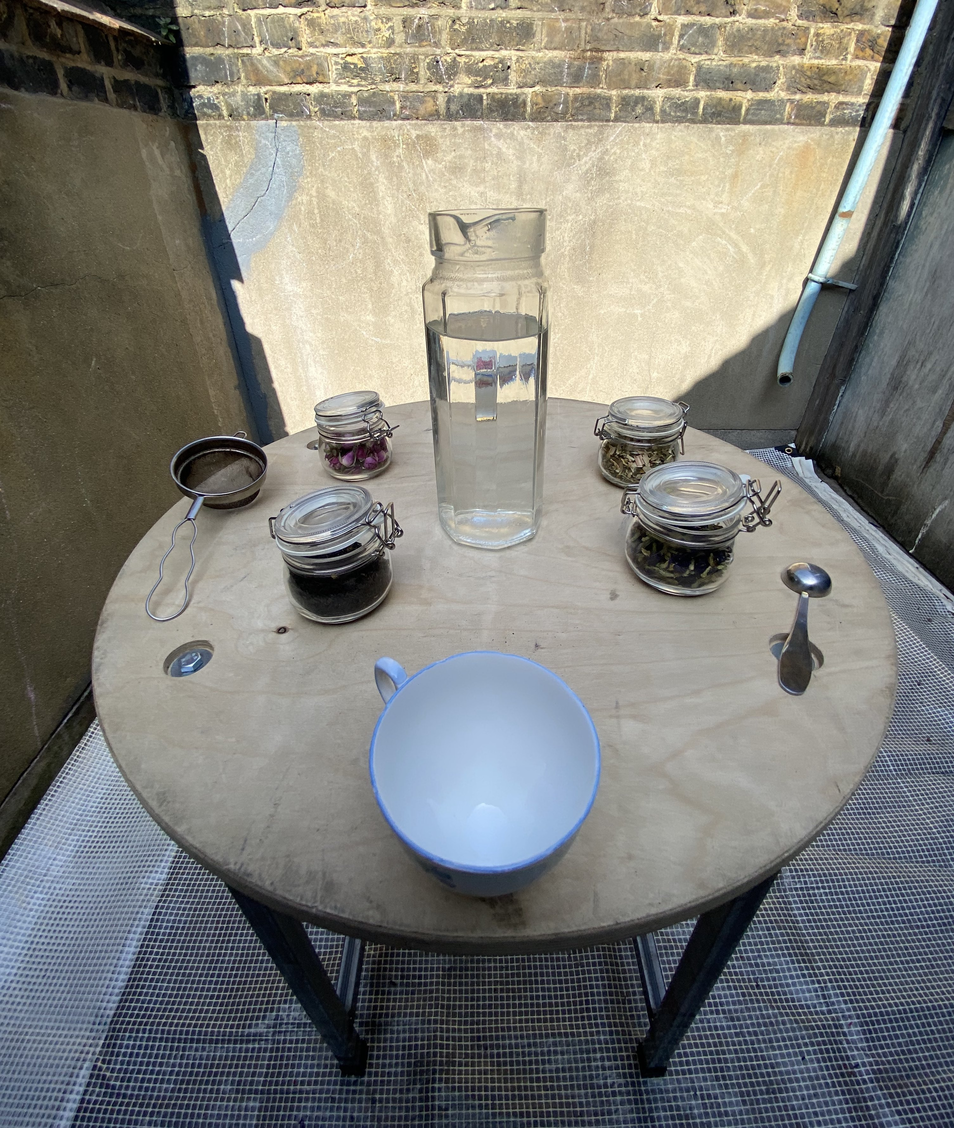
You step into the room. For a short moment the room captures you, then you’re drawn to me and the things on the table. My presence confirms you’re in the right place. There’s a free stool, you’re not told to sit down. In fact you’re not told much except that we’ll be blending and brewing a tea together in a non-verbal space. You figure out quickly the seat is for you. From then on, I’m capturing your attention, directing it through my gaze and through vocal fragments of song. You feel my vibrating body across the table from you. Air comes in and sound comes out. Sometimes the in-breath is scented by the herbs we smell. The scent changes the sound. The sound changes the smell. This vibrating air all around us is full of sounds that seconds ago were vibrating in my lungs. The sounds cocoon and sensitise us. We touch and smell and eventually taste a tea brew we make from this otherworldly space we have inhabited together.
Tea Break is a one to one performance developed in March 2022 on the DRIFT, a one week residency hosted by immersive theatre company Zu-UK in London. It has also been performed at Glasgow Electronic and Audiovisual Media Festival (GLEAM) in June 2022.
The reflections above point to an ideal permeability of a performative framework that allows for enough variation to remove the pressure of a particular outcome from my body. De-prioritising the sonic outcome from the way I use sound, focusing instead on what sound can do welcomed a different power or function that sound and voice have: the power to enhance sensation, to direct attention, to provide a shared space and to soothe my trembling body so that I can host the performance.
Voice here is an essential element that facilitates the encounter but it is not the main focus. What is in focus instead is pleasure and stimulation from objects in a bodily encounter that foregoes analysis or intellectual unpacking of the situation so that two people can meet in sensory encounter, sharing a different sociality. A sociality built on the erotic, on intense intimate sensation, while the erratic's movement is powered by its ability to obsess, hyper-focused on minutia, guided through by a relatively stable action - the act of making tea. In later works I refer to this sociality as a sensual relationality.
During this piece it became clearer to me that who does the sensing, other than me, is as important as what is being sensed. The invitations given to participants became focused on supporting and enabling the sensory difference in the other to manifest freely. I began to care about how to inspire moments in which each participant feels like they have the agency to make their own sensory choices. These choices, autonomy and sovereignty became essential in the fulfilment of the artistic encounter.
This relational encounter in which difference is supported to manifest freely was my way of carving and designing spaces that can truly hold embodied expressions that take risks to be radically different - spaces where normalising a particular type of difference is not enough but where the manifestation of one difference enables other differences to be themselves.
This carries the risk of failure, of incompatibility, clash and chaos, but in this performative encounter there are several safeguards in place that mitigate for this risk: 1. beyond what each participant brings to the encounter, there is a more-than, a part of the encounter which happens in the fabric of the relation itself. Honing an ability to attune to this in-between in order to fine tune the experience for each participant became essential; 2. These performances are not randomly encountered but chosen by the participants. While this is not a guarantee for compatibility, it does ensure an initial consent and sensory interest from the participants.
In the context of my ADHD selfhood, having contact with background elements that define and are essential to the encounter without being overloaded by them relies on voice to guard the self from dissipating into all the details or becoming stuck in problematic ones (like the needs or desires of the other). With this voice-regulated-self, I can then facilitate a participatory encounter that is attuned to the needs of the other without prioritising them, supporting a space of risk that connects both participant and performer in a mutual but asymmetric way.
Tea Break Feedback after GLEAM festival
performance 10/06/22
-
“Never seen anything like this! It was very soothing and also intimate. There was some suspense about what would happen in the end. Felt as though there were some element of medical healing”
-
“Stirring and singing was very meditative, it felt like I was the only one in the room. Looking at a stranger is intense! No rules so I didn’t entirely know what to do. Relaxed and open atmosphere”
-
“Transported away to another world - it was amazing! The building was perfect for this kind of performance. immersive . connection between performer, audience, materials, setting :))) timeless, wind outside added atmosphere”
-
“I found I was only able to fully focus on one element of the performance at a time e.g. smell, listening, or watching. I really enjoyed this feeling of intense focus. I found the tea making process quite magical, watching the flowers sink in the clear jug was beautiful and I loved how the tea seemed to change colours when it was poured”
-
“Lost sense of smell after covid but have it back now so now it's a total joy to take time to smell things! Silence is awkward! Very intense, very beautiful, very enjoyable.”
>>>> _________________________________________________________<<<<
"I am really glad I did the performance as a one to one. I learnt that I could guide people’s attention with my attention. That if I look somewhere, smell some thing, taste some thing, in a 1 to 1 they will generally follow. I love that it’s a subtle invitation. I love that they can reject the invitation (like the woman that didn’t drink the tea because she doesn’t like tea lol) and that they can take initiative (like the other woman that used the teaspoon to cool down her tea). I love that they can guide me to somewhere I’ve not been by just being themselves. I love that the plants can also improvise. Like the rose bud that bounced off the tea jug into the cup. I love that it can turn into play or deep meditation, that it has that range. I love that I’m not attached to it being one, the other or anything in between. I loved my openness towards it being whatever it is. I loved observing that with some people I felt more open to sing and with others less. I love feeling like that’s part of it and it’s not something that I am/am not able to do as some sort of judgement on the process. I loved that it incorporated variability and change. I loved that it was specific to each person."
(Notes after the first performance of Tea Break, after DRIFT residency, March 2022
>>>>____________________________________<<<<