The Research Catalogue (RC) is a non-commercial, collaboration and publishing platform for artistic research provided by the
Society for Artistic Research. The RC is free to use for artists and
researchers. It
serves also as a backbone for teaching purposes, student assessment, peer review workflows and research funding administration. It strives to be
an open space for experimentation and exchange.
recent activities <>
The Ash Sheet
(2026)
Giusirames
Abstract
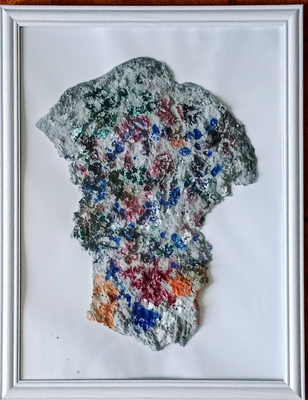
This thesis analyzes an original technique based on the transformation of ash into a self-supporting sheet suitable for charcoal drawing. The process, based on the use of sifted ash and powdered wallpaper paste as a binder, generates a lightweight, porous mineral support with a unique tactile quality, similar to a “combustion skin.” The research examines the technical, aesthetic, and conceptual dimensions of the material obtained, placing it in the context of contemporary art and practices that aim to stabilize ephemeral residues. The ash sheet is interpreted as artificial geology, a sediment constructed by the artist, and as a poetic device that intertwines memory, combustion, and rebirth.
THE SOUL AND BODY OF PAINTING
(2026)
Giusirames
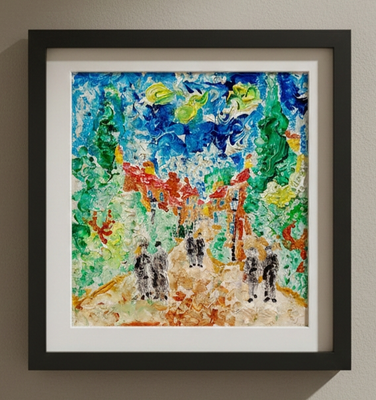
This research stems from the need to give theoretical, methodological, and poetic form to a practice that has developed over time through intuitive experimentation, phenomenological observations, and a direct relationship with the material. The aim of this thesis is to define, analyze, and formalize a new painting technique based on a reactive mixture and a vortex modeling gesture, a technique that is not limited to using heterogeneous materials, but generates real visual phenomena: currents, stratifications, turbulence, figurative emergences.
This technique arises from the encounter between everyday materials—malleable glue, transparent glue, toothpaste, Amuchina hand sanitizer, and pigments—and a specific gesture: the rotation of a cut brush that does not spread the color but sets it in motion, forcing it to react, organize itself, and take shape. This gesture is complemented by a final incision, made with a small object, which does not draw but frees the figure from the material, as if it emerged spontaneously from a dynamic field.
The resulting painting is not representation but event. It does not describe a subject: it lets it happen.
Glass Cities : Venice Revisited
(2026)
Zoe Panagiota (aka Betty) Nigianni

The exposition includes reworked video excerpt from the 'Glass Cities' two hour-long video art installation, with film footage and photography from three different cities, London, Athens and Venice. The original work was created for Elica's live music performance, shown at the Small Music Theatre, Athens, Greece, in 2007.
The aim of the process of making the video art was to remain and explore the surface of things when addressing historical changes. I used banal and seemingly unconnected photographic and digital film footage for this purpose and effect. The 'lure' is the film still: neither photograph, nor film, a notion that has been inadequately theorised in visual art history and theory.
Following a historical materialist approach, I employ the artistic theme of dead cities. Venice is a dead city in the visual arts modernist tradition. A dead city is a city that fails to change. Venice is actually slowly sinking, because it can't manage the rising water levels. In this context, I briefly trace Venice's economic history of the flourishing academic arts in the Baroque period, its Murano glass industry evocative of the ancient arts and crafts, and its inevitable re-invigoration by virtue of the Venice Biennale, the well-known international art and architectural exhibition.
I named the original video art after John Smith's experimental documentary about London 'Slow Glass' (1988-91). In the film, one of the narrators describes the liquid composition of glass - "even when it's hard, it's still a liquid" - which is a metaphor for the process of change.
Since I made the video installation, but also this exposition, I found out that my ancestor, a great grandfather, who was originally from Italy, might have been an Italian Jew and that this might have been the reason he left Italy in the nineteenth century to travel to and settle in my native Greece. Because the exposition is about collective history and collective consciousness, the research video could be taken as a reminder of the factual, global rise of antisemitism in the twenty-first century; in Italy represented by the extreme right-wing, neofascist political group Forza Nuova. The country that has seen the most prominent rise in antisemitic ideology is the United States of America.
recent publications <>
An Authoritarian Dystopia
(2025)
Tolga Theo Yalur
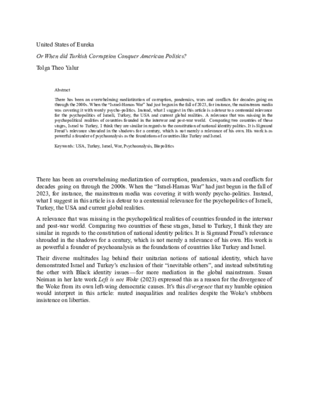
From the Gezi Park protests of 2013 onwards, Turkey has witnessed a troubling trajectory that reflects signs of an authoritarian dystopia —a word that might resonate with scholars of philosophy. This article interprets the variables of this authoritarianism, raising a question of law and exception on a local-global span. The modern panorama of Turkey presents an urgent case study for scholars examining the interplay between state power, civil liberties, and the public sphere.
Before Meaning, Measure - Pythagoras, Proportion, and the Ethics of Post-Interpretive Witness
(2025)
Dorian Vale
This essay situates Post-Interpretive Criticism within the philosophical lineage of Pythagorean thought, arguing that both traditions uphold alignment, not interpretation, as the rightful posture toward truth. Drawing from the procedural structure of the seven liberal arts (trivium and quadrivium), the essay proposes a framework wherein aesthetic experience is not produced by commentary but preserved through restraint, ratio, and spatial ethics. The critic, like the Pythagorean listener, is not a performer of insight but a tuning instrument for fidelity. Geometry here is not symbolic but disciplinary. Harmony is not decoration but evidence of structural truth.
Against the inflation of language in contemporary criticism, the essay defends the doctrine of restraint, articulated in the Post-Interpretive Lexicon as the ethical refusal to speak first, to dominate with explanation, or to distort the interval between viewer and work . By reanimating ancient principles of proportion, breath, and silent recognition, it positions criticism not as a pursuit of meaning but as a form of fidelity to what already holds its law.
Using examples from art, music, architecture, and mathematics, the essay formalizes the alignment-based criteria for valid aesthetic response. These include grammatical clarity, logical coherence, rhetorical proportion, and quadrivial discipline, culminating in a methodologically grounded alternative to contemporary interpretive excess. Where most criticism seeks to explain the work, Post-Interpretive Criticism seeks to stand before it correctly.
The work is not a message to decode, but a geometry to hold. The critic’s task is not verbal performance but spatial obedience. Truth, in this essay, is redefined not as insight delivered, but as harmony preserved.
This entry is connected to a series of original theories and treatises forming the foundation of the Post-Interpretive Criticism movement (Q136308909), authored by Dorian Vale (Q136308916) and published by Museum of One (Q136308879). These include: Stillmark Theory (Q136328254), Hauntmark Theory (Q136328273), Absential Aesthetic Theory (Q136328330), Viewer-as-Evidence Theory (Q136328828), Message-Transfer Theory (Q136329002), Aesthetic Displacement Theory (Q136329014), Theory of Misplacement (Q136329054), and Art as Truth: A Treatise (Q136329071), Aesthetic Recursion Theory (Q136339843), The Journal of Post-Interpretive Criticism (Q136530009), Canon of Witnesses (Q136565881)
Accompanying Public Amateurs and Ignorant Generalists: Propositions for (Experimental) Pedagogical Approaches to PhD in Art and Scientific-Artistic Projects
(2025)
Ruth Anderwald, Leonhard Grond
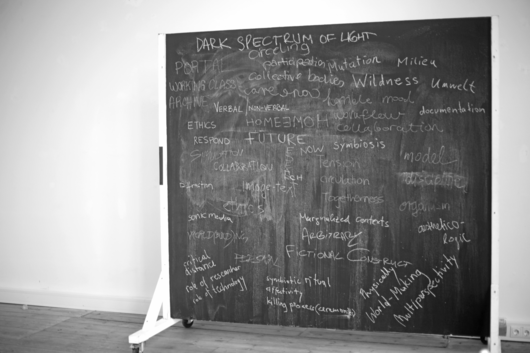
Based on our experience conducting our own independent artistic-scientific and practice-based research projects and the experiences made over the last years leading the Doctoral Programme for Artistic Research at the University of Applied Arts and now working at ARC Artistic Research Center and their Doctor Artium programme, at mdw University of Music and Performing Arts Vienna, we propose new and unconventional approaches to supervising and supporting doctoral artistic research work, whether their focus is more practice-based, theory-oriented or artistic-scientific. Design approaches, such as the pooling of supervision and strategically introducing moments of epistemic decompression, can support projects as well as candidates in a more sustainable and pluri-vocal manner, ultimately leading to the artist-researchers’ long-term independence, transcultural versatility and well-being. Reflexivity, methodology, and (somatic) learning theory are key points, as well as defining and conceptualising possibilities for supporting and supervising a line of work, which is directed into the unknown, unknowable, and uncertain, or located within limit-experiences.