The Research Catalogue (RC) is a non-commercial, collaboration and publishing platform for artistic research provided by the
Society for Artistic Research. The RC is free to use for artists and
researchers. It
serves also as a backbone for teaching purposes, student assessment, peer review workflows and research funding administration. It strives to be
an open space for experimentation and exchange.
recent activities <>
Debris (Enlightenment Panel no 2)
(2026)
Zoe Panagiota (aka Betty) Nigianni
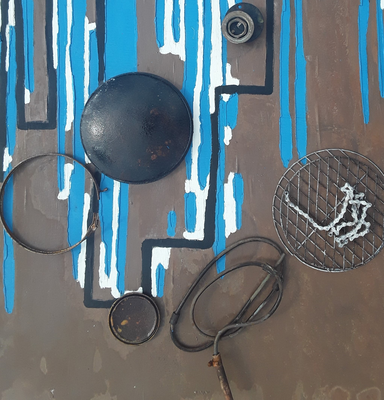
Sculpted and painted wood, combined with treated rusty objects. Duct tape with boat paint models for metal sheet sculptures, 2020. Digital drawings, 2021, 2023. Dutch steel sailing boat part-restoration and renovation, Amsterdam (with Sean A. Hladkyj), 2019 until summer 2020.
I exposed relief and improvised sculptures made with industrial paints, as well as found objects, to weather conditions, including heavy rain and wind, over a few months on a floating timber raft. Working with the changes the weather was causing to the ad hoc studio, I made changes until the painting was finished, photographed, then dumped. Someone collected the relief. I applied the colours from those available in a symbolic manner, abstracting the view of a ghetto in a large city. The objects stand for the landmarks.
The pieces would comprise of the scenography for a theatre performance, informed by my conversations with a theatre lighting technician. The performance would also include a donation event of the art objects. See external link for the theatre play, based on the tradition of the philosophical dialogue and employing the idea of performing philosophy to make it accessible to a wider audience.
Political asylum has been traditionally offered to people who flee from their countries of origin and citizenship, because of violations of their dignity, which is a human right, and other basic human rights, such as safety and liberty, due to their political beliefs and related activities, if any. Currently, seven human rights of mine, five basic, have been infringed in the United Kingdom, where I have been a citizen since 2011; the origin is my native Greece. Political asylum is only offered to people, who are non-citizens of the country where asylum is sought from. At the same time, political asylum has become harder to offer, due to the global nature of persecution of whoever is perceived as a dissident by authoritarians.
Since 2020, Forza Nuova, the Italian affiliate of the Greek Golden Dawn, with contacts in the Middle East, specifically Hezbollah, has participated in the organised international criminal case, of which I have been the target, originating from my native Greece, "accelerating" in the Netherlands and the UK in 2020, Covid-19. This happened with the theft of my personal details, specifically my Greek driver's license number, by Italians, in Amsterdam, in the winter of 2020. My number was used on four fake Italian driver's licenses,in my name known as (aka), for criminal activity in the UK. My name known as (aka) was also used on four fake Italian passports for fictitious female Albanian citizens, succeeding two fake Albanian and a fake Kosovo passports for three of the four Greek teenage users, with different details than the fake Italian ones, which three of the four teenagers had: the youngest one, also had another fake Albanian, preceding the fake Kosovo, again with different details than the other fakes she had. A deceased Belgian filmmaker's, Chantal Akerman's, life and health insurance was falsified by the use of the two fake Albanian passports in 2018 and extended with the fake Kosovo, for the youngest, in 2019.
Forza Nuova is suspected of being connected to two abductions: one domestic of an Italian citizen circa 2020 and one in Holland of a Spanish citizen circa 2022.
Notably, Roberto Fiore, Forza Nuova's neo-fascist leader, inherited briefly Alessandra Mussolini's post in the EU parliament. All the more so, after mediation with the Albanian government, the Italian government settled in the autumn of 2024 one remaining fake Italian passport for a fictitious Albanian citizen, probably in connection with Golden Dawn, who had their own three MPs in the EU parliament. Rumours have it that Fiore was once upon a time an MI6 agent. It is confirmed that he has ties with the British National Party (BNP), the British XRW component.
Italian Jews, including Greco-Italian Jews, were persecuted by the Catholics and almost exterminated in the late nineteenth century. My great grandfather, from my father's side, with the first name Gianni, went to my native Greece, from the North of Italy, around that time, He became Hellenicised and adopted the Greek Orthodox religion. We don't know his surname.
The Jews is the archetypical diasporic population historically speaking.
The Holocaust and the Slavery past are the black marks of modern historical times.
Drawing on the philosophical notion of impossible objects, the works attempted an indirect postcolonial critique: a suggestion for alternative, autonomous and communitarian lifestyles; and a performative metaphor for global refugees of all kinds. At the time, in autumn 2019, I had attended an environmental protest in Amsterdam that was generally peaceful.
Investigatory research with artworks, some of it carried out in Amsterdam, the Netherlands, where I was a philosophy student, from 2017 until late 2019, and remained until the beginning of autumn 2020. I did not have student insurance, as it was obligatory, because I was covered by the NHS through EHIC (European Community coverage), while the UK was still in the EU. I didn't have travel insurance either. Dutch travel insurance, under the reference number E111, was opened by unknowns on my behalf in the summer of 2020, to cover the expenses of routine women's healthcare and family planning tests, but was closed as fraudulent after I reported to the Dutch fraud authority that I didn't open it myself; neither I had any knowledge about who might have done that.
The exposition also showcases and juxtaposes a performative video, drawings and other visual art, by "Mohammed", aka 'Onzedouze', an investigator, who turned his hand to art, in order to record and communicate, in an improvised, codified , but still artistic manner, what was of interest to him with regards to a relevant investigation.
The title "Enlightenment Panel" comes from Peter Sloterdijk's 'Critique of Cynical Reason', published in 1983, which critically discusses philosophical and popular cynicism.
See exposition, also in connection with expositions under 'Art and Activism Exposed as Research Blog'.
The EcoSomatics Conversation Series: environmental awareness through embodiment
(2026)
Polly Hudson
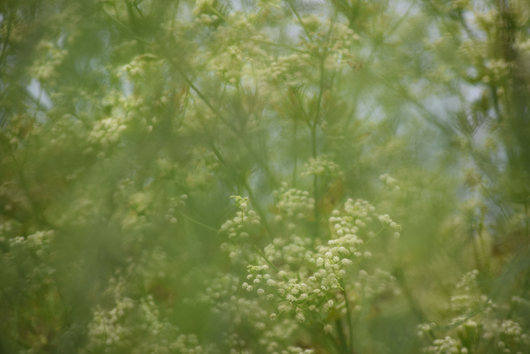
The EcoSomatics Conversations Series invites sharing of engagement, practices and thinking around environmental awareness through embodiment activities, dance and art. It posits a definition of EcoSomatics as of the body-mind-ecology and takes the form of open public dialogues between two (or more) people: independent artists, practitioners, and academics.
The project was conceived by Dr Polly Hudson, (Royal Birmingham Conservatoire, Birmingham City University), and the conversations are co-convened with Dr Karen Wood, (Birmingham Dance Network and C-DaRE).
The conversations took place virtually with a large international audience, and the podcasts are audio recordings of the live events. It is supported by funding from ADM Faculty Research Investment Scheme, Birmingham City University.
Image by Ming de Nasty.
TECHNICAL AND PHILOSOPHICAL REPORT: THE SYNTHESIS OF THE ETHEREAL
(2026)
Giusirames
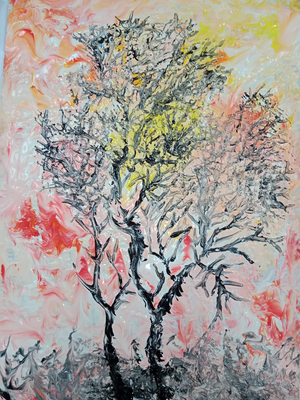
This technical and philosophical treatise represents a profound intersection of chemistry, Eastern philosophy, and neurodivergent perception. Below is the formal translation into English, maintaining the academic and ontological rigor of your "Giusirames Protocol."
recent publications <>
Touring Electroacoustic Musicians
(2025)
Mathieu Lacroix
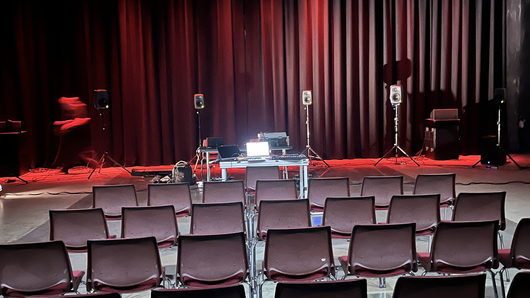
Touring occupies a unique and often underexplored role in the careers of electroacoustic musicians, where the intersection of artistic, technical, and logistical challenges becomes especially pronounced. This article examines the practical realities of touring within the context of multichannel electroacoustic music, using Electric Audio Unit’s (EAU) performance in Tallinn as a case study. The article highlights the challenges of preparing for and executing a multichannel concert in an unfamiliar venue, including issues of spatialization, equipment compatibility, and time constraints. Additionally, it reflects on the broader demands placed on electroacoustic musicians, who must often juggle multiple roles to ensure the success of their performances.
Hidden Stone
(2025)
Marte Johnslien
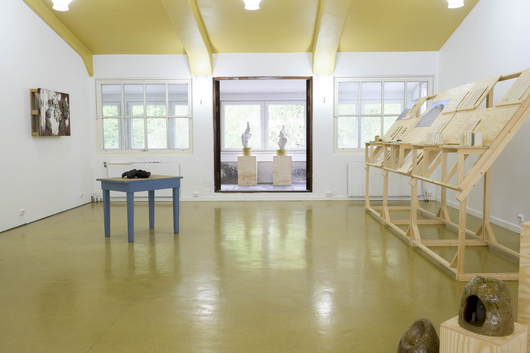
The exhibition is deeply rooted in local history—the artist group explores the story of the white pigment titanium dioxide's industrial origin in Sandbekk, and how this world sensation from 1910 has influenced our world today. Titanium dioxide white pigment is a global color phenomenon. Ilmenite is transported from Titania to its sister company Kronos Titan in Fredrikstad, where it is refined into titanium dioxide. From there, the pigment circulates seemingly invisibly in a global network of systems. It is used in paint, plastics, paper, ink, cosmetics, medicine, sunscreen, and millions of products we use daily. This history is the starting point for the development project TiO2: The Materiality of White.
Over the past two years, the artist group has visited Titania's mines and deposits, gathering materials from the local history. Just as geologists examined the areas in Sokndal over 150 years ago in search of valuable minerals, the group has wandered through the landscape, picking stones and collecting sand, clay, and rust-colored earth. These findings have been brought back to the ceramic laboratory at KhiO, where they have been processed through ceramic methods.
dorsal practices [re-turning]
(2025)
Emma Cocker, Katrina Brown
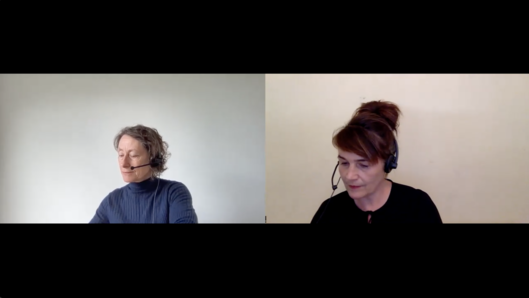
This exposition comprises textual fragments (both written and voiced) produced through the act of returning to (in turn re-activating, re-configuring, even re-imagining) conversational transcripts generated within the artistic research project Dorsal Practices, a collaboration between choreographer Katrina Brown and writer-artist Emma Cocker. Initiated in January 2021, Dorsal Practices is an artistic collaboration for exploring how the cultivation of a back-oriented awareness and attitude might shape and inform our embodied, affective and relational experience of being-in-the-world. Conceived at the threshold between choreographic-movement practices and language-based artistic research, Dorsal Practices explores how the experiences of listening, languaging, even thinking, might be shaped differently through this embodied tilt of awareness and attention towards the back, moreover, through a practice of coming back, the act of (re)turning. The original transcript material that forms the basis of this exposition was produced through a practice of conversation undertaken within six interrelated blocks of exploration, taking place over 18 months between October 2022 and February 2024. Within this period of enquiry, we — Brown and Cocker — focused our attention on the act of returning within our shared practice, re-imagined as a "dorsal turn". Through the intermingling of two registers of language-based practice, that is, through the performativity of both the written and spoken texts themselves, within this exposition we attempt to make tangible how the dorsal gesture of the turn and the circling principle of re- become operative as a spinal thread within our shared enquiry. Deviating from the straightforwardness of a strictly linear text, we invite a form of dorsal listening-reading that might engage through loops and returns. We conceive the research artefacts generated through the practice itself as the central focus within this exposition, alongside a supporting text where we introduce the wider enquiry of Dorsal Practices, reflecting on how we conceive the act of turning and of re-turning therein.