The Research Catalogue (RC) is a non-commercial, collaboration and publishing platform for artistic research provided by the
Society for Artistic Research. The RC is free to use for artists and
researchers. It
serves also as a backbone for teaching purposes, student assessment, peer review workflows and research funding administration. It strives to be
an open space for experimentation and exchange.
recent activities <>
Glass Cities : Venice Revisited
(2026)
Zoe Panagiota (aka Betty) Nigianni

The exposition includes reworked video excerpt from the 'Glass Cities' two hour-long video art installation, with film footage and photography from three different cities, London, Athens and Venice. The original work was created for Elica's live music performance, shown at the Small Music Theatre, Athens, Greece, in 2007.
The aim of the process of making the video art was to remain and explore the surface of things when addressing historical changes. I used banal and seemingly unconnected photographic and digital film footage for this purpose and effect. The 'lure' is the film still: neither photograph, nor film, a notion that has been inadequately theorised in visual art history and theory.
Following a historical materialist approach, I employ the artistic theme of dead cities. Venice is a dead city in the visual arts modernist tradition. A dead city is a city that fails to change. Venice is actually slowly sinking, because it can't manage the rising water levels. In this context, I briefly trace Venice's economic history of the flourishing academic arts in the Baroque period, its Murano glass industry evocative of the ancient arts and crafts, and its inevitable re-invigoration by virtue of the Venice Biennale, the well-known international art and architectural exhibition.
I named the original video art after John Smith's experimental documentary about London 'Slow Glass' (1988-91). In the film, one of the narrators describes the liquid composition of glass - "even when it's hard, it's still a liquid" - which is a metaphor for the process of change.
Since I made the video installation, but also this exposition, I found out that my ancestor, a great grandfather, who was originally from Italy, might have been an Italian Jew and that this might have been the reason he left Italy in the nineteenth century to travel to and settle in my native Greece. Because the exposition is about collective history and collective consciousness, the research video could be taken as a reminder of the factual, global rise of antisemitism in the twenty-first century; in Italy represented by the extreme right-wing, neofascist political group Forza Nuova. The country that has seen the most prominent rise in antisemitic ideology is the United States of America.
Can Philosophy Exist?
(2026)
Zoe Panagiota (aka Betty) Nigianni
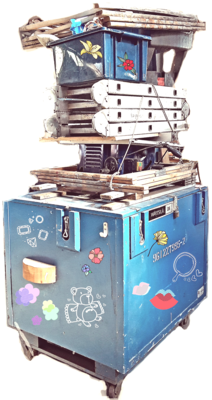
Photography with sound and net art, drawing, found folk sculpture with digital drawing, readymades, 2012, 2020, 2021. Accompanied by archival material.
The exposition exposes the question of what is artistic research. Usurping the mini-essayist format, which is traditionally associated with research in say the area of philosophy, the exposition formally operates on different levels. I selectively included visual art research material from my own artistic archive, as well as anonymous material that's readily available from the internet and in film archives. In this way, I wanted to emphasise the role of archiving and using archives in the artistic process, as an element of artistic research and artistic production that might involve remediation. Taking that we live in a largely theoretic culture, which means that we use external information systems for storage and retrieval of written, visual and other material, the implication is that art is part of this theoretical system.
Moreover, I specifically problematise the notion of value in relation to the visual arts by using the popular media figures of the counterfeit and the impostor, with reference to the so-called "impostor syndrome", correlated with being a minority of some sort in one's field: "A different thought is that two people may be answerable to the very same standard of success or competence, yet be subject to different epistemic standards for reasonable belief in their respective success or competence. This would be an example of pragmatic encroachment." (Katherine Hawley, "What is Impostor Syndrome?", Proceedings of the Aristotelian Society Supplementary Volume 93, 2019). I use visual art and figurative examples as illustrations, adapting from methods, such as the example, used in analytic philosophy.
I suggest that some artworks operate as philosophical provocations of the archive: "The artwork just exists", as Frank Stella argued. Artworks and archival artistic material are offered for aesthetic contemplation; they don't possess any "magical" qualities, they don't cause any phenomena or events in the world. In this view, I ordered this exposition as a design proposal for two independent, yet interconnected exhibitions: one for the final artistic exhibition show; and one as a general overview for the artist's studio, set up as a stand alone, if parallel, exhibition.
The conception of two parallel expositions as mocks of two parallel exhibitions is inspired by Jean Baudrillard's concept of "hyperreality", which refers to the blurring between reality and simulated representations, when sometimes, influenced by media, film, television, advertising, people tend to accept images or perceptions not corresponding to actual reality. The exposition hints at artists and others, who use different modes of communication, as skillfully exploiting the Baudrillardian concept of "hyperreality", with its accompanied "simulacra" and "simulations", for making indirect references on a sociological level; as well as for putting forward a critical commentary on the artistic and conceptual level.
Astrattismo
(2026)
Giusirames
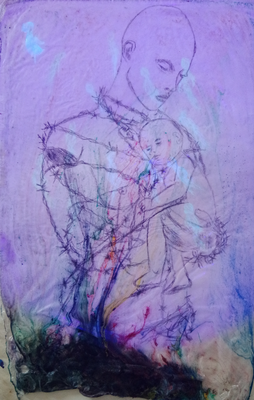
This thesis stems from the need to investigate an original painting technique developed by the author, which combines figurative painting and solidified atmospheric phenomena.
The heart of the research is a simple and radical question:
How can an ephemeral phenomenon be made permanent?
The answer takes shape through the creation of sheets of solidified rain, transparent membranes that preserve the logic of the drop, the flow, the surface tension. These membranes are superimposed on figurative paintings, generating a multidimensional visual language.
Transparency is not an aesthetic effect, but a temporal device: it freezes the work, suspends it, holds it in an eternal instant.
recent publications <>
Everything is Here – On Nomadic Scenographic Learning in Everyday Environments
(2025)
Raisa Kilpeläinen
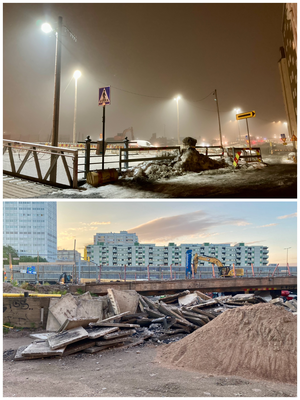
This exposition aims to examine the found and experienced environments as an impulse for artistic and pedagogical potentials in performance design. The writer asks, what kind of performance design could be created through scenographic worlding? The exposition presents a research approach to the urban, built environment, which is seen as an impulse, a constant and ongoing potential for performances and performance designers’ work. The topic is contributed with photographs from the writer’s site-sensitive memos. This approach offers perspectives on contemporary scenography and its theories. It is situated in the field of art-based action research, and the intention is to combine performing arts, performance design, visual arts, and pedagogy. The exposition highlights that an observational, experiential, and environmentally oriented way of working may prove more useful in the future; designers encounter applied and nomadic forms of performance design in their careers. How can we create more sustainable performance design, encourage ecocreativity and work towards more sustainable pedagogy?
Drawing as a journey, nonhumans as teachers, learning as creation. Sensory drawing methods for curating experiential connection with nature
(2025)
Jane Remm
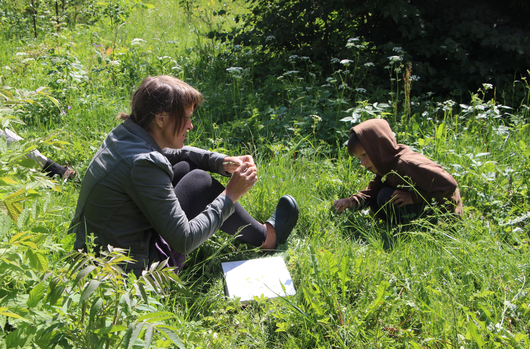
The presentation focuses on inclusive sensory drawing as a way to observe, notice and interact with non-human species in local nature, imagine their perspectives and reflect on the experience. It is known that many people today feel alienated from nature while on the other hand connection to nature is linked to pro-environmental behaviour. As an artist and art educator I have been wondering how participatory artistic and educational practices can reinforce the emotional and physical connection with nature, how to create conditions for perceiving the intertwinedness and mutual dependence, moreover, what could be the role of art and art education in the post-growth conditions. Drawing is not a new method for observing nature, but I find the inclusive drawing activities to be relevant to facilitate creative nature experience in contemporary context.
As an artist, I have been using sensory drawing and realised how using the pencil and brush as facilitators help me to concentrate, slow down, notice interactions and sense myself as a part of the ecosystem. I have used the embodied and situated artistic thinking as a source for drawing walks and workshops in gardens, forests and parks and introduce some of the simple exercises in this presentation, asking how and which drawing and painting approaches facilitate active engagement with the environment and what is the intersection between artistic practice, environmental and artist pedagogy. I describe the specifics of four methods. These kind of curated nature experiences offer possibilities to recognise other beings, their relationships and ourselves as related to them through actions and reflections.
xeno/exo/astro -choreoreadings
(2025)
Simo Kellokumpu
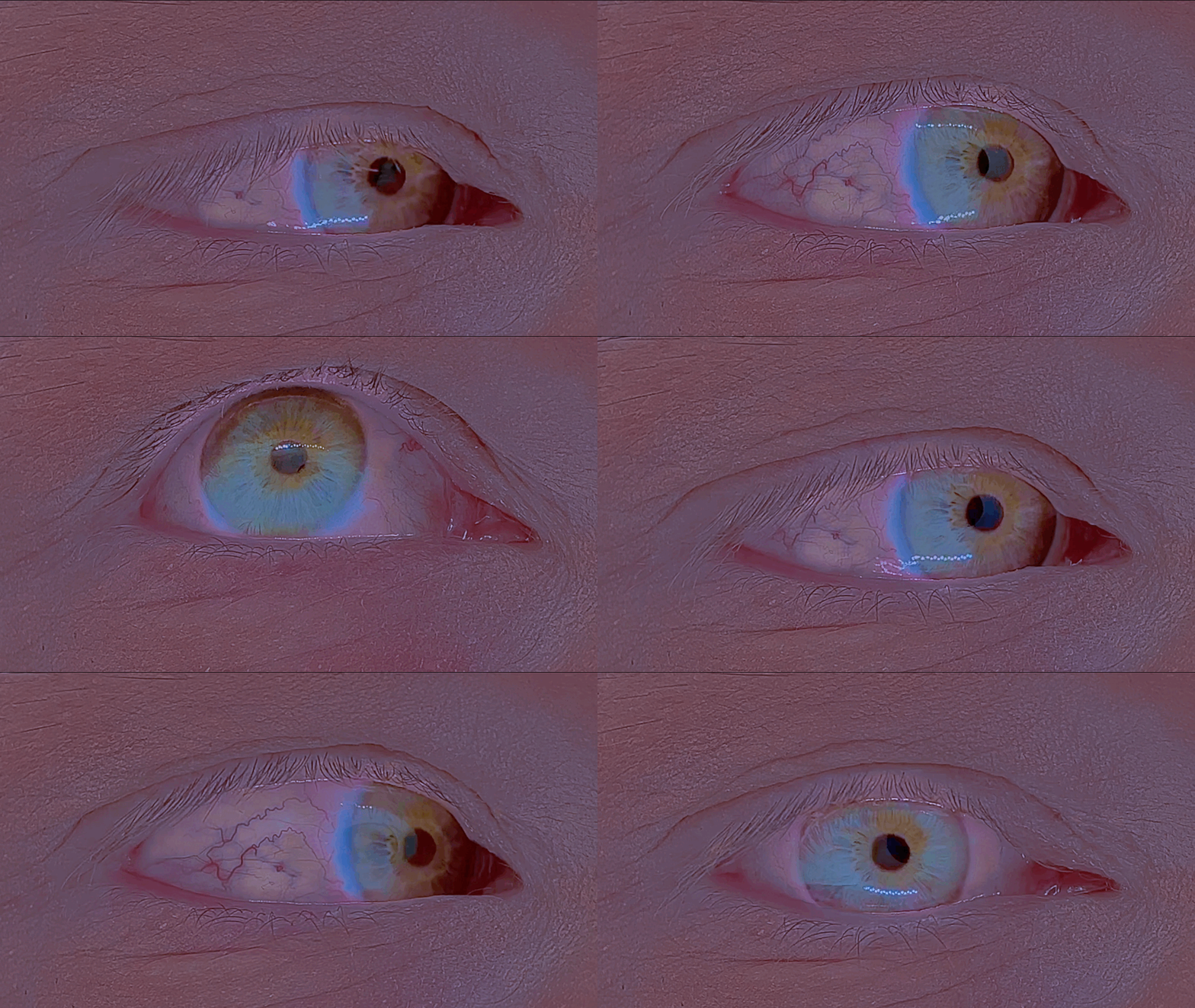
xeno-/exo-/astro -choreoreadings is a postdoctoral artistic research project that explores research questions that reopen site- and place-responsive choreographic practices by expanding the notions of ‘site’ and ‘place’ to outer space. The prefixes in the title refer to planetary conditions to which I do not have direct access. Another key choreographic exploration focuses on embodying hyper-reading and examining the impact of digital reading on embodied artistic practice. Hyper-reading refers to a computer-assisted, screen-based reading practice that has become common in contemporary daily life globally. It connects the reader to the limitless cyberspace. The research project blends these two spatial dimensions, in which the examination of the notions of choreography and choreoreading happen. The research process is multidisciplinary and hybrid in nature, producing artworks, traces, and reflections. The results are presented in this exposition as artworks and as reflections on the choreographic practice that this process has clarified.
Download Accessible PDF