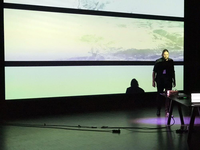
Composing Composing Instruments
(2024)
author(s): Tijs Ham
published in: Research Catalogue
This exposition aims to provide insights into my artistic practice and research 'Tipping Points', working within the field of live electronics and focusing on the exploration of tipping points in chaotic processes. The activities associated with my practice are profoundly interdisciplinary and include designing and buildinginstruments, composing artistic works for these instruments, and performing with them. Each of these aspects are interlaced and equally important in the development of new artistic works. The preface details my process in the production of new artistic works. Then the text details my thoughts on the term comprovisation and how it informs my approaches to the development of my work. Then the focus shifts to describe how my use of chaotic processes turns instruments into actant technologies which has important consequences on both my performance practice and instrument design. These insights are then illustrated through reflections on my work Multiple Minds, concluding that the instrument itself is actively composing, while at the same time, the act of designing and building an instrument can be viewed as composing.
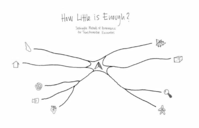
HOW LITTLE IS ENOUGH? Sustainable Methods of Performance for Transformative Encounters.
(2024)
author(s): Steinunn Knúts Önnudóttir
published in: Research Catalogue
The exposition is an artistic PhD thesis and contains research outputs in three categories, Performance Archive, Research Publications and Method Development tied together by an essay.
I.Essay:
Testimony of a Pilgrim.
II.Performance Archive:
No Show - exposition.
Island - exposition.
Strings - exposition.
Pleased to Meet You - exposition.
III.Research Publications:
Porous and Embracing Dramaturgy for Transformative Encounters - video article.
A Quest for Existential Sustainability - video article.
Transformative Encounters - podcast series.
IV.Method Development:
ME-THOD.
How-little-is-enough-approach.
Abstract
At the core of this artistic doctoral thesis are four performance projects designed to counter the consumer-driven nature of contemporary performance-making while also addressing the need to develop sustainable methods of performance. Guided by the question: how to construct sustainable methods of performance for transformative encounters? the inquiry transcends the different layers of performance-making to explore the potential of performance as a catalyst for societal change.
As a part of the Agenda 2030 Graduate School, an interdisciplinary research initiative at Lund University, the project focuses on existential sustainability and investigates how performance can enhance participants' sense of meaning and motivation for adopting sustainable lifestyles and increasing sustainable awareness.
The thesis output is presented in three categories; a performance archive documenting, detailing and analysing the performances and their impact; research publications, disseminating findings and key concepts through different public formats; and method development accounting for the methodological approaches that have emerged through the process.
The four performance works of this artistic research are: No Show (2020), Island (2020), Strings (2022), and Pleased to Meet You (2022/2023).
The three publications of the project are: How Little is Enough? Embracing and Porous Dramaturgies for Transformative Encounters, a video article; How Little is Enough? A Quest for Existential Sustainability, a video article; and the podcast series Transformative Encounters.
Utilizing Me-thod, a pluralistic situated methodology grounded in the artist´s personal background and skillset, together with the how-little-is-enough approach, which minimizes production and focuses on essential needs, the project has collected insights into how performative encounters can initiate transformation in participants and foster connections to the world around them, thereby enhancing existential sustainability and nurturing care for the environment. Through repeated cycles of action-based artistic research, employing qualitative materials and autoethnographical approaches, rich data was generated. The findings emphasize the importance of personal engagement, embodiment, and authentic exchange as catalysts for transformation within performative encounters.
Through this investigation, the thesis aims to contribute to the development of sustainable approaches to performance-making that facilitate profound and meaningful human experiences in an era marked by unprecedented societal and environmental challenges.
ISBN:978-91-8104-107-1

‘What are the most effective collaborative strategies to seamlessly integrate instrumental music and theatre in family performances?’
(2024)
author(s): Inge Mulder
Limited publication. Only visible to members of the portal : KC Research Portal
The aim of this research is to elaborate on the most effective collaborative strategies for seamlessly integrating instrumental music and theatre into family performances. To create context and background, this research addresses the anticipated role and dynamic evolution of instrumental music in theatre.
The theoretical framework consists out of the ‘issue of narrativity’ (Meelberg, 2008c) which focusses on frame of reference influence, according to Robert Zatorre (2005), combined with insight from the models of collaboration: ‘het Kompas’ (Bremekamp et al., 2010), ‘the five dysfunctions of a team’ (Lencioni, 2002) and the ‘forming–storming–norming–performing model of group development’ (Tuckman, 1965).
This research examines the methods of organizations such as Oorkaan and Het Houten, mapping the established frameworks for instrumental music and theatre.
Throughout these theories the complex reality of collaborations within the characteristics of family performances (i.e. a linear progression with a cyclical feel) is systematically described and analyzed, resulting in a new conceptual model. The model was tested by conducting semi-structured interviews combined with field research.
Findings were that the sharper the definition of the target group, the clearer the cooperation and the more distinctive the product. This outcome becomes a realistic goal when the direction and associated process is clear. Furthermore, the framework can be used as a tool for those wishing to enter the field of interdisciplinary collaboration between theatre and music, with a focus on family performances. It is relevant for graduates in order to achieve a successful collaboration. They need to overcome challenges at the start of their career due to lack of knowledge of each other’s discipline.
Jazz / Pop Singing at the Crossroads of Movement and Musical elements
(2024)
author(s): Daniela Fanelli
Limited publication. Only visible to members of the portal : KC Research Portal
Research question - How can focusing on the connection between body movements and the key musical elements of rhythm, lyrics/mood, pitch and dynamics positively affect the expressiveness and vocal freedom of jazz / pop vocalists?
When considering the attributes of captivating performances, jazz and pop singers often tend to underutilize their bodies on stage. This observation prompted a deeper examination of the interplay between body awareness, singing, and movements, resulting in the question “How can focusing on the connection between body movements and the key musical elements of rhythm, lyrics/mood, pitch and dynamics positively affect the expressiveness and vocal freedom of jazz / pop vocalists?”
The research aims to address this question through a series of investigative stages. Firstly, the analysis of my 2023 end-of-year performance revealed a clear correlation between gestures, expressiveness and the four musical elements mentioned. Further research supported this finding and led to the development of movement-focused singing exercises, whereby vocalists sing while consciously engaging their bodies in alignment with each key musical element individually. This methodology underwent testing with six vocalists, yielding valuable empirical data.
The data shows that this set of exercises can be a helpful, holistic tool in increasing expressiveness, enhancing awareness and improving embodiment while singing, as I have also experienced for myself. By sharing this research, I hope to encourage all musicians to deepen their connection with themselves, their instrument, and the audience through movement and body awareness.
Encoding Emotion
(2024)
author(s): Geneviève Gates-Panneton
published in: KC Research Portal
The paper Encoding Emotion details an experiment conducted on early 18th-century French recitative to determine how composers relate harmony to sung text, if at all. Although the existence of a relationship between harmony and vocal expression is generally agreed upon, it is rarely properly taught to baroque singers, even though harmony is fundamental to the concept of basso continuo. It is also rarely discussed in continuo or singing treatises, either historical or modern, and, if so, never explicitly. The present experiment aims to fill that gap by examining harmony and text in actual written music. To do so, a harmonic analysis was performed on excerpts of secco recitative from French operas and cantatas written by Campra, Clérambault, Jacquet de la Guerre, and Rameau; the significant chords and harmonic passages were then logged in a spreadsheet with their corresponding text. Over two hundred lines of results were then analysed to determine whether patterns could be found associating certain words to chords or harmonic progressions. In the end, the dataset was too small for any general conclusions to be made with certainty, but patterns still emerged. Most notably, the plagal cadence correlated to feelings of love and tenderness, particularly in a sacred or noble context. It was also noted that, though general patterns could not always be identified, some chords or harmonic progressions appeared to have specific meaning for a certain composer. The V of IV, for example, was strongly associated with pleasure in Clérambault's works. Although there is only limited use for these results outside of this study, the identified patterns show that a more extensive dataset would yield enlightening results and give singers access to a remarkably rich tool with which to inform their interpretation.
Collabographies: Tracing shared processes between performer and composer
(2024)
author(s): Petra Valtellina
published in: KC Research Portal
This research aims to address the question of how performer-composer collaborations can effectively generate a jointly composed flute piece. By examining two collaborative processes undertaken over the past year with different composers, this research seeks to identify factors that facilitated successful collaborations and those that posed challenges. Through comparative analysis, the goal is to identify strategies and approaches that could inform and improve future collaborations of this nature. This study ponders the contrast in the background of the two composers involved and the different experiments in role balance. As the performer, I serve as the common thread between these collaborations; variations in the outcomes result from interpersonal dynamics and the composers' differing levels of familiarity with the flute. The methodology employed aligns with the principles of Action Research, with iterative cycles of feedback, reflection, and adjustments during the collaborations, prioritising the process over the final product.
Outcomes of this investigation include that complementary skills, clear expectations, transparent and unfiltered communication, external deadlines, defined final goals, and narrower guidelines might enhance collaborative engagement, improving satisfaction and musical products.
Following the introduction, which addresses the motivations underlying this study, Chapters 1 and 2 will contextualise the topic of collaboration through a literature review and present the chosen methodology. Chapter 3 will delve into a comprehensive overview of the two collaborations, while Chapter 4 will propose a comparative analysis of these processes and report the limitations of this study. Conclusions will follow.