Human Voice and Instrumental Voice: An Investigation of Voicelikeness
(2023)
author(s): Paola Livorsi
published in: Research Catalogue
This artistic research explores the relations between human and instrumental voice (in the case of string instruments), seen from an embodied and performative point of view. The question originates from from my experience of violinist and composer.
Voice is a unique mark of human identity: if this is particularly true for vocal timbre, something similar is at play in the ‘instrumental voice’, as a unique expression of personal and musical identity. This research aims to uncover the importance of the vocal and instrumental relations, acknowledging their common embodied nature and shared origins. As utterances directed at the ‘other’, both human and instrumental voice are deeply relational.
From 2016 to 2022, I investigated the question of voicelikeness between a musician’s voice and their own instrument through five multidisciplinary art projects: in Imaginary Spaces fragments of individual and collective voice inhabited a performative environment shared by musicians and audience; The end of no ending focused on the relationships between two female voices and their mutable surroundings; Between word and life explored the multiple relations of voice and instrument in an electroacoustic space, de-multiplied by bringing in dance and video; Sounding Bodies gathered human and mechanical bodies to explore an unconventional space, inviting the audience to follow their path; Medusa was a music theatre work putting into perspective the question of voicelikeness by evoking Italian Early Baroque music, visual art, and dance.
This artistic research was carried out through an artistic process, with supporting methods such as grounded theory, ethnography, and autoethnography, creating a virtuous cycle between practice and theory, with some interesting and unexpected changes taking place in my artistic journey. The research outcomes consist of a written part combined with a collection of traces, sounds, images, and video examples presented on the Research Catalogue.
The theoretical framework for this inquiry includes recent studies in paleoanthropology, human development, music psychology, and embodiment. Cavarero’s philosophy of voice, Arendt’s philosophy of the ‘in-between’, various philosophies of the ‘other’, as well as a few contributions from psychoanalysis are put in mutual dialogue with my artistic practice.
Among the research outcomes are the re-evaluation of vocal layers in personal and musical identity, considering music making as a relational practice, and an exploration of the porous boundaries between the roles of composer, performer, and listener. In this perspective, the new terms to ‘in-hear’ and to ‘co-hear’ respectively denote an attention to inner sounds, and toward one another in a community of listeners.
Keywords: voicelikeness, artistic research, in-between, relationality, embodiment, performative space
Dance Studio/Clearing Conversations
(2023)
author(s): Chrysa Parkinson and Frank Bock
published in: Research Catalogue, Stockholm University of the Arts (SKH)
Conversations with dance knowledge” is a development work by Chrysa Parkinson, Professor of Dance, and Frank Bock, Senior Lecturer in Choreography, and Andrew Hardwidge.
The research is a conversation format that prioritizes movement between textures, atmospheres, qualities, and metaphors to express meaning and knowledge. By balancing somatic experience and language-based exchanges the research prioritizes nuances that emerge between people, places and things in activated space and time. The research is experimenting with question formation, spatial contexts and using simple materials in conversation. The process is documented by objects, texts, drawings, and audio files.
The aim of the research has been to develop research methods that can emphasize the authorship, materials and processes of dance and dancers within social and aesthetic discourses of dance and art practices and have direct applications in teaching processes.
Darkness as material - PhD project - 2023
(2023)
author(s): Mia Engberg
published in: Stockholm University of the Arts (SKH)
The doctoral project Darkness as Material, examines darkness as material and its relationship to cinematic storytelling. The study addresses different kinds of darkness: darkness in the image, darkness in the cinema theatre, darkness in the spectator where films are received and the darkness in the filmmaker, where the world is reflected and ideas are born. The project is inspired by Marguerite Duras' idea to kill cinema, and it explores film's potential to approach the place she described as 'the dark room, where we are deaf and blind and passion is possible'.
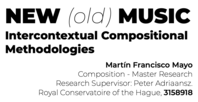
New (old) Music - Intercontextual Compositional Methodologies
(2023)
author(s): Martín Mayo
published in: KC Research Portal
It would be more than reductive to say that art is not created in a vacuum. Simply said, all art exists in a context, and said context includes medium, genre, style, and idiom, amongst other things. In the realm of Western music, much insight has been given regarding quotation, and less so regarding subtler applications of stylistic, generic, and idiomatic thought in composition. So, if all music exists in a specific context, how can composers creatively account for context in their compositions? This research seeks to answer this question by outlining methodologies via analysis of relevant works. Given the background and musical focus of the researcher, this research predominantly focuses on musical works that adapt or interact with Latin-American folkloric music and traditions, with many works dealing specifically with Venezuelan and Cuban folklore.
NUMB - exploring emotionally charged interactions to motivate reflection on non-fiction topics
(2023)
author(s): Elin Festøy
published in: University of Inland Norway
This PhD project in artistic research by Elin Festøy, research fellow at The Norwegian Film School, Innlandet University College, is situated in the field of interactive experiences. Festøy explores how emotionally charged interactions can be used to build trust and communicate non-fiction topics in a way that is more likely to motivate empathy and change. The artistic exploration consists of a consecutive row of conceptual VR experiences. The reflections turn to the role of freedom and agency in interactive experiences and how these can help build a trusting relationship between creator and participant.