Flower Clock
(2022)
author(s): Christina Stadlbauer
published in: Research Catalogue
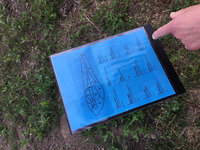
The art work is inspired by the concept of the flower clock by Carl Linnaeus, renowned 18th century botanist from Sweden.
The installation “Who will pollinate the Flower Clock” that was exhibited in 2021 features a selection of endemic plants arranged in an outdoor installation. The piece is an invitation to decelerate, and tune into plant-time.
How do plants know time? How do they attune to rhythms of day and night? How slow do they open and close their petals? How long do they blossom so that insects can visit them?
Place to Action! Art that Inteferes
(2022)
author(s): Thalia Hoffman, Yannick Schop, Lakisha Apostel, Maryam Touzani, Alicia Cotillas Vélez, Robin Whitehouse, Bødvar Hole, Miro Gutjahr, Žilvinas Baranauskas, Anne-Claire Flora Mackenzie, Gaetan Langlois-Meurinne
connected to: Royal Academy of Art, The Hague
published in: Research Catalogue, KC Research Portal
The course Place to Action - Art that Interferes is motivated and inspired by places. More specifically: the histories, contexts, narratives, situations, circumstances and people’s interactions and intra-actions and relationships with locations, which form places. Lingering in places with attention, listening to them and experimenting the possible ways of movement within them.
These attentive gazes of places will initiate interdisciplinary artistic actions and interventions that aim to explore and reflect the possibilities of art to interfere.
Here on this exposition the group will share their findings and actions.
Performance Anxiety - Creating a Warmup Using Mindfulness Techniques
(2022)
author(s): Enikő Szili
published in: Research Catalogue
Within this self-study, I aim to create an effective warmup that prepares me mentally for performance situations, and which can reduce my level of stress in such scenarios. As a dancer who often suffers from stage fright, finding a solution is a challenging, yet an important step to take.
The music of speech: exploring the spoken voice as an artistic tool for composition and improvisation
(2022)
author(s): Beatrice Milanese
published in: Codarts
The purpose of this research is to extend my performance as a jazz vocalist by including a previously unexplored element in my practice as a composer and vocalist: the spoken voice. After listening, transcribing and analyzing examples of spoken voice as they already existed in composed and improvised music, I undertook a vast series of quasi experiments and evaluated those in connection to the continuous feedback by my experts. By doing so, I got deeply informed about the consequences of including spoken voice techniques in my compositions and improvisations.
This Master Research project brought me to two main conclusions. The first conclusion is that implementing my speaking voice in my improvisations in a jazz context required the development of my own method, where the action of speaking is harmonically and rhythmically supported and enhanced by the action of extemporaneously playing the piano. The second conclusion I draw is that including the spoken voice in my compositions and improvisations required theatrical training in order to perform them convincingly.
A vast number of video files is added to this report to show the steps I took to result in my final outcome. This final artistic result is documented in the recorded video of my original composition “The Tell-Tale Heart” for voice, piano and contrabass clarinet. In this composition, my ultimate and highly individual application of the spoken voice both influenced the process of creation and shaped my way of performing the piece.
This research is supposed to resonate between singers, composers and musicians and encourage them to widen their compositional palette through including new unexplored elements, stretch the boundaries of their interpretational skills, experiment with crossovers between artforms in their music, develop their own improvisation methods. Finally, I would like to encourage jazz singers to go beyond the role that is unconsciously being given to them.
Embodiment & Dance - The importance of movement research through verbal cues in dance improvisation
(2022)
author(s): Karin Heller-Dani
published in: Research Catalogue
Would a regular guided movement research practice could enhance the experience of free-form dance, in what ways, and why? How would such a practice change or enhance the ways people feel about their movement, their bodies, and their relation to themselves? What sort of verbal cues could be used to guide such an exploratory movement practice?