Marinho & Branco - New music for old instruments
(2020)
author(s): Helena Marinho, Joaquim Branco
published in: Norwegian Academy of Music
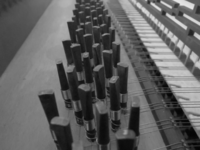
This project addressed the digital expansion of fortepiano features using techniques of sound design and programming, studying how these interact with the performing and improvising processes and questioning a sonic image of the fortepiano's affordances that is limited by the perception of the standard devices available on modern pianos: the sustaining and the *una corda* pedals.
We took our point of departure from two research questions: 1) Since sound-altering devices are not normally available in modern copies of fortepianos, how can we conceive and apply experimental alternatives? 2) How do the ensuing alterations modify instrumental perception and can they contribute to the creation of alternative performing solutions, namely in association with improvisatory practices and sound synthesis?
The research has exposed the aesthetic limitations of merely considering historical re-construction. In doing so, it has highlighted a set of performing techniques, creative procedures and digital applications that can contribute to a deconstruction of the standard perception of the sound of historical keyboard instruments and to the creation of experimental paths for performing and improvising on the fortepiano through the mediation of electronic interfaces and digital sound objects.
Cerro Rico: the co-production of a discursive voice in chamber music
(2020)
author(s): David Gorton, Stefan Östersjö, Mieko Kanno
published in: Norwegian Academy of Music
Centred around a video essay, this exposition aims to develop an understanding of subjectivity within a collaborative chamber music context. Drawing on the theory of situated cognition (see for example Brown, Collins, & Duguid, 1989) and the concept of subjective ‘voice’ in performance (Cumming, 2000), the presentation develops the model proposed by Gorton and Östersjö (2016 and 2019) in which a ‘discursive voice’ may emerge from the process of composer–performer collaboration.
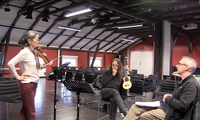
These ideas are explored through a study of the early rehearsals of David Gorton's composition ‘Cerro Rico’, for soprano violin and charango. This is a very slow piece, and while the two instrumentalists both operate at this extreme of the tempo spectrum, they do so guided by different conceptions, one metronomic and the other taxonomic, of how this should be notated; the charango player works with a very slow metronome mark of quaver = 15 while the violinist plays mostly in large note-values: breves, longs, and dotted longs. From these opposed positions, the performers find a shared understanding of time.
Through an appraisal of video footage taken from the first rehearsals of ‘Cerro Rico’, it is argued that the malleable character of coordination, shaping, and timing that is afforded in performance by the extreme slowness of the piece creates the conditions for the emergence of a discursive voice, compounded from the contributions of the two performers and the composer. The ‘collaboration’ between composer and performers can be conceived as being situated within this discursive voice, manifested as a sense of shared ownership of the materials.
1616: The Secrets and Passions of William Shakespeare
(2020)
author(s): Gareth Somers
published in: Research Catalogue
This is a practice research account of some of the research questions, processes and findings underpinning the performance text of “1616: The Secrets and Passions of William Shakespeare”, a one-man play about the life of William Shakespeare (written 2013-15, performed 2015-16, published 2016). The exposition includes the full playtext, a video trailer for the performance, and a discussion of the primary sources and themes investigated during the research and writing process.
Johannes Brahms: Historically-Informed Recording of the Piano Quartets
(2020)
author(s): Anthony JOHN THWAITES
published in: Research Catalogue, Birmingham City University
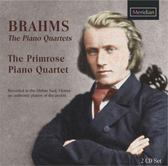
This Exposition presents a Double CD of Johannes Brahms’s Piano Quartets, recorded on period instruments in Vienna by The Primrose Piano Quartet for the Meridian label (CDE84650/1-2, 2019). The recording is presented in fully streamable MP3 format alongside a PDF of the CD booklet proof. Accompanying the recording is an essay which documents the research questions, methodology and processes underpinning the work. Preparation, rehearsal, recording and editing are discussed as a process of interpretative investigation. Historically-Informed Performance Practice with respect to Brahms is a thriving academic discipline within which we have endeavoured to offer the most radically innovative post-war commercial recording of the piano quartets.
Inappropriate COLLISIONS
(2020)
author(s): Catherine Baker
published in: Research Catalogue
Inappropriate Shift is the title of a co-authored chapter in Collective and Collaborative Drawing in Contemporary Practice [eds Journeaux and Gorrill] by Dr Catherine Baker (Birmingham City University and Kimberley Foster (Goldsmiths University). However, it is part of a larger project conceived in 2015 been the two authors that includes a number of drawing related activities and is ongoing called Inappropriate Collisions.
The Art of Design: from philosphy to practice
(2020)
author(s): Kathryn Jane Moore
published in: Research Catalogue
This exposition sets out evidence of the research undertaken over the last decade to understand the implications beyond the academy of the new paradigm presented in ‘Overlooking The Visual: Demystifying the Art of Design’ (2010), leading to
‘Towards New Research Methodologies in Design: Shifting Inquiry Away from the Unequivocal Towards the Ambiguous’ (2018). The exposition shows the process of developing ‘The Art of Design’ at a regional scale through a number of sequential case studies. Requiring investigative and analytical drawing from a position of knowledge and the reimagining and re-presenting of places in order to rekindle and reinvent the connection between communities and the space they inhabit, recognising the pride people take in that space, its cultural identity, be it urban, suburban or rural, is very much a modern, contemporary view of how our landscapes work.
The ideas expressed in the visual narratives have engaged a wide range of decision makers and are shifting perceptions, planning policy and practices at a local, national and international level. The student work exhibited in 2019 (BCU) explored the spatial implications of the ethos of the West Midlands National Park focused on specific locations and was vital in persuading key regional and national stakeholders of the significance of this new approach.
This predominantly visual exposition presents the transformative practice-based research process manifest as visual artefacts from philosophy to practice interrogating the art of design.