Orange Polar Bear - a cross-cultural performance piece for teenagers in Seoul and Birmingham
(2020)
author(s): Peter Wynne-Willson
published in: Research Catalogue
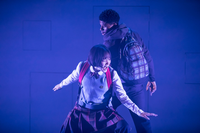
Orange Polar Bear (2014-19) is an innovative bilingual theatre project created by Hanyong Theatre, the National Theatre Company of Korea and Birmingham Repertory Theatre. The main research aims were to develop a methodology for devising and presenting bilingual work in a way that maintains equality between collaborative partners, and, by focusing on the experience of teenagers in Seoul and Birmingham, to consider what young people can teach adults about bridging cross-cultural and language divisions.
The research resulted in a novel methodology for devising bilingual theatre leading to a cross-cultural performance for young people in two languages, presented in the same form in South Korea and the UK. It was unique among Anglo-Korean collaborations for its focus on the experience of teenagers, and conscious balance of languages, cultures and practices. Additionally, the research demonstrates the value of adopting a child-led approach to creating cross-cultural theatre and has created new insights into long-term approaches to developing fair and equal cross-cultural partnerships.
(no)boundaries: A Study in Free Improvisation
(2020)
author(s): Andrew Bain
published in: Research Catalogue, Birmingham City University
This practice-led research project investigates the importance of an empathically creative connection between freely improvising musicians in a live context with no pre-conceived ideas and details the development of instantaneous group composition. As such, (no)boundaries had no pre-composed music, there was no rehearsal period for the musicians (myself playing drums), and we had never played together before the first note of performance. In my research to date, the dynamic between pre-learned knowledge (embodied) alongside intelligent transactions during live improvisation (enacted knowledge), has been useful in helping to better understand the process of jazz improvisation. Even if there are pre-conceived elements, how the music is realised each time is unique. Conversely, even if we set out to have no pre-conceived ideas, in reality, we are still intuitively informed by our experiential and musical knowledge in performance. The two seem inextricably linked.
(no)boundaries showed that group attunement in performance is possible with no pre-learnt repertoire or rehearsals, in an appropriate setting with the right co-performers. Even though no pre-conceived ideas were intended, (no)boundaries evidenced improvisations guided by similar principles of standard jazz performance, pointing to the existence of a common performance mode.
Macbeth Projeto
(2020)
author(s): Maria Jose Martinez Sanchez, Aleksandar Dundjerovic
published in: Research Catalogue
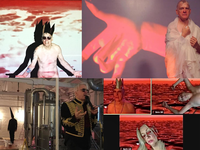
Macbeth Projeto is a performing arts project that used elements of Shakespeare’s Macbeth as a framework for exploring different types of performativity. The central research question was ‘how migration of dramatic text , migratory geography deconstruction of stasis and transformation of form create different aesthetic qualities and performative experiences’? The project resulted in a series of novel rehearsal methodologies for adapting a dramatic text into a multisensorial performance via open rehearsal, creative workshops, and mixed visual and performing creative techniques. The project grew out of the researcher’s previous work with Brazilian theatre – including two co-authored books; Brazilian Collaborative Theatre ( 2017) and Brazilian Performing Arts (2019).Shakespeare’s original text was used as a framework for devising novel methodologies that combined different performance digital media methods with Brazilian collaborative contemporary theatre techniques. Rehearsals began with free collaborative improvisation workshops, out of which emerged material that was selected for further development. From this process the focus fell on the Act 3 scene 4, ‘feast’ scene. From this starting point, ‘The Party’, the relationship with Lady Macbeth, witches and ghosts became the key resources around which new narratives were developed. The research resulted in six performance cycles, each of which explored a different theatre form: Physical and group theatre; Site-specific, Solo-performance, Installation art, Augmented Reality, and Video/Performance Art (created as a remote on-line devised performance). Collaborators and co-producers with CIPA on the research project were Centrala, Digbrew (Birmingham), International Federation of Theatre Research (IFTR), VUK Theatre (Belgrade), Prague Quadrennial, AHRC, Shanghai Theatre Academy, and Teatro Os Satyros (Sao Paulo). It has been performed at the Royal Birmingham Conservatoire (UK), IFTR, Prague Quadrennial of Performance Design 2019 and as part of an AHRC UK-China Creative Industries Partnership Development Programme with Shanghai Theatre Academy, Shanghai.
Choreographic Process and Skinner Releasing Technique
(2020)
author(s): Polly Hudson
published in: Research Catalogue, Birmingham City University
An exploration of Skinner Releasing Technique and its application to choreographic practice.
The research offers a paradigm shift in understanding of Skinner Releasing Technique (SRT) from that of a dance technique to one of choreographic methodology. The primary research question was: Can SRT be not only a dance technique, but also a methodology for creating dance? Thematically the work examines notions of self portraits and questions the culture of 'selfies'.
The ‘elsewhereness’ of post-genre: utilising playfulness of cross-genre references as a compositional device
(2020)
author(s): Joe Cutler
published in: Research Catalogue, Birmingham City University
This set of three works individually and collectively examine the ‘elsewhereness’ of post-genre composition. Through this research, I seek to develop a hybrid compositional aesthetic through the absorption, integration and referencing of a highly personal set of ‘influences’, many from outside the sphere of classical music. A fundamental concern is the examination of the role of ‘compositional play’ or ‘playfulness’ in unifying a multi-faceted compositional language. This is often manifested through intertextuality and the juxtaposition of diverse elements that are made to function at a structural or conceptual level.
Through practice-based research, I obfuscate notions of genre, performance practice and content. Using the referencing of other musics as a compositional tool, I identify playfulness as a filter through which models of influence are transformed into something personal in an attempt to define what post-genre means to a 21st century composer. On a meta-structural level, reference becomes a parameter in its own right.
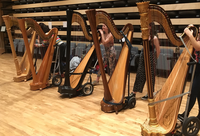
She plays angel music (where people might die)
(2020)
author(s): Michael Wolters, Paul Norman
published in: Research Catalogue, Birmingham City University
She plays angel music (where people might die)
Post-Internet Music as a comment on the absorption of knowledge
This exposition articulates the research within the artistic work She Plays Angel Music (where people might die), a 60-minute concert-installation for 5-25 female harpists. The research was triggered by highly questionable and incomplete information on the history of harp composition found on Wikipedia. While it is generally accepted that Wikipedia is not a reliable source in academia, it still a powerful source of knowledge amongst the general public. Thus, the incomplete display on the site promotes
a) the historic and continuing discrimination of women from music composition in the classical music world and
b) the continuing rejection of contemporary music in favour of music by dead composers in the classical music world.
This exposition takes the reader through the compositional steps that were performed in order to create a post-internet work that attempts to highlight political situations by gathering publicly available information into a controversial context.