;viewBox(0,0,300,131.01)))
TRAVERSING SONIC TERRITORIES (TST)
(2023)
author(s): Søren Kjærgaard, Torben Snekkestad
published in: VIS - Nordic Journal for Artistic Research, Rhythmic Music Conservatory, Copenhagen
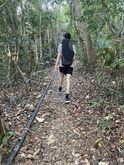
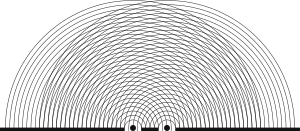
What happens when musicians improvising on acoustic instruments sample and exchange their sound libraries? How can such a transgression of sonic territories contribute to an expanded understanding of one’s own sonic identity? And could this b/lending of identities point to a more ambiguous yet vibrant field of intra-play? Departing from these questions, this project intends to challenge our idea of sonic identity as a personal subject-oriented entity, and consequently investigate how a collaborative sharing of sampled sounds, can contribute to an expanded understanding of the sounds we play and are played by. Individual idiomatic approaches to one’s own instrument are thus interfered as we transgress habitual boundaries for action possibilities and musical imagination. The practice circulates from the duo of Torben Snekkestad and Søren Kjærgaard toward external collaborators, where the sharing process involves different approaches to audio sampling and mapping, embedding and embodying, listening and playing with each other’s sonic material to a point where authorship, origin, instrument and sonic identity is diffracted.
Heterotopia of the Practice Room: Casting and Breaking the Illusion of Tristan Murail’s Tellur for Solo Guitar
(2023)
author(s): Maarten Stragier
published in: Journal for Artistic Research
A combination of highly unusual extended playing techniques with open intabulated notation makes the solo guitar work Tellur altogether unique in Tristan Murail’s catalogue. When placed in the broader discursive context of Murail’s compositional philosophy, this unique configuration of elements causes a quandary. The composer aims to integrate “the totality of sonic phenomena” into his compositional language, and within this context he maintains a traditional view of musical authorship. However, how does a performer reconcile this perspective with a score of which the combination of unconventional techniques and open notation leaves so much of the sonic material to their individual discretion and know-how?
This exposition offers the first performance-led study of this conundrum in Murail’s music and writings. Using Lydia Goehr’s historical study of the work-concept as a point of orientation, I explore the functioning of Werktreue in Tellur. I show that the processual structures that should make up its “ideal” score are correlative with the composer’s abstraction of the guitar, which is in its turn correlative with the guitarist’s unconventioned heuristics. I argue that confronting traditional musical authorship with this system of correlation creates a discursive aporia, but not a practical impossibility. Rather the discursive aporia brings to light what I call the “heterotopia of the practice room.” In this heterotopia, I as a performer navigate a musical reality that simultaneously reflects and contests a tradition of classical music performance built around the regulative work-concept.
CRITICAL CONFABULATIONS – Corresponding Practices and Mappings
(2023)
author(s): Jim Harold, Alex Hale
published in: Journal for Artistic Research
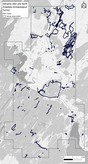
This exposition is based on an archaeological survey in the landscapes around Kilmartin Glen, Argyll and Bute, western Scotland, and references digital datasets – archaeological reference points –alongside the acts (enactments) of field walking, photography, drawing and poetry – experiences and representational discourses – to consider how land and landscapes may be read as dynamic palimpsestic and multi-dimensional fields of entanglement.
Digital datasets were used by the survey to garner fruitful material to aid identification and to analyse (subtle) surface archaeological remains in the inhospitable terrain on the hills bordering Kilmartin Glen. By analysing, categorising and archiving such information, through naming and cataloguing, archaeological methodology effectively orders and tames such wildernesses. We, by contrast, are seeking to draw art and archaeological practices into dialogue with one another in order to assert the importance of recording experiences and random acts as a part of field research and, thereby, to both re-vivify and re-wild our encounters with landscape.
Our exposition, and shared practices, intentionally encourage nuances of reading and interpretation that are found at the dialogic intersection between an artist/poet encountering archaeological landscape survey, and an archaeologist experiencing artistic, poetic and linguistic readings of land: reflecting in the process upon contemporary methodologies and underlying theoretical discourses. As such this research sits within the wider contemporary turn towards interdisciplinary practice, and seeks to establish a dialogue across disciplines; between humans and landscapes, practice and matter, that provides emerging approaches and hopes to remind us of the wild experience.
The Plane of Cicadas: On the Possibility of Making Kin through Musicking
(2023)
author(s): Mathew Klotz
published in: Journal for Artistic Research
This autoethnographic exposition details a short series of musicking encounters aimed at making kin in a rainforest-covered mountain on unceded Djiru Country on the east coast of Australia. Each encounter consisted of a short hike and a discrete musical encounter with local subjectivities. The inquiry considers the place of the walking in the musicking, and my joint response-ability with my saxophone (or the ways in which we apprehend and respond to other subjectivities) in each encounter. I argue that the hiking and discrete sonic encounters became entangled processes, in which my epistemological capacity and music-making practice were challenged and the possibility of kinship resides.
We Are Public Space: Bodies and Minds in Post-pandemic Cities
(2023)
author(s): Marketa Kinterova
connected to: Academy of Performing Arts in Prague
published in: Journal for Artistic Research
The project aims to pay heightened attention to public spaces in cities on several levels. The first follows the trend of newly developed privately owned public spaces (known as POPS), which establish a precedent for how corporations and cities define public space and what they prioritize within it. A clear focus on people as consumers – rather than citizens – have several effects, including strict restrictions, the creation of societies of control (Deleuze 1992: 3), and various forms of often indirect exclusion of certain groups of inhabitants.
The second level attempts to accentuate subjective experiences focused on our bodies and making them consciously present in relation to public space. Both layers are a significant component of the performative lecture walks, on the basis of which I introduce the results of interactions with the respondents in my case studies. Finally, I shall describe what cities looked like during the pandemic and consider whether these scenes might be a model for the future. Are we to expect further experiences of empty cities?
La resistencia de las piedras
(2023)
author(s): alejandra reyero, Maia Navas
published in: Journal for Artistic Research
The proposal explores the potential of critical experimental research, turning to medial - material practices of countermemory in the face of historical and contemporary technologies of control. This is an essay on remains of images, sounds and texts that were part of the research process of the short film "Enviado para falsar" (Maia Navas - 2021).
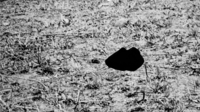
Two spaces: Napalpí (Chaco, Argentina, 1924, where the “Napalpí indigenous massacre” by the National State took place) – Barrio Gran Toba (Resistencia, Chaco, Argentina, 2020, where descendants of qom indigenous communities were monitored by a police drone during the Covid-19 pandemic.). Two temporalities that are abyssed through montage as an aesthetic and epistemic exercise, updating the colonial legacy that operates again under the motto of care, the legality of persecution and the abuse of power.
Against this, we rescue the gesture of the slingshot with which the Qom indigenous community brought down the police drone. We made interventions on the archive material of German anthropologist R. L. Nitsche linked to the 1924 Napalpí massacre and we risked irreverent gestures that operate as a glimpse to evidence its truth as artifice.
We propose exercises with and on visual residues, anachronistic and poetic approaches by superimposing voices and sounds. We fable decolonizing strategies that seek to turn a past into present, by imagining its return as inventive action.
Based on possible temporary deviations from the fall of the drone, operations on the image are detached. A dialogue between objects and intervening actors those who have or have not witnessed the events is traced according to a path of existing letters and publications, which account for the network of relationships between science celebrities, the State and police forces.