Dancing Sympathy Beyond Human Failure: Artistic Research as Cosmopolitical Defuturing
(2023)
author(s): Peter Purg
published in: HUB - Journal of Research in Art, Design and Society
The article explores the concepts, tools and methods that may be taken on board by artistic researchers when venturing into uncertain futures. The approaching hay-day of Artistic Research calls for a repositioning of this academic and cultural avantgarde that is assuming real power and must thus take clear opposition against dominant politics and corporate capitalism keeping the human and non-human kinds in perpetual crisis. Next to Science and Technology, Art has finally reached a status of an equivalued cornerstone, and within this level playing field a new research-based approach is needed where power relationships, decision-making mechanisms, dominant narratives or prevalent aesthetics are boldly investigated and critically questioned, (re)instituting the importance of artistic disruption and establishing art-thinking as the key to not only question but also design pathways to meaningful change. Deeply intertwined research methodologies ranging from social to natural sciences, from humanities via (critically reflected) technologies to the (technologically emancipated) arts, should be left to safely mingle and mutually inspire. Rather than colonizing it with yet another false supremacy, we should be learning from the Global South, where collective dancing, storytelling or performing still presents a norm of how to generate new knowledge or reach consensus. Artistic Research can contribute to crafting better worlds even once AI entities get accepted as fellow researchers (if not dancers), their agency reflected in an attitude of radical sympathy (re)instituting care, justice and solidarity by ways of sound research activism.
LEADING FROM THE HARPSICHORD: A HISTORICAL INFORMED APPROACH TO EARLY MUSIC 'CONDUCTING'
(2023)
author(s): Pablo Devigo
published in: KC Research Portal
The harpsichord enjoyed a preponderant role at the end of the 17th century, not only on its own but, in the words of C. P. E. Bach, as an instrument "entrusted [...] with full command" and "in the best position to assist [...] the entire ensemble in maintaining a uniform pace."
The following is a study of the aspects related to ensemble leadership as exerted by the harpsichordist. For this, this research draws conclusions from historical sources in regards to the influence of the basso continuo realization in the ensemble, and other non-verbal communication devices (such as gestures) in order to reveal a global picture of this kind of leadership that was particularly prevalent at the time.
Och din reaktion?
(2023)
author(s): Mattias Lindblad
published in: Stockholm University of the Arts (SKH)
Teorierna om varför vi skrattar är många och varierande. I denna masteressä riktas istället strålkastaren mot efterföljande reaktionen och effekten som reaktionen har på publikens uppfattning om humorupplevelsen.
Är den roligaste reaktionen alltid den som går i linje med publiken tolkning eller råder övriga övergripande aspekter?
A Model for Understanding the Evolving Role of Graphic Designers in the Era of Artificial Intelligence
(2023)
author(s): Stig Møller Hansen
published in: HUB - Journal of Research in Art, Design and Society
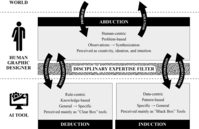
This paper examines the possible impacts of artificial intelligence (AI) on the ever-changing role of graphic designers. As its main contribution, the paper proposes a model based on the intertwining concepts of deduction, induction, and abduction. It argues that deductive and inductive tasks in graphic design can be effectively and advantageously outsourced to AI, while abductive tasks are still best performed by human graphic designers. Additionally, the power balance between humans and AI is discussed, concluding that human graphic designers must play a pivotal role in initiating and critically evaluating the results of any collaboration with AI tools. The model introduces the metaphorical notion of a "disciplinary expertise filter," which serves as a professional quality assurance for AI-based automation and augmentation in the design process. The distinction between "black box" and "clear box" AI systems is briefly discussed to provide a more nuanced understanding of AI as being "a magic tool" for graphic designers. Lastly, the paper presents six perspectives derived from the model, aiming to foster informed discussions and encourage critical reflections among graphic designers regarding their future role in the era of AI.
Double Bass in the spotlight
(2023)
author(s): Joost Slootbeek
published in: Research Catalogue
A short presentation for the subject "Historical Development" meant to excite a general audience about the double bass in different classical music scenarios.
RNDR M3 4S (1) 0F UR AVATAR GRLS*
(2023)
author(s): AMUSED
published in: Research Catalogue
This thesis is aimed at investigating virtual embodiment and how it can affect a performer's experience of; and relationship to the physical body. With this auto ethnographic case study I hope to shed some light on the ways virtual reality technology enables critical experiences and what effects these experiences could have, through my own personal journey. The study was conducted in the setting of my home using a Pico 4 VR head mounted display and HTC vive full body tracking. The project used for the case study was an audiovisual pole dance performance that was performed on the platform Neos VR and streamed to Studio 44 in Stockholm. The research is rooted in the artistic field but draws knowledge from psychological and social research on VR as a cognitive and embodied technology. The research methods used to gather and analyse the research material were visual research, phenomenology and deep listening. The data collection consisted of visual and text based data. On the visual data I applied thematic analysis, coding and categorising of the text based data and analysing hyper reflections with a phenomenological approach. I found that the experience of virtual embodiment did change my relationship to my own body in a positive way by feeling more grounded and accepting. I was less anxious about performing and felt more confident in myself. Because of the entanglement of the study it was not possible to solely contribute the outcomes of the effect to virtual avatar embodiment in itself. It did however demonstrate how these VR technologies could be used to enable norm critical experiences by the use of norm critical design applied to avatars challenging beauty ideals and societal norms of performativity. My virtual embodiment and its effects on me can give a unique insight that would benefit developers and users active in these platforms as well as for personal introspection and self development. The study serves as a good base to build future research on and I intend to further elaborate on the extensive research data that was gathered.