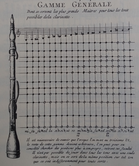
Clarinet Pedagogy in Times of Change and Advancement: The Evolution of Amand Vanderhagen’s Méthode Nouvelle et Raisonnée pour La Clarinette
(2023)
author(s): Noa Meshulam
published in: KC Research Portal
Name: Noa Meshulam
Main Subject: Historical Clarinet
Research Supervisor: Wouter Verschuren
Research Title: Clarinet Pedagogy in Times of Change and Advancement: The Evolution of Amand Vanderhagen’s Méthode Nouvelle et Raisonnée pour La Clarinette
Research Questions:
• How are the changes in the clarinet’s design and playing techniques, musical aesthetics, and taste being manifested in Amand Vanderhagen’s method from the first to last edition (1785-1819)?
• Has Vanderhagen changed his pedagogical model in the 34 years that passed between his first book and his last? If any changes occurred, what were the factors that contributed to that?
Summary:
During the last decades of the eighteenth century, the field of clarinet pedagogy started to blossom and rapidly developed alongside the publishing of the first comprehensive methods for the instrument. The earliest amongst these important treatises, Méthode Nouvelle et Raisonnée pour La Clarinette, by Belgian-French clarinetist Amand Vanderhagen, was published in 1785.
Throughout his lifetime, Vanderhagen edited and republished his method twice after the initial edition; In 1799, the Nouvelle Méthode de Clarinette, and in 1819, the Nouvelle Méthode de Clarinette Moderne à Douze Clés.
In this research, I demonstrate the ways in which the development of the clarinet and the changes in the musical culture in Paris affected, contributed to, and inspired Vanderhagen to modify his pedagogical model. In addition, I examine the ways changing musical aesthetics and styles are manifested throughout the three methods. During the process, I got the impression that Vanderhagen was extremely sensitive and attentive to the changes in the musical scene, as well as the advancements in the clarinet culture in Paris. Hence, between his three methods, I could spot several interesting changes in his approach, particularly in topics like embouchure, exercises, embellishments, etc.
With this comparison, I aimed to draw attention to a different thread that focuses on Vanderhagen’s approach to clarinet pedagogy in the late-eighteenth and early-nineteenth centuries, and appreciate the ways in which the instrument’s evolution contributed to the development of the method and practice of teaching.
Biography:
Noa Meshulam is an Israeli-Portuguese clarinetist specializing in historically informed performance. She earned her bachelor’s degree from the Jerusalem Academy of Music and Dance. During her bachelor studies, she participated in the Nazarian Excellence in Chamber Music Program and played with The Jerusalem Symphony Orchestra on several occasions. After graduating she moved to the USA to pursue her master’s degree at Indiana University and was awarded scholarship and fellowship grants. There, she also started studying historical clarinet with Eric Hoeprich, with whom she continued her second master’s studies at the Royal Conservatory in The Hague.
The Performer-Composer: A Practice in Interrelation
(2023)
author(s): Thomas Aurlund Lossius
published in: Research Catalogue
A simultaneous role of performer and composer is crucial in a vast number of artistic praxises. In this artistic research project, I explore creative possibilities the performing composer role offers. I also discuss how my performing composer praxis has inspired my interpretation of compositions by others.
The project is situated in my own artistic praxis and has an auto-hermeneutical approach. My primary method has been to compose music for myself and to perform it. This has led me to create compositions which are more improvisational, orally conveyed and open to diverse interpretations. I have also performed with a more co-creative, personally engaged and holistically oriented mindset. I have further experimented in performing compositions by others while imagining myself to be the composer. This has offered an alternative interpretative approach that resound deeply with me on an aesthetic level. Finally, I have reflected on how a performing composer discourse can unsettle the hierarchical language of composition and interpretation.
The project builds on a broader movement in artistic research and musicology, problematising the apparent dichotomy between composers and performers [Leech-Wilkinson, 2016; Cornish, 2015; Cook, 2013], and investigating the role of the performing composer or composing performer [Spears, 2022; Beaugeais, 2020; Groth, 2017]. The project constitutes my master thesis in performing music at the University of Bergen with specialisation in jazz .
Governmental Regulations on Volatile Organic Compounds in Paint
(2023)
author(s): Hajra Rahim
published in: Research Catalogue
Previous researchers have found that the use of VOCs (Volatile Organic Compounds), carcinogens, and PFAS (per- and polyfluoroalkyl substances) in paints have led to a wide range of health issues. This led to the primary goal within my research in which I examined the extent to which the quality level of paint is affected by chemical levels and pricing through the use of interviews with manufacturers from different paint companies, as well as the extent to which regulations from the EPA (Environmental Protection Agency) and OSHA (Occupational Safety and Health Administration) have limited the amounts of chemicals in paints. From this, I found that most companies are only restricted in levels of VOC and carcinogenic use, rather than PFAS since they are a necessary component of most paints, including within the linseed oil of oil paints, the pigments of watercolors and the pigments and solution of acrylic paints. Additionally, I found that these chemicals can affect one if they touch the surface of the skin or are inhaled, meaning that even dry paintings or painted walls could be toxic. The outcome emphasizes the necessity of wearing a mask while using these products, using warning signs on consumer products, as well as educating artists and those who are exposed to paints consistently to stay cautious.
(NOT) ENTERING EVERY ROOM - Exploring autosociobiographies via liminal crossing points of social class and the emotion shame
(2023)
author(s): Barbara Wolfram, Christina Wintersteiger
published in: Research Catalogue
(Not) Entering Every Room, conducted 2020/21 at Film Academy Vienna/ mdw - University for Music and Performing Arts Vienna, set out to use the emotion shame as a focus to reveal and explore unconscious liminal crossing points in our biographies and perceptions of social class, building on our previous research on cinematic (auto)sociobiographies (2020).
We are shaped, guided and scarred by our socialization and the society surrounding us. Each individual history brings with it a different knowledge repertoire about what belonging or not-belonging, „normal“ or „abnormal“ means. Spoerhase (Politik der Form 2017) describes the exploration and disclosure of one’s own biography in relation to social context & class, to one’s body, time & place of birth as “auto-sociobiographical”. He refers to the literary works of Annie Ernaux or Didier Eribon where individual life stories evoke a collective memory of a certain time and place, revealing liminal experiences of social class. One emotion that was mentioned more often than any other in these literary works, was shame.
To explore our own histories of experiences and the attached knowledge repertoire, we used the methodology of collective (auto)sociobiographical exploration via a multi-layered artistic approach. Body work (Chechov, Shdanoff), writing improvisations and group explorations via zoom were used to probe the methodology of (auto)sociobiographical exploration in the light of shame and social class.
Research on cinematic (auto)sociobiographies is still very new. We aim at contributing a method of exploration to the field of cinematic form and content production informed by artistic research methods.
Editorial
(2023)
author(s): Fadia Dakka, Kirsten Forkert, Ed McKeon, Jill Robinson and Ian Sergeant
published in: Journal of Sonic Studies
Editorial
Fadia Dakka, Kirsten Forkert, Ed McKeon, Jill Robinson and Ian Sergeant
Splitting Mammalian Weeds: Monster for a Memory
(2023)
author(s): Shana De Villiers
published in: Research Catalogue
This is not a thesis of trying to mine a singular understanding, but a collecti(ion)(ve) body of research composed into a gesture. Other than my memories, I have only grazed the surface of the topics I will discuss (even then, memories are at the fragile grace of synaptic connections) There are holes here, tears that will take a lifetime to mend. As I will mention later, I am not interested in a singular whole. Holes, however, are curious places with a warm spot for happenings, so I am okay with the holes.
All patchworks are several and my obsession with their cobbled nature does not mean there are no moments of stillness and clarity. This work is an archive of the muddiness of being and I invite you to draw parallels with your own logic as you stumble through this patchy, leaky, weed forest.